67 lead generation statistics and trends for 2026

Summarise this article with:


In this blog
- Our top 10 B2B lead generation statistics for 2026
- Statistics about B2B lead generation challenges
- Statistics and insights by lead generation channel
- Paid lead generation channels
- Multi-channel lead generation statistics
- Personalisation in lead generation
- Statistics on B2B lead nurturing and conversion rates
- AI in lead generation statistics
- Emerging lead generation trends and tools
- Methodology and sources

Lead generation has never been more important, or more difficult to get right.
B2B buyers are researching independently, buying committees are growing, inboxes are more crowded, and AI has made it easier than ever to send messages that seem efficient but feel forgettable.
In 2026, the strongest B2B lead generation teams are no longer chasing volume for volume’s sake, and these stats prove it. Instead, they’re building lead generation systems around better targeting, stronger intent signals, useful content, multi-channel visibility, and personalisation that actually means something.
To help you understand where the market is heading and hone your own strategies, we’ve pulled together the most useful statistics and trends for 2026 – combining industry research with exclusive data from our State of Prospecting 2026 report.
Our top 10 B2B lead generation statistics for 2026
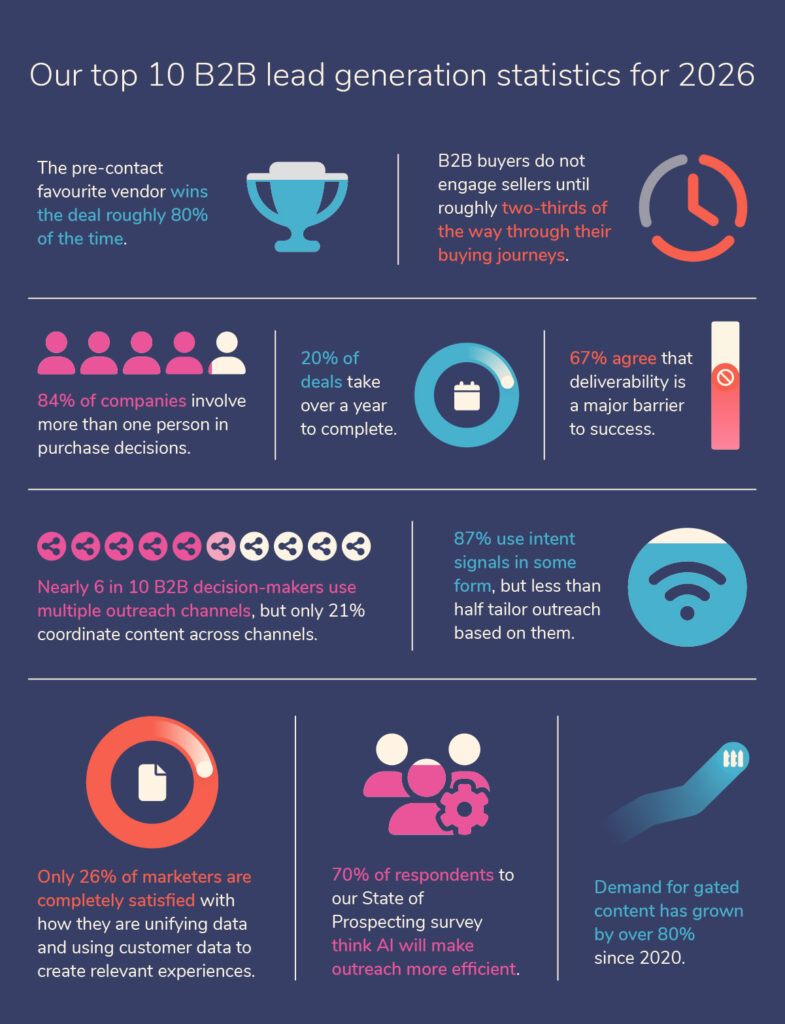
- The pre-contact favourite vendor wins the deal roughly 80% of the time. → Read more
- B2B buyers do not engage sellers until roughly two-thirds of the way through their buying journeys. → Read more
- 84% of companies involve more than one person in purchase decisions. → Read more
- 20% of deals take over a year to complete. → Read more
- 67% agree that deliverability is a major barrier to success. → Read more
- Nearly 6 in 10 B2B decision-makers use multiple outreach channels, but only 21% coordinate content across channels. → Read more
- 87% use intent signals in some form, but less than half tailor outreach based on them. → Read more
- Only 26% of marketers are completely satisfied with how they are unifying data and using customer data to create relevant experiences. → Read more
- 70% of respondents to our State of Prospecting survey think AI will make outreach more efficient. → Read more
- Demand for gated content has grown by over 80% since 2020. → Read more
Statistics about B2B lead generation challenges
B2B lead generation has become more complex because the buying landscape has changed. Buyers often have tighter budgets, less trust, and the need to involve more stakeholders in purchase decisions.
At the same time, marketing and sales teams are dealing with fragmented tech stacks, deliverability pressure, and harder-to-measure journeys.
1. 61% of vendors believe their audience is less trusting of prospecting than before
More than 6 in 10 sellers think trust is now one of the biggest barriers in lead generation.
Buyers often see too many generic messages, overblown claims, and poorly timed sequences. As a result, they are more sceptical of outreach before they have even read the message.
To build trust, credibility has to be established earlier – this means creating content, increasing brand visibility, and offering useful insights before engaging in direct communication.
2. 71% of survey respondents say most outreach they receive feels sales-led rather than helpful
Our State of Prospecting research found that nearly three-quarters of buyers can tell when a message exists only to serve the seller. When outreach feels overly sales-led, it gives prospects little reason to engage. It becomes just another pitch in an already crowded inbox.
The best lead generation campaigns focus less on pushing for a meeting and more on creating a useful reason to respond. Helpful does not mean passive. It means making the buyer feel understood before asking for their time.
3. 57% of B2B decision-makers say most outreach feels impersonal and irrelevant
Personalisation has become somewhat of a buzzword, but some B2B sellers are doing it better than others – adding a first name, company name, or industry token isn’t enough.
Now, buyers expect outreach to reflect their actual situation, priorities and challenges.
If most outreach feels impersonal, there’s a clear opportunity for brands that do the research, refine their targeting, and write like they understand the person on the other end.
4. 58% of B2B professionals say there is more competition
The B2B market is crowded, with more suppliers chasing the same buyers, using similar tools, channels, and messages.
This makes it harder to stand out and easier to be ignored. So, to compete, businesses need a clearer point of view, sharper positioning, and stronger relevance.
5. 59% of respondents to our State of Prospecting survey say buyers have tighter budgets
When money’s tighter, buyers naturally become more cautious, more value-focused, and more likely to involve additional stakeholders.
This means they need stronger proof that your solution is worth the investment. So your lead generation messaging should reflect that by making value, impact, and risk reduction easy to understand.
6. 44% of B2B sales and marketing professionals say decision times are longer
Longer decision times make short-term campaigns less effective. Prospects may engage today but not be ready to buy for months.
If your lead generation activity stops after one sequence or one campaign window, you risk disappearing before the buyer is ready. This is why always-on visibility, nurture, and intent-based follow-ups matter.
7. 43% of B2B decision-makers say leads go silent mid-process
Not every silent lead is a lost one – budgets change, priorities shift, and stakeholders can need more time to validate options. Your strategies have to cater to this, which means implementing clear nurture and follow-up processes; otherwise, those leads can easily drift away.
But this doesn’t mean the answer is to chase harder, it means understanding how to stay relevant, useful, and visible until the timing is right.
8. 84% of companies involve more than one person in purchase decisions
The single-decision-maker model no longer reflects how most B2B deals are conducted. Buying groups include budget holders, technical reviewers, end users, procurement teams, and senior stakeholders. And each person likely has different priorities.
That means lead generation needs to speak to the account, not just an individual. As a result, multi-threaded, account-based engagement is becoming essential.
9. One in five deals takes over a year to complete
Some B2B buying journeys are very long – imagine 20% of your pipeline taking a year to convert. That creates a challenge for teams that judge lead generation only by immediate results. A prospect might be valuable even if they do not convert quickly.
The businesses that win longer deals are usually the ones that stay visible and useful over time, rather than disappearing after the first few touches.
10. 47% of B2B content marketers say their tech stack lacks streamlined marketing data management and reporting
If teams can’t trust their data, they struggle to target accurately, personalise effectively, or report performance clearly.
This can weaken both campaign execution and strategic decision-making, showing the importance of clean data for running more effective lead generation campaigns.
11. 56% of B2B content marketers struggle to attribute ROI to content efforts
Effective content can influence leads long before conversion – a blog, guide or report may not generate an immediate enquiry, but it can shape awareness, trust and preference.
To measure content ROI properly, teams need to look beyond last-click attribution and consider influence across the full buyer journey.
12. 41% of survey respondents say their outreach data and tools are not fully integrated across sales and marketing
If marketing sees one set of signals and sales another, opportunities are easily missed. This can mean messaging becomes repetitive, mistimed, or inconsistent.
Integration and alignment matter because buyers experience your brand as one company, not as separate sales and marketing systems.
Get your teams singing from the same hymn sheet with our complete guide to sales and marketing alignment.
13. 37% of B2B sales and marketing professionals cite a lack of coordination between teams as a top challenge
Marketing creates demand, sales convert it, and customer support provides proof and insight – but if these teams aren’t aligned, performance suffers.
Coordination is especially important in long B2B journeys, where timing, handoffs, and context can make or break conversions.
14. 67% of marketers agree that deliverability is a major barrier to success
Deliverability is now a strategic lead generation issue, not just a technical one. It’s affected by data quality, sender reputation, engagement, relevance, and volume.
To improve your chances of arriving in inboxes, focus on better targeting and messaging, as they reduce the risk of low engagement, complaints, and spam signals.
15. 45% of B2B content marketers lack a scalable model for content creation
Content is central to modern lead generation, but many teams struggle to produce it consistently, which creates a bottleneck.
To make informed decisions, buyers need useful information across the journey, and sales teams need assets that support conversations.
A scalable content model does not mean publishing more for the sake of it. It means creating reusable, high-value assets that can support multiple channels and buying stages.
16. 61% of B2B professionals say their prospecting does not cover all of their TAM
If you don’t know the full size and shape of your market, you cannot prioritise it effectively. You may be over-contacting some prospects while missing others entirely.
Future-ready lead generation will rely on live, enriched audience data that helps teams see and reach the full opportunity.
17. 55% of B2B content marketers say creating content that prompts a desired action is challenging
Content needs to do more than attract attention – for lead generation, it should guide the reader towards the next step, e.g. downloading a guide, booking a demo, joining a webinar or speaking to sales.
If content doesn’t prompt action, the issue may be weak intent alignment, unclear CTAs or content that educates without moving the buyer forward.
Statistics and insights by lead generation channel
When it comes to lead generation, each channel plays a distinct role. Some channels create awareness, such as social media, while blog content and whitepapers can help capture demand and nurture interest.
The strongest strategies work across multiple channels, aligning messaging and showcasing your brand as an expert in your field.
Content marketing statistics
1. 74% of B2B marketers say content marketing helped generate demand or leads in the last 12 months
Content remains one of the most important lead generation channels. Buyers want to research before they speak to sales, and useful content helps them compare approaches and decide which suppliers are worthy of their investment.
Although it can help capture leads, the content you create shouldn’t be designed only to rank highly on Google. You also need to support buying decisions and help prospects do their best work to showcase your expertise.
2. 62% of B2B marketers believe content marketing helped nurture subscribers, audiences, or leads
More than 6 in 10 agree that content is not only a top-of-funnel tool but also helps nurture prospects who are not yet ready to convert. Guides, reports, case studies, webinars, and email content can all keep buyers engaged while they move through the journey.
If your content strategy stops at the awareness stage, you’re missing a major opportunity to add value and support conversion.
3. 49% of B2B marketing professionals say content marketing helped generate sales or revenue
Content can influence commercial outcomes, even when it’s not the final conversion point.
A buyer may read several pieces of content before filling in a form or speaking to sales.
This level of influence can be difficult to measure, but it still matters, highlighting a real need to create content that connects to sales conversations, buyer objections, and real business problems.
4. 61% of B2B marketers expected their organisation to increase investment in video
Video continues to grow as a B2B content format, helping make complex topics easier to understand, bringing experts to life and creating more engaging touchpoints across the buyer journey.
Formats such as product explainers, customer stories, webinars, and short thought-leadership clips can all support lead generation. The difference between videos that work and videos that don’t usually comes down to usefulness.
Before pressing record, ask yourself: Why am I filming this? Regardless of the format, content needs to be useful, answer real buyer questions, and not just made because the format is popular.
5. 52% of B2B marketers expected increased investment in thought leadership content
Thought leadership helps brands build authority before buyers are ready to talk, helping you build trust over time.
If your audience already recognises your expertise, they’re more likely to engage when outreach or conversion opportunities appear.
Thinking of kicking off your thought leadership strategy? Remember: the best content is specific, original, and opinionated – generic industry commentary is unlikely to stand out.
Email marketing statistics
1. Email is used by 56% of businesses as a top lead generation channel
Email remains a core B2B lead generation channel, and it’s easy to see why – it’s direct, scalable, and measurable.
This doesn’t mean email is easy, though. Buyers are more selective, inboxes are crowded, and generic messages are increasingly ignored.
Email works best when it is targeted, relevant, and connected to other channels as part of a holistic sales approach.
Check out our email marketing statistics and trends for more valuable insights on this channel.
2. 22% of email marketers struggle with measuring or proving email ROI
Email is measurable, but proving its revenue impact can be tricky because it often plays a role in a wider journey.
Prospects may open, click, ignore, return later, speak to sales and then convert weeks or months after the first campaign. To prove ROI, email data needs to connect with CRM and pipeline reporting.
Need a hand with improving your email marketing ROI? Sopro is an award-winning B2B email marketing agency.
3. 77% of B2B buyers say they are more likely to open an email with an offer-led subject line
Our State of Prospecting report found that clear value gets attention. One way to do this is with offer-led subject lines that give recipients a legitimate reason to open an email.
That doesn’t mean that every email needs a discount or promotion. In B2B, your offer could be insight, a benchmark, a useful idea, or a relevant opportunity.
Our report also found that buyers were more likely to open emails with the following subject line styles:
- 71% for personalised using their name or company name
- 69% for a question in the subject line
- 64% for an intriguing or mysterious subject line
- 64% for topical, trend or current affairs-related subject lines
- 60% for an urgent or time-sensitive subject line
- 59% for a humorous subject line
- 47% for a shocking or alarmist subject line
Social media statistics
1. 51% of businesses use paid social media as a top lead generation channel
Paid social can help brands reach specific audiences, promote content, retarget website visitors, and build familiarity before direct outreach. For B2B, LinkedIn is often central, but other platforms may support awareness and remarketing.
The most effective paid social campaigns are connected to wider lead generation activity and form part of a complete strategy.
2. 73% of B2B marketers using paid channels use social media advertising or promoted posts
Social advertising is a common paid promotion tactic for B2B marketers, and it’s easy to understand why. You can target by job title, company, sector, interest or behaviour, helping teams get content and offers in front of the right people.
Targeting isn’t everything, though. Competition is high, so to compete, you need strong creative, clear value, and good landing pages designed to capture contact details and convert.
3. 49% of B2B marketing professionals say paid social produced the best content marketing results
For nearly half of B2B marketers, paid social (including social media ads and promoted posts) is one of the strongest ways to distribute content and support lead generation. It can help original research, webinars, reports, and guides reach audiences that organic posts may not.
This means there’s a great opportunity to use paid social to create warmer audiences for future nurture and outreach.
4. 85% of B2B marketers say LinkedIn delivers the best value among social platforms
LinkedIn remains the leading B2B social platform; it’s where professionals share ideas, follow industry conversations and research suppliers.
This makes the platform especially valuable for thought leadership, account engagement, paid campaigns, and prospecting.
But LinkedIn isn’t just a posting channel, you should use it as part of a wider visibility and relationship-building strategy.
5. 68% of B2B marketers increased their use of LinkedIn in the previous 12 months
Over two-thirds of marketers have increased their LinkedIn usage, highlighting what a great resource it is; however, this also means more competition for attention.
Buyers are already there, so the aim is to consistently show up with useful content, ensuring your brand is adding something worth noticing.
6. 31% of B2B marketers increased their use of YouTube in the previous 12 months
Video-led search and education are becoming increasingly important, and YouTube can support buyers who want to learn visually, compare solutions, or understand complex topics before speaking with sales.
Uploading videos can also extend the life of webinars, demos, and expert content, so leveraging YouTube and its massive user base is less about going viral and more about being useful to buyers during research.
7. 22% of B2B marketers say Facebook delivers the highest perceived social ROI
LinkedIn often dominates B2B conversations, but it is not the only platform that can drive value. Facebook may work for certain audiences, sectors, retargeting campaigns or community-led activity.
The right channel depends on the buyer, the offer, and the campaign goal. The lesson is to test based on evidence, not assumptions.
Paid lead generation channels
1. Among paid channels, 61% of B2B marketers say (pay-per-click) PPC produced the best content marketing results
When buyers are already looking for answers, paid search can put your content, landing page, or offer in front of them at the right moment. That makes it powerful for demand capture.
The key is matching the ad, keyword, landing page, and CTA to the buyer’s stage – not everyone is ready for a demo.
Multi-channel lead generation statistics
1. 58% of B2B decision-makers use multiple outreach channels, but only 21% coordinate content across channels
Most teams have moved beyond single-channel lead generation, but many have not joined the dots between each channel.
Email, LinkedIn, paid social, website engagement, and sales follow-up often run separately. That creates disconnected experiences for buyers and fragmented reporting for teams.
Multi-channel only works properly when the channels are coordinated.
2. 81% of B2B decision-makers say results improve when multiple channels are combined
Your audience isn’t in one place, so your message shouldn’t be restricted to just one. Instead, try repeated, relevant exposure across the channels your audience uses.
Combining channels increases visibility, recall, and engagement. The goal is not to be everywhere at once. It is to be present in the right places with a consistent message.
3. B2B buyers pick an average of 2.9 channels when asked how they prefer to be contacted, up from 2.5 in 2025
Buyers don’t rely on one channel in their research and buying journey, and they may be open to several types of contact, depending on timing, context, and value.
Lead generation is a multi-channel experience, which gives marketers more flexibility but also more responsibility for coordinating it.
Personalisation in lead generation
Personalisation has become one of the biggest themes in modern lead generation.
But the meaning has changed. It’s no longer about inserting a name into a subject line.
Real personalisation is about relevance: reaching the right person, with the right message, at the right time, through the right channels.
Are you here because you need a hand with personalising outreach at scale? Let Sopro help. Our generative AI messaging service is powered by performance data from over 80 million emails.
1. 83% of marketers recognise a shift towards personalised, two-way messaging
Buyers don’t want to be spoken at, they want to be spoken to. This means more relevant, conversational and responsive interactions with brands.
Basically, lead generation needs to move away from one-way broadcast campaigns and towards engagement that feels more tailored.
Two-way messaging also means listening – buyer behaviour, replies, questions, and intent signals should all shape what happens next.
2. Only 26% of marketers are ‘completely satisfied’ with how they are unifying data and using customer data to create relevant experiences
Most teams know personalisation matters, but many are unhappy with how they use data to deliver it.
Personalisation depends on knowing who the buyer is, what they care about, where they are in the journey, and how they have interacted with your brand before. Without that connected view, personalisation quickly becomes guesswork.
If you want better lead generation results, start with the data layer. Clean CRM records, accurate audience segmentation, intent signals, and campaign reporting enable relevant outreach.
3. 33% of B2B sales and marketing decision-makers say buyers expect more information and more personalisation
Prospects expect more – they don’t just want to know what you sell. They want to understand how it applies to them, why it matters now, and whether you understand their situation. That means every lead generation touchpoint needs to do more work.
The strongest campaigns combine useful information with tailored relevance. They give buyers enough context to feel informed, without overwhelming them before they’re ready to talk.
4. 41% of B2B marketers are prioritising personalisation or customisation of buyer engagement in their budgets
Personalisation is now a budget priority, not just a messaging preference. This shows that B2B teams are investing in the systems, data, and processes needed to make buyer engagement more relevant. That could mean better segmentation, more advanced CRM workflows, AI-assisted research, or account-based campaigns.
The risk is investing in personalisation technology without improving the strategy behind it. Tools can help, but they can’t decide what is genuinely useful to the buyer.
5. 25% of B2B buyers would share personal information for experiences that deliver value
B2B buyers will share information when they believe the content, insight, or experience is worth it. That matters for gated content, demo requests, event registrations, and progressive profiling.
If your form asks for too much and the reward feels too thin, conversion will suffer. If the value is obvious, buyers are more willing to share.
6. 16% of email marketers cite collecting and analysing data for personalisation as a top challenge
Personalisation depends on data capability, so if teams cannot collect, organise or interpret customer and prospect data, personalised campaigns become difficult to deliver.
Other top challenges faced by email marketers include measuring the impact of personalisation on email performance (15%) and efficiently developing personalised content (17%).
7. 96% of organizations using AI for personalisation see measurable business benefits
AI can make personalisation more scalable when it is backed by high-quality data.
The value lies in using AI to identify patterns, tailor content, recommend next steps, and support more relevant experiences. But AI is only as useful as the strategy behind it.
Personalisation should feel more human to the buyer, even if AI helps power it behind the scenes.
Statistics on B2B lead nurturing and conversion rates
Lead generation doesn’t stop when someone fills in a form, replies to an email, or visits your website.
In B2B, many prospects need time, proof, and internal alignment before they become opportunities. That makes nurturing one of the most important parts of the revenue journey.
1. 59% of B2B marketers plan to increase investment in multi-channel lead nurturing through 2026
Buyers move between email, websites, content, social media, events, and sales conversations. A single-channel nurture strategy cannot reflect that journey.
The best nurture programmes will intelligently combine channels, using behaviour and intent to determine what happens next.
Explore how multi-channel content and smart strategies can build relationships that convert in our free PDF – How to Nurture Leads: The Ultimate Guide.
2. 55% of marketers say increasing conversion rates from MQLs to opportunities is a top priority
For many B2B teams, the challenge is not just generating marketing-qualified leads, but helping those leads progress into genuine sales opportunities.
That depends on clear qualification criteria, strong sales and marketing alignment, timely follow-up and a shared understanding of what makes an opportunity worth pursuing.
If MQL-to-opportunity conversion is weak, it may be a sign that the handoff needs tightening, lead scoring needs refining, or nurture activity needs to do more before sales get involved.
3. 52% of marketers are measured on the number of qualified sales opportunities they generate
This is a positive shift because it moves measurement closer to commercial impact. Rather than focusing only on lead volume, marketers are being judged on whether their activity creates opportunities that sales can realistically progress.
That makes lead quality, qualification criteria, and sales alignment essential. The clearer the definition of a good opportunity, the easier it is to measure and improve lead generation performance.
4. 43% of marketers are measured on the pipeline influenced
Marketing doesn’t always create the original opportunity, but it often helps move prospects closer to conversion.
Nurture emails, case studies, webinars, retargeting, and sales enablement content can all influence whether a lead stays engaged, builds confidence, and progresses through the pipeline.
This is why pipeline influence matters – it highlights the role marketing plays, especially in longer buying journeys.
5. 87% of survey respondents use intent signals in some form, but under half trigger or tailor outreach based on them

Many teams can see signs of buyer interest, such as website visits, content engagement, or company changes. But fewer teams use those signals to shape what happens next.
For lead nurturing, that’s a missed opportunity. Intent signals can help teams decide when to follow up, what message to send, and which content will be most relevant based on where the buyer appears to be in their journey.
The opportunity is not just about collecting intent data, but about using it to make nurture journeys more timely, tailored, and likely to convert.
6. 43% of B2B marketers adjust messaging to reflect buyer interests or company changes
Adaptive outreach is more relevant than static sequences. Let’s say a company has recently raised funding, hired a new leader, expanded into a market, or engaged with specific content; your messaging should reflect that context.
This is how lead nurturing becomes more useful. It responds to what the buyer is doing, not just where they sit in a pre-set workflow.
AI in lead generation statistics
AI can now be incorporated into every stage of the lead generation process, from content and campaign planning to data quality, personalisation, prospecting, and sales follow-up.
But the data also shows a more nuanced picture. AI can make teams faster and more efficient, but it does not automatically make outreach more trusted or relevant.
1. 85% of marketers actively deploy generative AI, up from 75% in 2024
Generative AI has moved from experiment to everyday marketing tool, with most marketers now actively using it for tasks like content creation, research, campaign planning, analysis, and customer engagement.
For B2B lead generation, the question is no longer whether AI will be used; it’s how well it’s used.
2. 93% of CMOs using GenAI report ROI
A vast majority of senior marketing leaders are seeing commercial value from AI. While that doesn’t mean every use case is equally valuable, it does suggest AI is more than a passing trend.
When applied well, AI can improve speed, productivity, personalisation, and decision-making. The challenge is connecting AI activity to measurable lead generation outcomes.
3. 93% of marketing teams are budgeting for GenAI through 2026
AI investment is set to continue, so it’s likely that AI capability will become a baseline expectation in marketing teams, tools and agencies.
But budget alone will not create an advantage. To deliver better lead generation results, AI needs to be supported by clear strategy, good data, governance, and human oversight.
4. 67% of senior B2B decision-makers plan to invest in AI for prospecting and personalisation next year
Our State of Prospecting report revealed that B2B teams are investing in AI to research accounts, identify patterns, tailor messaging, and prioritise outreach.
This can make prospecting more efficient and more relevant when used well, but personalisation still needs substance. AI can help surface insights, but teams still need to decide what those insights mean for the buyer.
5. 89% of B2B sales and marketers are using AI in prospecting
AI adoption in prospecting is now widespread, with only 11% of teams not using AI in some part of the process, such as writing, research, targeting, or workflow automation.
This means AI is no longer a differentiator in and of itself. The key difference is how thoughtfully it’s applied.
6. 58% of survey respondents use AI for writing outreach messages
Over half of respondents to our State of Prospecting survey said they were using AI to save time on writing outreach messages.
AI can definitely help teams write faster, but without the right editing and input, it can make outreach more generic, not more relevant.
The best use of AI is to support better research and structure, then let human judgement refine tone, relevance, and clarity.
7. 57% of B2B decision-makers are using AI to improve data quality and targeting
Better data and sharper targeting improve everything that follows: deliverability, relevance, response quality, sales confidence, and conversion.
AI can help identify poor-fit accounts, enrich data, and surface patterns that would be hard to spot manually. In other words, AI should not just help you send faster. It should help you choose better.
8. Marketers’ top GenAI use cases include chatbots at 62%, content generation at 45%, and trend analysis at 36%
AI is being used across the marketing funnel, with chatbots supporting conversion and qualification, content generation speeding up campaign production, and trend analysis helping teams understand market movement and buyer interests.
For lead generation, these use cases are most powerful when connected. A chatbot, content programme and insight workflow should all feed into the same view of the buyer.
9. 45% of B2B marketers using GenAI report increased workflow efficiency
Rather than seeing AI as one single tool, marketers are using it to improve several parts of their workflow. Research also found that 51% of B2B marketers using GenAI report fewer tedious tasks, 42% report improved content optimisation, and 38% report improved creativity.
For lead generation, these benefits matter because they can give teams more time to focus on strategy, audience understanding, and campaign quality. But speed is only useful if it improves the outcome. AI should help teams create better, more relevant campaigns, not simply more activity.
10. 94% of marketers report improved personalisation from GenAI
AI is helping marketers tailor experiences more effectively, such as adapting messaging by segment, recommending content, summarising account research, or identifying buyer patterns.
For lead generation, this can improve relevance at scale, but improved personalisation should be judged by buyer response and commercial outcomes, not by how personalised the message appears.
11. More than 9 in 10 marketers cite efficiency in processing large datasets as a GenAI benefit
91% cite efficiency in processing large datasets as a GenAI benefit, while 90% say GenAI delivers time and operational cost savings.
AI can be particularly useful when teams need to process large amounts of data across CRM systems, analytics platforms, intent tools, spreadsheets, and campaign dashboards.
Used well, this can improve targeting, segmentation, lead scoring, and reporting, while saving time on research, drafting, and analysis. The real difference will come from how those savings are reinvested, whether into better strategy, testing, buyer experience, or sales follow-up.
12. 70% of respondents to our State of Prospecting survey think AI will make outreach more efficient, but not more human
This is the caveat every team should remember. AI can speed up prospecting, but buyers still respond to relevance, credibility, and human connection.
A perfectly automated sequence can still fail if it feels generic or careless. AI should support the process of building relationships, not replace the human judgement needed to create them.
Read ‘Should you use AI for sales prospecting?’ to understand more why so many teams are turning to AI and how you can use it while maintaining a human touch.
Emerging lead generation trends and tools
Lead generation is becoming more signal-led, connected, and focused on early buyer influence. The most effective teams are using intent data, outbound activity, content, and market insight to understand where buyers are in their journey, which accounts are worth prioritising, and when to follow up.
1. 47% of B2B marketers plan to deploy or test intent or signal data
It helps teams understand which accounts may be researching, comparing, or moving closer to a buying decision. That makes outreach more timely and prioritisation more accurate.
Intent data only creates value when teams know what to do with it, including workflows, ownership, and fast follow-up.
2. 68% of businesses plan to invest in outbound marketing next year
Despite the rise of self-directed buying, businesses still need ways to reach the right accounts proactively. The difference is that outbound now needs to be more targeted, more relevant, and better connected to brand and inbound activity.
Take your outbound strategy to the next level with the strategies found in our ‘What is outbound lead generation?’ guide.
3. B2B buyers don’t engage sellers until roughly two-thirds of the way through their buying journeys
A lot happens before sales gets involved – buyers are researching, comparing, discussing internally and forming preferences long before they speak to vendors. That means your brand may be included or excluded before you know the opportunity exists.
Lead generation needs to influence the early journey, not just capture the final hand raise.
4. The pre-contact favourite vendor wins the deal roughly 80% of the time
If buyers already have a favourite vendor before they engage, late-stage sales activity can only do so much. Brand visibility, content, peer recommendations, and early education all shape who makes the shortlist.
This emphasises the importance of building your presence and creating content across platforms and explains why demand generation and lead generation need to work together.
5. Nearly 70% of B2B buyers say economic conditions affected their vendor choice
Outside influences mean buyers are becoming more cautious, more value-focused, and more risk-aware. They need a stronger reason to act and clearer evidence that the investment will pay off.
Lead generation campaigns should reflect that by making value, proof, and commercial impact easy to understand.
6. Demand for gated content has grown 83.8% since 2020
Gated content is not dead, and if it’s relevant and interesting enough, buyers will still exchange details for content when the perceived value is high enough. The key is to make the asset genuinely useful, specific and worth the form fill.
Thin guides and generic downloads are unlikely to work. Original research, benchmarks, templates, and practical tools have a stronger value exchange.
Expert Q&A: Lead generation in 2026

How is lead generation changing in 2026?
Lead generation is becoming more data-led, more personalised, and more connected across channels.
Another big change is that buyers are doing more research independently. They have access to more information than ever, including reviews and social proof, and AI makes it easier to access this than ever before.
At the same time, AI, intent data, automation, and attribution tools are helping teams improve targeting, timing, and follow-up.
For me, the biggest shift is from volume to relevance. The strongest teams are focusing less on generating as many leads as possible and more on reaching the right accounts with the right message at the right time
What KPIs should you track for lead generation?
To effectively refine your strategies, you need to focus on what truly moves the needle:
- Lead quality – Quantity is pointless if they’re not the right fit.
- Conversion rates – How well are you turning leads into customers?
- Cost per lead (CPL) – Are you spending wisely or just throwing money at the wall?
- Time to conversion – How long does it take for leads to become opportunities or customers, and where do they slow down?
These KPIs aren’t just numbers – they’re your guide to smarter decisions and better results
What is lead scoring in lead generation?
Lead scoring is your shortcut to efficiency. It’s about ranking leads based on their likelihood to convert. High scores? They’re hot prospects. Low scores? Maybe nurture them a bit more.
Factors like demographics, behaviours, and engagement levels help you prioritise your sales team’s efforts on the leads most likely to generate revenue. Simple, powerful, and absolutely essential
What are the most common problems in B2B lead generation?
Here are the lead generation challenges we find B2B companies encounter most:
- Low-quality leads – You’re attracting interest, but not from the right accounts or decision-makers.
- Misaligned sales and marketing – Teams are working from different data, definitions or priorities.
- Lack of follow-up – Leads grow cold faster than you think, especially when timing and intent signals are missed.
- Overreliance on a single channel – Diversity is your safety net, so explore multi-channel campaigns to protect your pipeline.
- Weak or irrelevant messaging – If your value isn’t clear or relevant, don’t expect buyers to engage.
What is the difference between demand generation and lead generation?
Think of demand generation as the spark, and lead generation as the fire.
- Demand generation builds awareness and piques your audience’s interest.
- Lead generation captures that interest and turns it into actionable contacts.
One feeds the other, but they’re not the same.
Demand generation builds awareness and interest; lead generation turns that interest into identifiable prospects and opportunities. Together, they’re a business development powerhouse.
Does lead generation fall under sales or marketing?
Lead generation falls under both sales and marketing, and various lead gen activities should be shared across teams.
Marketing typically focuses on attracting attention, creating demand, and capturing leads at the top and middle of the funnel. Sales then qualifies those opportunities, builds relationships, and converts them into revenue.
The companies that generate the most leads are those where sales and marketing teams work together. And if your teams aren’t, you’re effectively leaving money on the table
Methodology and sources
Sopro is a specialist B2B lead generation agency with expertise in account-based engagement and email marketing services.
We conducted proprietary research as part of The State of Prospecting 2026 report. Insights and findings from that research related to B2B lead generation have been compiled here, along with data from other sources, to form a complete collection of lead generation statistics:
- Gartner Sales Survey
- Demand Gen Report / Emerald, 2025 Demand Generation Benchmark Survey
- Content Marketing Institute / MarketingProfs, B2B Content Marketing Benchmarks, Budgets, and Trends: Outlook for 2025
- Data & Marketing Association, Email Benchmarking Report 2025
- Litmus from Validity, State of Email 2025
- HubSpot, 2025 Social Media Marketing Report
- Sprout Social, Social Media Marketing ROI Statistics
- Salesforce, State of Marketing
- Adobe / Forrester Consulting, Personalization at Scale
- Twilio, 2025 State of Customer Engagement
- NetLine, 2025 State of B2B Content Consumption & Demand Report
- 6sense, 2025 B2B Buyer Experience Report
- SAS / Coleman Parkes, Marketers and AI: Navigating New Depths



Share