
The State of Prospecting 2026
The essential report guiding smarter, more effective outreach.56 LinkedIn lead generation statistics and trends for 2027

Summarise this article with:


In this blog
- Our top 10 LinkedIn lead generation statistics for 2027
- LinkedIn user statistics and global reach
- LinkedIn website traffic statistics
- LinkedIn engagement statistics
- LinkedIn advertising costs and conversion statistics
- LinkedIn’s role in the B2B buying journey
- LinkedIn social prospecting and multi-channel statistics
- Sopro’s expert predictions for lead generation on LinkedIn
- Lead generation on LinkedIn: putting the statistics to work
- Methodology and sources
LinkedIn is an important part of B2B lead generation, helping businesses reach decision-makers, share their expertise, and build relationships with potential customers. From organic engagement to paid advertising, the platform plays a role at different stages of the buying journey.
We’ve pulled together the latest LinkedIn lead generation statistics and trends for 2027. Alongside platform and industry data, we’ve included exclusive insights from our State of Prospecting 2026 research, drawing on our experience as a B2B lead generation agency, to explore what the figures mean for your outreach strategy.
Pssst…LinkedIn is only one piece of the lead gen puzzle. Check out our 67 lead generation statistics and trends for 2026 for the bigger picture.
Our top 10 LinkedIn lead generation statistics for 2027
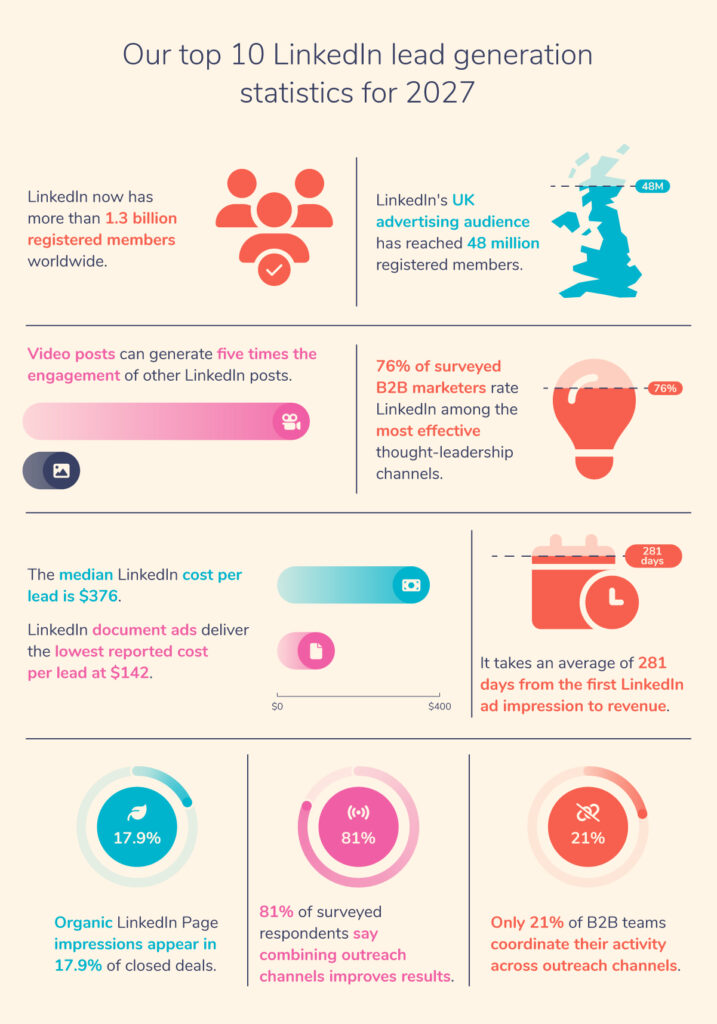
- LinkedIn now has more than 1.3 billion registered members worldwide. → Read more
- LinkedIn’s UK advertising audience has reached 48 million registered members. → Read more
- Video posts can generate five times the engagement of other LinkedIn posts. → Read more
- LinkedIn is a leading thought-leadership channel for 76% of B2B marketers → Read more
- The median LinkedIn advertiser pays $376 per lead. → Read more
- LinkedIn document ads deliver the lowest reported cost per lead at $142. → Read more
- It takes an average of 281 days from the first LinkedIn ad impression to revenue. → Read more
- Organic LinkedIn Page impressions appear in 17.9% of closed deals. → Read more
- 81% of surveyed buyers say combining outreach channels improves results. → Read more
- Only 21% of B2B teams coordinate their activity across outreach channels. → Read more
LinkedIn user statistics and global reach
1. LinkedIn now has more than 1.3 billion registered members worldwide
LinkedIn’s 1.3 billion members give B2B businesses an enormous pool of potential customers to reach. The challenge is narrowing that audience down to the businesses and decision-makers most relevant to your services.
Start by understanding your total addressable market (TAM), including the industries, company sizes, and job roles you’re targeting. This gives you a clearer starting point for LinkedIn advertising and prospecting campaigns.
2. LinkedIn’s UK advertising audience has reached 48 million registered members as of late 2025
LinkedIn’s reported UK advertising audience of 48 million registered members gives businesses considerable scope to reach professionals across different industries and job roles.
It’s worth remembering that advertising reach is based on registered members, rather than monthly active users. Our experience has shown us that businesses can make better use of that reach by building audiences around their ideal customer profiles and reviewing which segments are engaging with their campaigns.
3. North America accounts for more than 290 million LinkedIn members
The scale of LinkedIn’s North American audience explains why it matters to international B2B marketing plans. Businesses expanding into the US should focus on company fit and buying roles before allocating budget.
4. EMEA is LinkedIn’s largest reported region, with over 430 million members
EMEA’s scale is useful context for any companies with European ambitions. The next step is to build separate addressable audiences by country, rather than assuming a message that works at home will travel unchanged.
5. Asia-Pacific is home to more than 410 million LinkedIn members
LinkedIn’s 410 million members across Asia-Pacific give businesses access to professional audiences in both established and emerging markets. Companies planning to expand into the region could use LinkedIn to research industry networks, connect with local business leaders, and identify potential partners before launching wider prospecting campaigns.
6. Over 226 million LinkedIn members are based in South and Central America
LinkedIn’s 226 million members across South and Central America give B2B businesses another region to consider when planning international expansion. It’s worth looking at each market individually, as buying behaviours, language preferences, and business practices can vary considerably across the region.
7. LinkedIn supports 36 languages, opening up international B2B audiences
LinkedIn’s support for 36 languages makes international outreach easier, but translation alone won’t deliver results. Our analysis of 650,000 emails shows how significantly message framing affects responses. Successful international prospecting requires country-specific targeting, locally relevant proof points, and messaging that accounts for how buying decisions differ between markets.
8. LinkedIn’s feed attracts over 1.8 million views every minute
With that much content being viewed, another generic company update can disappear quickly. LinkedIn content should reach the right buyers, rather than chase impressions. Our State of Prospecting research shows that 84% of buyers are more likely to engage when they recognise the sender. By aligning LinkedIn content and advertising with targeted outreach, businesses can build familiarity with prospects who genuinely matter to their pipeline.
9. Professionals make more than 18,000 LinkedIn connections per minute
Connection requests still play a role in relationship-building. They can be particularly effective when they’re personalised and follow an earlier interaction, giving prospects a reason to continue the conversation.
LinkedIn website traffic statistics
Semrush’s estimates for linkedin.com in September 2026 show the following website traffic and engagement figures.
1. LinkedIn.com attracted an estimated 1.89 billion visits in September 2026
LinkedIn attracted an estimated 1.89 billion website visits in September 2026, showing how regularly people return to the platform.
Although this figure measures visits rather than individual users, the level of activity creates plenty of opportunities for businesses to reach potential customers. Keeping company pages up to date and publishing useful content regularly can help businesses make the most of that attention.
2. The average LinkedIn website visit lasts 11 minutes and 28 seconds
An 11-minute session suggests LinkedIn can hold attention. Marketers still need to give visitors something worth doing next, whether that’s visiting a company page, reading a report, or starting a meaningful conversation.
3. LinkedIn visitors browse an estimated 7.64 pages per session
Almost eight pages per visit indicates plenty of movement around the website. A buyer may encounter several suppliers along the way, which makes consistent positioning across posts, profiles, and company pages valuable.
4. LinkedIn’s estimated website bounce rate is 36.13%
With a bounce rate of 36.13%, around two-thirds of LinkedIn visits involve further interaction with the site. People aren’t necessarily stopping at the first page they land on, giving businesses more opportunities to get their content, company pages, and expertise in front of potential buyers.
5. LinkedIn ranks 17th worldwide for website traffic
Ranking 17th worldwide for website traffic puts LinkedIn among the most visited websites, giving B2B businesses another reason to consider it alongside search engines and other digital marketing channels when planning how to reach potential customers.
LinkedIn engagement statistics
1. Complete LinkedIn pages see 30% more weekly views
This is a relatively easy improvement to make. A complete company page helps prospects understand what a supplier actually does, especially after they have seen a post or received a relevant message.
2. Posting on LinkedIn every week is associated with twice the engagement
Posting consistently gives businesses more opportunities to engage with their audience and stay visible between sales conversations. A weekly schedule is a useful starting point, particularly when posts share something valuable, such as customer insights, industry developments, or advice from your team.
Reviewing which topics generate comments and conversations can help shape future content and identify what your audience is most interested in.
3. Image posts typically achieve twice the comment rate, according to LinkedIn
Charts, benchmarks, and real examples can encourage discussion by giving people something specific to comment on or share with colleagues. That’s why image posts generate twice the comment rate.
4. Video posts can generate five times the engagement of other posts
Video gives B2B businesses an opportunity to put real people behind their expertise. Short explanations, product demonstrations, and interviews with specialists can help make complex subjects more accessible and encourage discussion.
Businesses could start by turning frequently asked customer questions into short videos featuring members of their team. It’s a straightforward way to create relevant content while showcasing the people and expertise behind the brand.
5. Live video has LinkedIn’s biggest reported engagement uplift, at 24 times
Live video gives businesses the chance to interact directly with their audience, respond to questions as they come in, and discuss topics in more depth. Hosting sessions around industry changes or common customer challenges can also give sales and marketing teams a better understanding of the issues prospective buyers are dealing with.
6. LinkedIn engagement peaks between 3pm and 8pm on weekdays
LinkedIn engagement may peak between 3pm and 8pm local time, but the best posting time depends on your audience. A buyer in San Francisco isn’t online at the same local time as one in London. A CFO at a manufacturing firm checks LinkedIn on a different schedule than a VP of Sales at a SaaS company.
If engagement is low, review your targeting and messaging before adjusting your posting schedule.
7. Wednesday at 4pm is a leading LinkedIn posting time
Wednesday at 4pm is a useful starting point for businesses reviewing their LinkedIn posting schedules. Testing this time against your existing schedule can help you understand whether it generates more engagement from your audience.
LinkedIn analytics can help identify when your followers are most active and which posting times consistently attract the strongest response.
8. Friday afternoon also features among LinkedIn’s strongest posting slots
Friday at 3pm and 4pm also performed well, making these additional slots worth including in your posting schedule.
LinkedIn advertising costs and conversion statistics
1. LinkedIn leads cost $202 on a spend-weighted basis
Cost per lead is a useful metric for understanding how efficiently your campaigns generate enquiries. But it’s worth looking beyond that initial cost to see how many leads turn into paying customers.
A lead at $202 could be great value if it converts into a high-value customer. If your sales team spends weeks chasing someone who was never likely to buy, that same lead becomes much more expensive. Tracking lead quality and customer acquisition costs alongside CPL gives you a better picture of how your LinkedIn campaigns are performing.
2. The median LinkedIn advertiser pays $376 per lead
The median CPL of $376 is considerably higher than the $202 spend-weighted figure, but there’s a reason for the difference. The spend-weighted average gives more influence to advertisers spending larger amounts, while the median looks at the midpoint across all advertisers, regardless of budget.
That means half the advertisers pay less than $376 per lead on average, and half pay more. It’s a useful benchmark for understanding how your own LinkedIn campaigns compare with others.
3. The most efficient 10% of advertisers achieve CPLs of $109 or less
The most cost-efficient 10% of advertisers achieved CPLs of $109 or less, showing what’s possible at the lower end. Achieving it depends on factors such as audience relevance and the strength of the offer, so it shouldn’t be presented as an automatic target.
4. A $196 LinkedIn CPL puts advertisers in the top quarter
A $196 CPL puts an advertiser among the most cost-efficient quarter. Achieving this level of efficiency depends on several factors, including the relevance of your audience, your advertising creative, and how effectively your campaigns convert interest into enquiries.
5. One in four advertisers pays $658 or more per LinkedIn lead
A CPL of $658 or more might seem expensive, but it doesn’t necessarily mean a campaign is underperforming. Businesses targeting senior decision-makers in competitive sectors may pay more to reach the right people, particularly when they’re selling high-value products or services. What matters is whether those leads turn into customers and generate enough revenue to justify the cost.
6. The most expensive 10% of advertisers pay at least $1,340 per lead
At the expensive end of the distribution, weak qualification becomes particularly costly. At this level of investment, reviewing lead qualification criteria and the enquiries reaching sales teams can help identify opportunities to improve campaign efficiency.
7. An average LinkedIn ad click costs $9.39
With an average CPC of $9.39, making the most of your LinkedIn advertising budget starts with reaching the right audience. LinkedIn’s targeting options allow advertisers to filter by factors such as industry, job title, and company size, while verified prospect data can help businesses refine their targeting further.
At Sopro, we use Audience Adsync to build targeted advertising audiences from verified prospect lists, helping clients reach more of their total addressable market on LinkedIn. Our approach can increase audience match rates to as high as 50%, helping businesses get more value from their advertising spend.
8. LinkedIn advertisers pay $63.19 per thousand impressions on average
At an average of $63.19 per thousand impressions, LinkedIn advertising represents a considerable investment in reaching professional audiences. Its value goes beyond immediate clicks or conversions. Consistent exposure can build brand familiarity, making prospects more receptive to future outreach, particularly during longer B2B buying journeys.
9. LinkedIn ads achieve a 0.67% click-through rate on average
With an average click-through rate of 0.67%, businesses have an opportunity to improve engagement by testing different advertising messages and creative formats. Experimenting with headlines, calls to action, and customer-focused messaging can help identify what encourages potential buyers to click.
10. About 5.9% of LinkedIn ad clicks become leads
Around six in every hundred LinkedIn ad clicks become leads, according to industry research. If your campaigns are attracting clicks but generating relatively few enquiries, review what happens after someone responds to your ad. A landing page with a clear proposition, relevant supporting evidence, and a straightforward enquiry process can make it easier for interested buyers to take the next step.
11. Document ads deliver the lowest reported CPL at $142
Document ads recorded the lowest average CPL at $142, making them worth testing as part of a LinkedIn advertising strategy.
They’re particularly valuable to businesses with useful resources to share, such as original research, industry reports, or practical guides. Giving potential buyers access to relevant information can help generate interest in your business and create opportunities for further engagement.
12. Single-image ads generate leads at an average cost of $200
The simple image format performs well – a sharp proposition and convincing customer evidence may work better than elaborate creative when the buyer needs to understand the offer quickly.
13. Video ad leads cost $265 on average
Video can be worth the additional cost when demonstrating an unfamiliar service or helping buyers evaluate complexity. A higher CPL isn’t automatically worse if resulting opportunities are stronger.
14. Conversation ads have a higher average CPL of $362
Conversation ads were the most expensive of these four formats. They may be worth testing for campaigns where a direct, personalised conversation is the intended next step.
15. LinkedIn Lead Gen Forms average $193 per lead
On-platform forms remove steps from the response process, which can help explain their lower CPL. Easier submissions make sales qualification especially important, as not everyone who fills a form is ready to talk.
16. Landing page conversions cost $346 per lead on average
At $346 per landing page lead, relying on paid traffic alone can become expensive. We recommend combining landing pages with ongoing email and LinkedIn outreach to build familiarity before buyers are ready to engage. Reaching more of your total addressable market consistently can create opportunities that paid ads alone might miss.
LinkedIn’s role in the B2B buying journey
1. LinkedIn takes 41% of ad budgets
LinkedIn accounting for 41% of advertising budgets shows how important the platform has become for B2B advertisers. The right allocation will vary depending on your goals and how you plan to use LinkedIn alongside other marketing channels.
For example, businesses looking to increase brand awareness among potential buyers might invest more heavily in LinkedIn advertising, while those focused on generating immediate enquiries may divide their budgets across paid search and other channels that capture existing demand.
2. LinkedIn is a leading thought-leadership channel for 76% of B2B marketers
LinkedIn is a valuable channel for sharing expertise and building relationships with potential buyers, particularly when they’re still researching solutions and aren’t ready to speak to sales.
Sharing practical advice, original research and insights from people within your business can help demonstrate your expertise and keep your brand familiar to prospective customers. This matters for lead generation, too.
Businesses can make better use of LinkedIn thought leadership by creating content around the challenges their target customers face, encouraging subject matter experts to contribute, and sharing relevant posts with prospects as part of their wider outreach activity.
3. It takes an average of 281 days from first LinkedIn ad impression to revenue
Around nine months between the first LinkedIn ad impression and revenue shows the importance of maintaining a longer-term view of advertising performance.
Businesses with lengthy sales cycles can benefit from tracking LinkedIn engagement alongside changes in website traffic, enquiries and sales pipeline activity. This helps build a clearer picture of how advertising contributes to the buying journey, even when a sale happens several months after the initial interaction.
4. Even after a LinkedIn ad conversion, revenue takes another 214 days on average
A 214-day gap between conversion and revenue shows why B2B lead generation needs to continue after someone fills in a form. Maintaining visibility across stakeholders throughout the decision-making process is vital, helping prevent promising leads from going cold.
5. LinkedIn ad engagement precedes revenue by an average of 212 days
LinkedIn ad engagement can happen months before a purchase, giving sales teams an opportunity to understand which accounts are showing interest.
Where that engagement can be connected to identifiable account activity, businesses can use it alongside other buying signals to help prioritise their outreach.
6. Organic LinkedIn Page impressions appear in 17.9% of closed deals
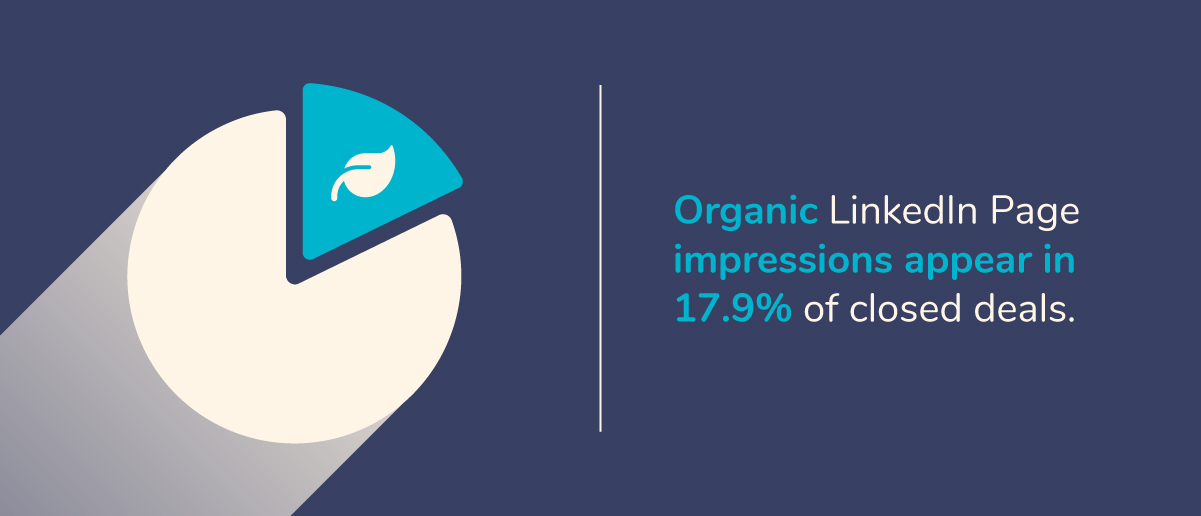
Organic LinkedIn Page impressions appeared in nearly one in five closed deals. Company pages can therefore be another point of contact during the buying journey, giving prospects an opportunity to learn more about a supplier before getting in touch.
7. Organic company page impressions can precede revenue by 90 days
Organic company page impressions appear an average of 90 days before revenue. Keeping your page updated with relevant content, service information and customer examples gives prospective buyers something useful to explore while evaluating your business.
LinkedIn social prospecting and multi-channel statistics
1. 81% of surveyed buyers say combined outreach channels improve results
LinkedIn can play an important role alongside email and phone outreach, helping sales teams build relationships and engage with prospects in different ways. The most effective approach is to coordinate these interactions so that each message builds on previous contact.
For example, a prospect who’s engaged with an email might receive a relevant LinkedIn connection request, followed by a conversation that references their interests rather than repeating the original sales pitch.
2. 80% of buyers are more willing to engage through their preferred channel
Getting in front of the right prospect is only half the battle. How you approach them matters too. LinkedIn can be particularly useful for engaging decision-makers who are active on the platform, but assuming every prospect wants to receive a direct message could mean missing opportunities. Understanding where your buyers prefer to communicate helps make outreach more relevant from the outset.
3. B2B buyers have an average of 2.9 preferred contact channels
With buyers open to several contact channels, there’s an opportunity to use LinkedIn at different stages of the buying journey. A prospect might discover your business through an expert’s LinkedIn post, research your services independently, and respond to an email weeks later. Maintaining visibility across these touchpoints helps build familiarity, even when buyers aren’t ready for a direct conversation.
4. 58% of B2B teams already use multiple outreach channels
More than half of B2B teams already use multiple outreach channels, giving them several ways to connect with prospective customers.
LinkedIn can be particularly effective for researching prospects, engaging with their content, and starting conversations, while email is often better suited to sharing more detailed information. Understanding where each channel works best can help sales teams make better use of the methods they’re already using.
5. Only 21% of B2B teams coordinate activity across channels
Despite the widespread use of multichannel outreach, only 21% of B2B teams coordinate their activity across different channels.
Keeping LinkedIn, email, and other channel interactions recorded in the same CRM can help teams understand which prospects have already been contacted, what they’ve engaged with, and when to follow up. This gives salespeople more context for their conversations and reduces the risk of overlapping outreach.
6. B2B teams use an average of 3.1 outreach methods
With B2B teams using around three outreach methods, there’s plenty of scope to make LinkedIn work harder within the mix. It can help sales teams engage additional decision-makers within a target account or reconnect with prospects who’ve gone quiet over email. The key is making each interaction purposeful, rather than repeating the same pitch across every channel.
Sopro’s expert predictions for lead generation on LinkedIn
With LinkedIn continuing to evolve as a B2B lead generation channel, what should businesses be preparing for in 2027?
Here, Sopro’s Head of Sales, Steve Harlow, shares his predictions for LinkedIn lead generation in 2027, drawing on his experience in B2B sales and prospecting to identify where businesses should focus their efforts.
1. LinkedIn prospecting will become more targeted as automation grows
In 2027, I expect more B2B teams to automate routine LinkedIn prospecting tasks, from identifying relevant contacts to managing connection requests and follow-ups. This will make it easier to reach larger audiences, but businesses will need to be more selective about how they use that capability.
As automated outreach becomes more common, I predict high-volume, generic sequences will become less effective. Salespeople who take the time to understand a prospect’s role, business challenges and reasons for engaging will have an advantage. Automation can handle repetitive tasks, leaving experienced teams more time to focus on personalising conversations and building relationships.
2. B2B thought leadership will have a greater influence on buying decisions
With 81% of B2B buyers having a preferred supplier before engaging sales, LinkedIn thought leadership will become increasingly important for building familiarity and trust. I expect buyers to favour genuine insights from experienced professionals over polished corporate messaging, particularly as 71% already consider outreach overly sales-led.
Businesses will also need to look beyond likes and impressions. Connecting LinkedIn engagement with website visits, account activity and outreach responses will help demonstrate its contribution to pipeline. Consistently sharing expert insights will help businesses establish credibility before sales conversations begin.
3. LinkedIn advertising will be judged on its contribution to pipeline
B2B marketers will increasingly look beyond cost per click and cost per lead when assessing LinkedIn advertising. With 84% of companies involving multiple stakeholders in purchase decisions, reaching the right accounts and influencing opportunities will matter more than generating cheap leads.
My prediction is that LinkedIn advertising will deliver the greatest value alongside direct outreach, particularly during longer buying journeys where familiarity influences responses. However, smaller addressable markets and shorter sales cycles may make the investment harder to justify. Measuring account engagement and pipeline influence will become increasingly important when deciding where to spend.
4. Buyer intent will shape when businesses use LinkedIn for outreach
I expect more B2B businesses to use buyer intent signals to decide when to approach prospects on LinkedIn, rather than relying on fixed outreach schedules. Someone who’s recently visited a company’s website or engaged with an email, for example, may be more receptive to a relevant LinkedIn conversation.
We’ll see closer collaboration between sales and marketing teams, with engagement data playing a bigger part in how outreach is planned. Salespeople will have more context about a prospect’s previous interactions, allowing them to make better decisions about when LinkedIn is the most appropriate channel to use.
5. AI will identify buying opportunities, but people will lead the conversations
I predict AI will play a bigger role in helping sales teams make sense of account activity and identify potential buying opportunities. By analysing website visits, LinkedIn engagement and other interactions together, AI could spot patterns that would be difficult for salespeople to track manually.
For example, increased activity from several people at the same company might suggest growing interest in a particular service. AI could bring that account to a salesperson’s attention and summarise recent interactions, giving them more context before making contact. Experienced salespeople will still be needed to interpret those insights, understand individual priorities and decide how best to approach the conversation.
Lead generation on LinkedIn: putting the statistics to work
These LinkedIn lead generation statistics show why marketers need more than a follower or lead count. Organic content can help build familiarity, paid activity can reach named accounts, and prospecting can connect interested buyers with a sales conversation. Each step needs a measure that fits its purpose.
LinkedIn for lead generation works best when it’s connected to the rest of the buyer experience. Sopro’s B2B email marketing agency service is one route for continuing relevant conversations outside the platform, where email is appropriate for the prospect.
Methodology and sources
This guide brings together the latest LinkedIn statistics from industry research and Sopro’s own findings from The State of Prospecting 2026. We’ve selected the most relevant insights to explore LinkedIn’s role in B2B lead generation, covering everything from audience demographics and engagement to advertising performance and buyer behaviour. This research has been paired with insights from the following sources:
https://news.linkedin.com/about-us
https://news.linkedin.com/2026/q4-earnings-and-business-highlights
https://www.microsoft.com/en-us/Investor/earnings/FY-2026-Q4/metrics
https://www.semrush.com/website/linkedin.com/overview/
https://datareportal.com/reports/digital-2026-united-states-of-america
https://datareportal.com/reports/digital-2026-united-kingdom
https://www.statista.com/statistics/933964/distribution-of-users-on-linkedin-worldwide-gender/
https://www.statista.com/statistics/273505/global-linkedin-age-group/
https://www.pewresearch.org/internet/2024/01/31/americans-social-media-use/
https://business.linkedin.com/advertise/linkedin-pages/best-practices
https://buffer.com/resources/best-time-to-post-on-linkedin/
https://metadata.io/linkedin-ads-cost-b2b
https://dreamdata.io/blog/announcing-linkedin-ads-benchmarks-report-2026
https://contentmarketinginstitute.com/b2b-research/b2b-content-marketing-trends-research
Watch your sales grow
Discover how Sopro helps hundreds of businesses sell more. We do the hard work, so you can do your best work.
See More


Share