27 demand generation statistics and industry trends

Summarise this article with:



Demand generation faces a clear commercial test in 2026.
B2B teams have more ways to create attention, but attention alone doesn’t build pipeline. With budgets under pressure, leaders need evidence that campaigns are reaching the right accounts, generating genuine buying interest, and yielding sales opportunities worth pursuing.
The latest statistics show a clear gap between access and execution. Most businesses use intent signals, yet fewer than half act on them. Multi-channel activity is common, but coordinated activity is rare. AI budgets are growing much faster than AI readiness.
To inform the next wave of successful B2B demand generation, we’ve pulled together the latest research, including Sopro’s State of Prospecting 2026, based on analysis of 126 million outreach emails and more than 25 million multi-channel data points.
Our top 10 B2B demand generation statistics for 2026
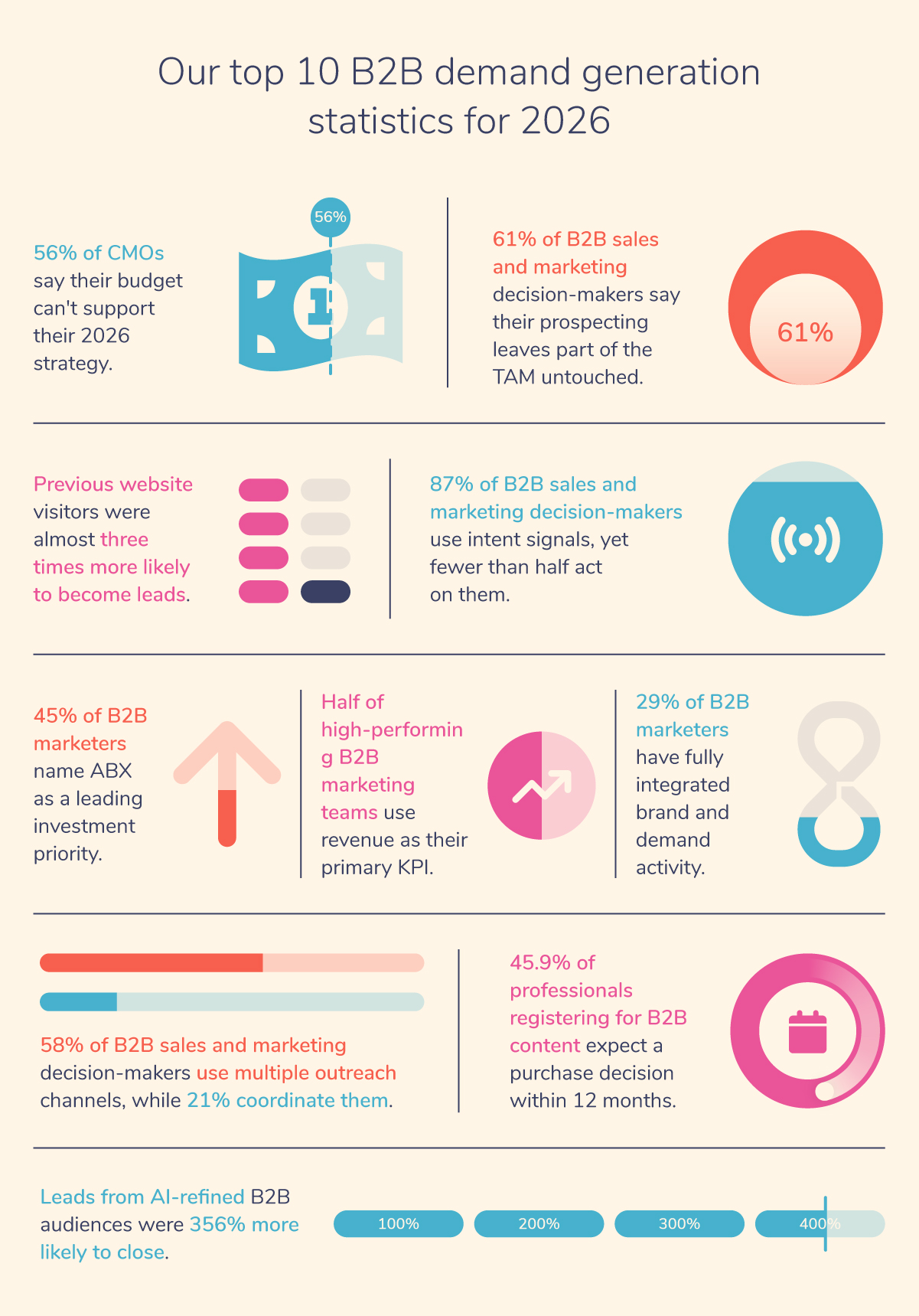
- 56% of CMOs say their budget can’t support their 2026 strategy. → Read more
- 61% of B2B sales and marketing decision-makers say their prospecting leaves part of the TAM untouched. → Read more
- Previous website visitors were almost three times more likely to become leads. → Read more
- 87% of B2B sales and marketing decision-makers use intent signals, yet fewer than half act on them. → Read more
- 45% of B2B marketers name ABX as a leading investment priority. → Read more
- Half of high-performing B2B marketing teams use revenue as their primary KPI. → Read more
- 29% of B2B marketers have fully integrated brand and demand activity. → Read more
- 58% of B2B sales and marketing decision-makers use multiple outreach channels, while 21% coordinate them. → Read more
- 45.9% of professionals registering for B2B content expect a purchase decision within 12 months. → Read more
- Leads from AI-refined B2B audiences were 356% more likely to close. → Read more
The state of B2B demand generation in 2026
The market isn’t moving in one tidy direction. Some teams have secured more investment. Others are being asked to deliver an ambitious strategy with flat or shrinking resources. Both face the same test: demonstrating how demand generation activity contributes to pipeline and revenue.
1. 43% of B2B marketers increased their budgets
Over a third (35%) of B2B marketers received a slight marketing budget increase, and 8% received a significant one. Combined, 43% reported an increase from 2024 to 2025.
For demand generation teams, this additional investment can support better targeting, stronger content, and more coordinated campaigns across priority channels. The opportunity lies in directing that spend towards activities that reach relevant accounts, build buying interest, and contribute to a qualified pipeline.
2. 56% of CMOs say their budget can’t support their 2026 strategy
Although some B2B marketers reported an increase, a larger budget can still fall short of what the wider strategy demands. A survey of CMOs and senior marketing leaders in North America, the UK, and Europe found that over half (56%) lacked the funding needed to deliver their plans.
Within demand generation, that gap can leave too many audiences and campaigns competing for limited investment. Phasing activity around the markets and accounts with the clearest revenue potential gives each campaign enough support to reach buyers consistently and influence consideration.
3. 89% of senior B2B decision-makers say prospecting is essential for new business, but has become harder
Budget pressure is only one constraint. Almost nine in 10 (89%) said prospecting remains essential for new business. However, prospecting has also become harder as buyers conduct more independent research and form opinions before speaking to sales.
With budgets already stretched, harder prospecting leaves less room for weak targeting. Account selection carries more weight when each response takes greater effort to earn.
4. 40% of global B2B marketers name unqualified leads as their main demand generation pain point
Reaching more buyers has limited value when the resulting interest comes from accounts that sales cannot progress. In a global survey of B2B marketers, two in five (40%) named unqualified leads as their primary demand generation pain point.
Lead quality is a budget issue as well as a sales issue. Responses add cost when the accounts behind them are unlikely to progress. Qualification, therefore, needs to shape demand generation before campaigns go live.
B2B audience targeting and intent data statistics
Demand generation starts before the first campaign goes live. The quality and coverage of the audience set the ceiling for everything that follows.
1. 61% of B2B sales and marketing decision-makers say their prospecting leaves part of the TAM untouched
Budget sets the limits of a demand generation plan. The next question is whether campaigns are reaching enough of the right market. Almost two-thirds (61%) of B2B sales and marketing decision-makers believe their prospecting leaves part of their total addressable market (TAM) untouched.
This matters beyond the prospecting function. Campaigns built around familiar database segments can keep investing in the same visible buyers while suitable accounts remain outside the plan. A current TAM gives teams a clearer view of the wider opportunity, allowing targeting and content to reach new prospects without losing relevance.
Learn more about TAM, SAM, and SOM: How to calculate your addressable market.
2. Previous website visitors were almost three times more likely to become leads
Market coverage establishes who could be relevant. Website behaviour adds another layer by showing where interest may already be forming. Companies that visited a supplier’s website before outbound contact were almost three times more likely to become leads once approached.
This highlights the importance of connecting first-party website data with wider demand generation activity. A visit may follow brand exposure, content consumption, or active research, while timely outbound gives that interest a route into conversation. Measuring those touchpoints together provides a clearer view of how demand develops across the buying journey.
3. 87% of B2B sales and marketing decision-makers use intent signals, yet fewer than half act on them
The website visit is one example of the wider intent signals now available to B2B teams. Among surveyed B2B sales and marketing decision-makers, nearly nine in 10 (87%) said their businesses use intent signals in some form, yet fewer than half use them to trigger or tailor outreach.
The gap lies in activation. A pricing-page visit may call for a different response than a leadership change or a burst of topic research, so each signal needs a defined threshold, owner, and timeframe. Once those rules are embedded in the demand generation workflow, intent data can improve campaign timing and relevance rather than remaining passive information.
Where B2B demand generation budgets are going
The earlier findings point to a common challenge: teams need to cover more of the right market and respond more effectively to signs of interest, often within limited budgets. Investment priorities are shifting towards strategies that focus on both.
1. 45% of B2B marketers name ABX as a leading investment priority
Account-based experience (ABX) led the priorities in B2B marketing, selected by over two-fifths (45%) of respondents.
This approach brings market coverage, account selection, and intent into one coordinated approach. Its commercial case rests on concentrating activity around accounts with meaningful revenue potential and giving those buyers a consistent experience across channels.
Technology can help organise the campaigns. Accurate data, a well-defined ideal customer profile and timely sales follow-up determine whether that precision becomes pipeline. Teams can retain strategic ownership while a B2B account-based engagement agency provides additional support with targeting, data, and campaign delivery.
2. 41% of B2B marketers prioritise personalised buyer engagement
That account-level focus is closely followed by investment in how buyers are engaged. Personalised or customised engagement was named as a budget priority by 41% of B2B marketers.
Useful personalisation changes the substance of a campaign. The account’s commercial situation, the recipient’s role, and any existing intent can influence which problem leads the message and what content follows. A name or company field alone creates only the appearance of personalisation.
Segmentation keeps the approach commercially viable. Accounts with similar needs can receive messaging built around shared challenges, with deeper research reserved for high-value opportunities or stronger signs of intent. This allows teams to increase relevance without turning each campaign into a one-off production job.
3. 65% of high-performing B2B marketing teams received more budget, while 50% of low performers faced cuts
These investment choices carry consequences for future funding. Budget increases went to 65% of high-performing B2B marketing teams and 12% of low performers. Half of low performers faced cuts, compared with 15% of high performers.
Performance and investment can reinforce each other. Better-funded teams have more scope to test and improve campaigns, while visible progress gives leaders a stronger case for continued backing. Demand generation reporting, therefore, needs to connect target-account engagement with pipeline and revenue throughout the year, well before the next budget review.
Demand generation ROI and performance measurement statistics
Demand generation ROI depends on deal value, margin, sales cycle, and the way influence is attributed across the buying journey. A single market-wide percentage would hide more than it reveals.
A more useful comparison is what B2B teams measure and how close those metrics get to pipeline and revenue.
1. 43% of B2B marketing teams use website traffic as a KPI
Website traffic is used as a performance metric by 43% of B2B marketing teams.
It provides an early indication that content and campaigns are attracting attention. Its value increases when teams can see whether visits come from target accounts, which pages those accounts view and what happens afterwards. Without those connections, a busy website can still sit alongside a weak pipeline.
2. 42% of B2B marketing teams measure revenue
Revenue sits just one percentage point behind website traffic, with 42% of B2B marketing teams using it as a performance metric. Commercial outcomes are now much closer to the centre of demand generation reporting.
Revenue reporting becomes more useful once marketing and sales agree on what counts. Marketing-sourced revenue attributes opportunities to marketing as its origin, while marketing-influenced revenue recognises its contribution across a longer buying journey. Shared definitions and attribution windows make the figure easier to trust when discussing performance and future investment.
3. 39% of B2B marketing teams track sales-qualified leads
Between early attention and closed revenue sits a practical handover metric. Sales-qualified leads, or SQLs, are used as a KPI by almost two in five (39%) of B2B marketing teams.
SQLs can show whether demand generation activity is creating interest that sales considers worth pursuing. Their value depends on a consistent lead qualification process. The metric quickly loses credibility if marketing applies it to form fills while sales reserves it for genuine buying conversations. Shared criteria around account fit, buying need, and readiness for contact keep both teams working from the same definition.
4. Half of high-performing B2B marketing teams use revenue as their primary KPI
The case for moving closer to revenue strengthens among the teams reporting the strongest performance. Half of high-performing B2B marketing teams use revenue generated as their primary KPI.
This gives earlier measures a clearer role. Traffic shows reach, intent signals guide timing, and SQLs indicate sales readiness. Revenue tests whether those parts combine into commercial value, keeping demand generation activity connected to opportunities the sales team can progress and the business can recognise.
5. High-performing B2B marketing teams track more metrics than low performers
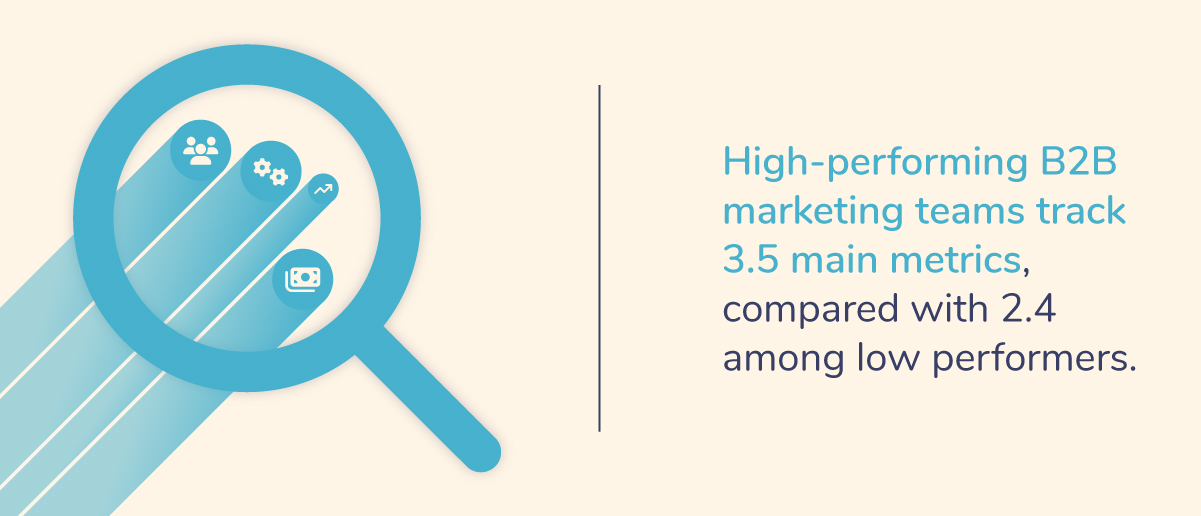
High-performing teams tend to look beyond the final number of a single metric. On average, they tracked 3.5 main metrics, compared with 2.4 among low-performing B2B marketing teams.
This doesn’t call for a longer dashboard. A small group of related measures can show whether campaigns reach the right companies and whether that attention develops into qualified pipeline and revenue. Each figure should help explain a result or guide a decision.
6. 41% of B2B marketers rate lead nurturing highly, rising to 69% among high performers
The performance gap also appears in what happens after demand has been created. Across all B2B marketers, 41% rated their B2B lead nurturing as very good or excellent. Among high-performing teams, the figure reached 69%.
Demand generation continues after the first sign of interest. Many prospects engage before they have the urgency, budget, or internal agreement needed to buy. Nurturing develops that early interest through useful content and relevant follow-up until the account is ready for a sales conversation. Without it, campaigns can attract attention that never finds a realistic route into pipeline.
Brand and multi-channel demand generation statistics
B2B buyers build familiarity across more than one campaign or channel. An article, paid ad, website visit, and outbound email may all shape the same buying journey, even when different teams manage them internally.
1. 29% of B2B marketers have fully integrated brand and demand activity
Brand activity builds familiarity before a buyer is ready to respond. Demand activity turns growing interest into measurable engagement and a route to sales. The earlier website finding illustrates the connection: prior engagement was associated with a much stronger response to later outreach. Separate plans and reporting make that shared contribution harder to see.
2. 58% of B2B sales and marketing decision-makers use multiple outreach channels, while 21% coordinate them
The same integration gap appears at the channel level. While 58% of B2B sales and marketing decision-makers use several outreach channels, only 21% of respondents coordinate activity across them.
Email, LinkedIn, and paid media can widen a campaign’s reach. Coordination requires each channel to work from the same account information and respond to what the buyer has already seen or done. This reduces repetition and gives sales useful context when interest turns into a conversation.
A B2B multi-channel marketing agency can support campaign planning and delivery across channels. Sales follow-up still needs clear ownership to avoid active interest stalling.
3. Awareness and conversion account for 62.6% of media spend in 2026
Media investment shows the same pull towards creating and capturing demand, as awareness and conversion accounted for 62.6% of total media spend, a rise of more than 10% since 2024.
Those outcomes sit at different points in the buying journey. Content, retargeting, and outbound can carry familiarity from first exposure into action, while shared account data prevents each channel from starting the conversation again. Coordination, therefore, belongs in the media plan itself.
B2B content demand generation statistics
Coordinated channels still need something worth putting in front of the buyer. Content gives B2B audiences a reason to engage before they’re ready for a sales conversation, while providing demand generation teams with signals they can use in later campaigns.
1. Demand for gated B2B content has grown 57.6% since 2021
Analysis of 7.2 million first-party B2B content registrations in 2025 found that demand for gated content was 57.6% higher than in 2021.
The growth shows that buyers will still exchange their details for useful content. The value needs to be clear before the form appears, especially when similar information is freely available elsewhere. A registration gives the team an identifiable sign of interest and a starting point for nurturing; purchase readiness still needs to be established.
2. B2B content registrations fell 8.6% during 2025
The longer-term growth hasn’t followed a straight line. B2B content registrations fell 8.6% during 2025, leaving demand 57.6% above 2021 levels.
The dip raises the standard for content-led demand generation. Publishing more gated assets is unlikely to be enough. The topic needs to address a genuine buyer concern, the value should be clear before the form, and distribution must put the content in front of relevant accounts.
3. 45.9% of professionals registering for B2B content expect a purchase decision within 12 months
The commercial value of those registrations matters more than volume alone. Nearly half (45.9%) of the professionals registering for B2B content expected to make a purchase decision within the following year.
This places content within a meaningful B2B buying window, although it doesn’t make every download sales-qualified. Topic, account fit, and subsequent behaviour can help demand generation teams judge whether an account needs further nurturing or is ready for direct contact.
4. Trend reports, playbooks and case studies are linked with near-term purchase intent
The type of content can help teams interpret the registration. Trend reports, playbooks, and case studies were among the formats linked with purchase intentions within the next 12 months.
Each supports a different part of the decision. Trend reports help buyers understand what’s changing, playbooks turn a problem into practical next steps, and case studies show how other companies have responded. Their role can continue after the download, providing demand generation and sales-relevant materials as the account moves closer to a decision.
5. Google AI Overviews were associated with a 58% lower click-through rate for the top organic result
The way buyers discover content is changing, too. A 2026 analysis found that the presence of an AI Overview was associated with an estimated 58% lower average click-through rate for the top-ranking page.
The research covered informational searches generally, giving B2B teams a broader view of how content discovery is changing. AI search can answer early questions before a buyer reaches a supplier’s website, leaving fewer visits and first-party signals at the start of the journey. Traffic data may therefore need context from later account engagement and pipeline activity.
AI demand generation statistics and trends
AI now sits across many of the demand generation tasks covered above, including audience research, intent analysis, content development, and performance reporting. Investment has grown quickly, while teams are still working out where it can make a measurable commercial difference.
1. CMOs allocate 15.3% of their marketing budgets to AI
AI initiatives receive an average of 15.3% of CMO marketing budgets, making the technology a material part of marketing investment.
Although the 15.3% allocation spans the wider marketing function, its scale shows how quickly AI is moving into the tools and processes that support demand generation. Audience research, data enrichment, message testing, and campaign analysis are all likely to receive part of that investment.
2. 30% of marketing organisations report mature AI readiness
Investment is moving faster than readiness. Only 30% of marketing organisations rated their AI readiness as mature or fully developed. Buying software can happen quickly. Preparing the data, working practices and human checks needed to use it well takes longer.
In demand generation, gaps in those areas can lead to poor account selection or automated messaging that feels irrelevant to the buyer. At scale, those mistakes affect campaign performance and trust in the brand.
Our guide to AI for sales prospecting explores where the technology can support targeting and campaign delivery while keeping people responsible for the final decisions.
3. Leads from AI-refined B2B audiences were 356% more likely to close
The clearest commercial case for AI appears in audience selection. Analysis of thousands of B2B campaign audiences used AI to refine company lists according to deeper suitability. Lead rates remained broadly unchanged, while leads from those refined audiences were 356% more likely to become closed deals.
The improvement appeared further into the pipeline, where commercial value becomes clearer. Here, AI helped demand generation activity reach companies with a stronger likelihood of becoming customers, increasing lead quality without relying on a rise in lead volume.
How demand generation and lead generation work together
Demand generation creates awareness, interest, and preference across a defined B2B market. Lead generation identifies the people or accounts that could become opportunities and creates a route into sales.
The buying journey rarely divides neatly between the two. An account may read an article, see an advert, visit the website, and later respond to outbound contact. Demand generation builds familiarity across those interactions, while lead generation captures and qualifies the response.
Connecting both disciplines gives marketing activity a clearer route into pipeline and gives sales more context for each conversation. A B2B lead generation agency can help identify and engage suitable prospects, turning existing or emerging interest into sales-ready opportunities.
Expert Q&A: Your demand generation questions

How do you build an effective demand generation strategy?
Start with the market, the commercial problem, and the revenue goal. Define the accounts that can buy, the roles involved, and the reasons they may act now. Then choose channels that can create awareness, capture signals, and open conversations with that audience.
Set qualification, ownership, and follow-up rules before launch. A campaign without a handover plan is content and media activity, not a pipeline system.
For a fuller breakdown of the planning, channels and metrics involved, read our complete guide to B2B demand generation.
What are the best software and tools for demand generation?
The useful stack usually covers market data, CRM, campaign delivery, intent, analytics, and sales workflow. The exact products matter less than the connections between them.
Before adding a platform, ask what decision it will improve. If the answer is vague, the tool may add another login without fixing the process.
Which trends are shaping B2B demand generation in 2026?
Three shifts stand out in the data: tighter funding, more revenue-focused measurement, and rapid AI investment. Running through all three is the same demand for precision. Teams need to choose accounts more carefully, coordinate the channels they already use, and prove what reaches pipeline.
Which metrics measure B2B demand generation success?
Use a connected set covering market reach, account engagement, qualified pipeline, and revenue. Add cost and conversion measures that suit the business model.
Define sourced and influenced pipeline with sales, then keep those definitions stable. A clean number with a disputed meaning won’t build trust in the programme.
What role does content play in demand generation?
Content gives buyers a reason to notice, remember, and trust a supplier before they are ready to speak. It also gives outbound teams a more useful reason to make contact.
Useful assets answer a live commercial question or help a buying group make progress. Search traffic is welcome, but buyer usefulness is the standard that matters.
What is the difference between inbound and outbound demand generation?
Inbound attracts buyers through content, search, events, and brand activity. Outbound proactively reaches selected accounts through channels such as email and LinkedIn.
They work better with shared data. Inbound engagement can improve outbound timing, while outbound conversations can expose the questions and objections that future content should answer.
Build demand generation around connected pipeline
The 2026 data doesn’t call for more disconnected activity. It points towards complete market coverage, sharper audience choices, faster use of intent and measurement that follows demand into revenue.
As a B2B demand generation agency, Sopro combines proprietary data, multi-channel outreach, live intent signals, and managed campaign delivery to help B2B companies create a more consistent pipeline.
Book a demo to discuss a demand generation programme shaped around your market and growth goals.
Methodology & sources
Sopro is a specialist B2B demand generation agency with expertise in lead generation and email marketing services.
We conducted proprietary research as part of The State of Prospecting 2026 report. Insights and findings from that research related to B2B demand generation have been compiled here, along with data from other sources, to form a complete collection of lead generation statistics:




Share