52 sales and marketing alignment statistics for 2026

Summarise this article with:


In this blog
- The state of sales and marketing alignment in 30 seconds
- How aligning sales and marketing impacts growth, revenue, and conversion rates
- Alignment matters more in 2026 than ever before
- Common sales and marketing alignment challenges
- Key characteristics of aligned sales and marketing teams
- Sopro’s tips for sales and marketing alignment
- Methodology and sources

Sales and marketing alignment statistics show a clear pattern: organisations that integrate their revenue functions outperform those that operate in silos.
While many leadership teams believe their departments are aligned, frontline data tells a different story. Misaligned goals, fragmented technology stacks, and inconsistent messaging continue to disrupt buyer journeys and stall pipeline progression.
For any B2B prospecting agency, alignment isn’t theoretical. It determines whether campaigns translate into a qualified pipeline, whether leads are followed up effectively, and whether revenue impact can be clearly attributed. Without shared ownership of targets, personas, and handoff processes, even well-funded demand generation programmes underperform.
The following sales and marketing alignment statistics for 2026 highlight where companies struggle, where high-performing teams differentiate themselves, and what measurable impact alignment has on growth.
The state of sales and marketing alignment in 30 seconds
Pushed for time, but want the latest stats? Here’s what you need to know…
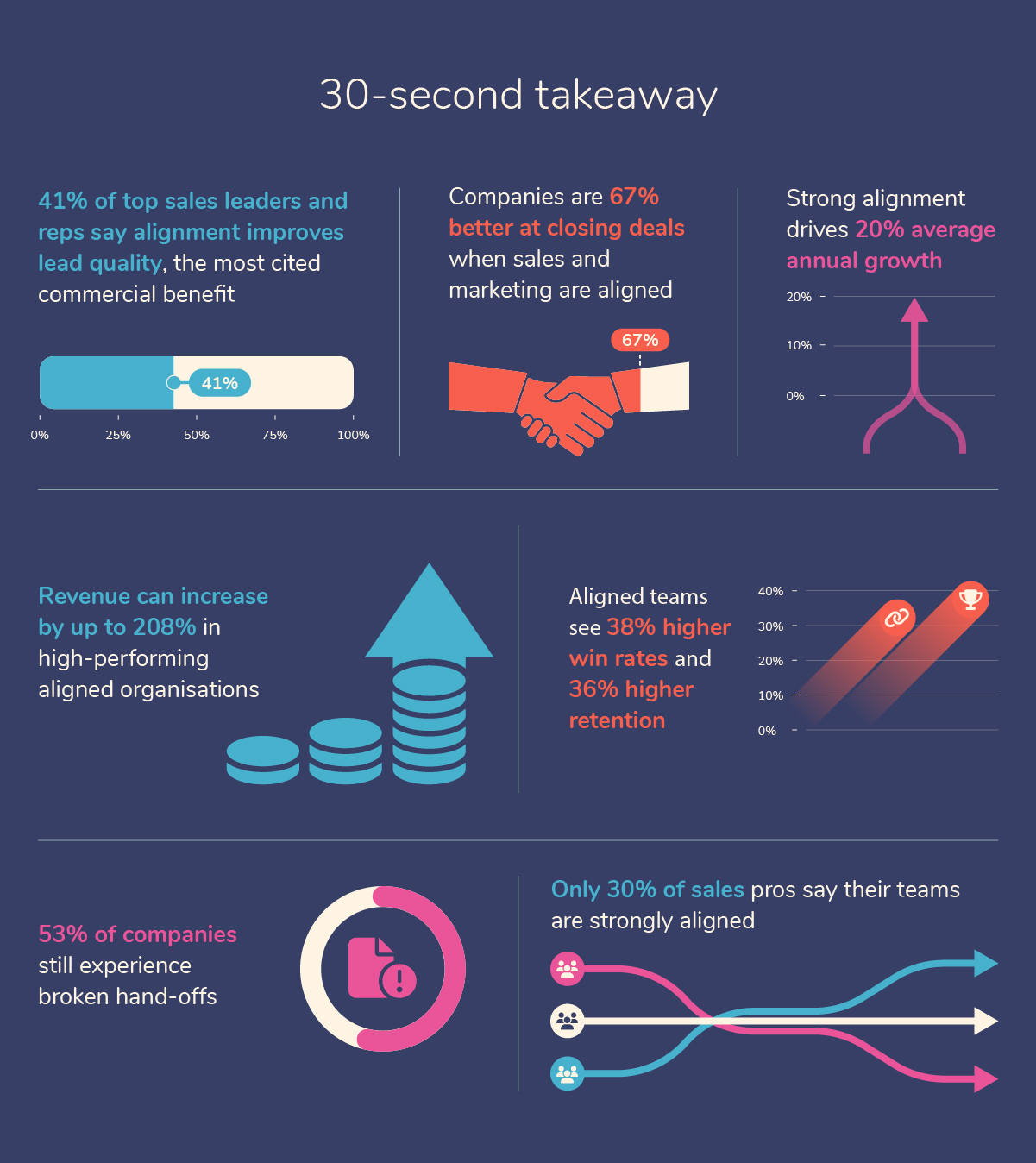
- 41% of top sales leaders and reps say alignment improves lead quality, the most cited commercial benefit → Read more
- Companies are 67% better at closing deals when sales and marketing are aligned → Read more
- Strong alignment drives 20% average annual growth → Read more
- Revenue can increase by up to 208% in high-performing aligned organisations → Read more
- Aligned teams see 38% higher win rates and 36% higher retention → Read more
- 53% of companies still experience broken hand-offs → Read more
- Only 30% of sales pros say their teams are strongly aligned → Read more
Sales and marketing alignment is no longer optional. It’s a structural growth driver that directly impacts pipeline, conversion, and revenue predictability.
How aligning sales and marketing impacts growth, revenue, and conversion rates
Sales and marketing alignment is no longer a cultural initiative; it’s a measurable commercial lever.
When revenue teams share data, agree on targeting, and collaborate across the buyer journey, the impact shows up in pipeline velocity, conversion rates, retention, and long-term revenue growth. Misalignment creates friction, duplicated effort, and revenue leakage.
Below are the most important sales and marketing alignment statistics for 2026, drawn from the latest industry research, and what they mean in practice.
1. 41% say alignment improves lead quality
When asked about the biggest benefits of sales and marketing alignment, more than two-fifths (41%) of top sales leaders say it improves lead quality.
Poor lead quality is one of the most common sources of friction between teams. Marketing focuses on volume. Sales focuses on conversion. Alignment shifts the conversation from quantity to qualification.
When both teams agree on ICP definitions, buyer intent signals, and qualification criteria, fewer leads are wasted, and more conversations turn into revenue.
Lead quality appears repeatedly throughout alignment research. It’s both the most cited benefit and the most persistent friction point.
2. 29% say alignment directly increases revenue
Nearly one-third of businesses report increased revenue as a direct benefit of aligning sales and marketing. Revenue growth improves because alignment reduces friction between stages and increases commercial clarity across the funnel.
When pipeline stages are clearly defined and shared ownership exists, revenue leakage reduces, and forecasting becomes more accurate.
3. Companies are 67% better at closing deals when aligned
Organisations improve by more than two-thirds (67%) when sales and marketing are aligned. Closing rates reflect more than just sales ability. They reflect pre-sale positioning.
When marketing warms the market with consistent messaging, and sales follow up with contextual conversations, prospects move through the funnel with fewer objections and greater clarity. Alignment improves both pipeline quality and conversion efficiency
4. Strong alignment drives 20% annual revenue growth
Companies with strong sales and marketing alignment experience an average annual growth rate of 20%.
Over multiple years, a 20% growth rate dramatically widens the gap between aligned organisations and their competitors. Alignment, in this context, becomes a strategic growth lever rather than an operational improvement.
5. Revenue can increase by up to 208% with effective alignment
Research shows that effective sales and marketing alignment can increase revenue by up to 208%. While this represents high-performing organisations rather than the average, it demonstrates the upper ceiling of what coordinated revenue operations can achieve.
The common thread across these businesses is shared accountability for pipeline and revenue outcomes. In many cases, this alignment is formalised under a revenue operations model, where sales, marketing, and customer teams operate against unified performance metrics.
6. Sales professionals are 103% more likely to exceed goals in aligned companies
Sales professionals working in aligned organisations are 103% more likely to exceed their targets. That’s more than double the likelihood of hitting quota.
When marketing delivers relevant, well-qualified opportunities and shares insight into buyer intent and engagement history, sales teams start conversations further down the buying journey. Alignment reduces prospecting friction and increases confidence in pipeline quality.
7. Marketing involvement boosts pipeline conversion by 65%
The average pipeline conversion rate increases by almost two-thirds (65%) when marketing actively contributes to the outreach, compared to sales-only cold outreach. This statistic highlights one of the clearest commercial impacts of alignment.
When marketing supports sales with targeted campaigns, nurturing, content, and retargeting, more prospects convert into an active pipeline, and fewer conversations go cold.
As an award-winning prospecting agency offering a suite of targeted B2B lead generation services, we know just how impactful outreach can be…when it’s coordinated effectively. Your messaging aligns, your resources work harder, and your conversion rates reap the rewards.
Want to hear more? Book a demo to get the low-down on how integrated sales and marketing support can fuel your pipeline.
For businesses working with a B2B lead generation agency, coordinated outreach and demand capture strategies can significantly improve conversion efficiency.
The same principle applies when partnering with a B2B prospecting agency: outbound targeting and messaging must align closely with broader demand activity to avoid duplication and wasted effort.
8. Shared buyer-journey collaboration boosts conversions 2.3×
Organisations that collaborate across the buyer journey see conversion rates increase by approximately 2.3× and are 1.6× more likely to exceed revenue goals. Alignment is most powerful when it extends beyond MQL hand-offs.
When marketing understands objections raised in late-stage sales conversations, and sales understands early-stage engagement signals, messaging becomes consistent and reinforced throughout the funnel. That continuity builds trust and accelerates decisions.
9. Marketing influences up to 29% of the pipeline when audience alignment is strong
Where marketing and sales are aligned on audience targeting and hand-off processes, marketing can influence up to 29% of the total pipeline. This challenges the idea that marketing’s job ends at lead generation.
In high-performing teams, marketing supports pipeline progression through remarketing, content enablement, intent monitoring, and account-based activity, especially in multi-channel environments.
For businesses operating as a B2B multi-channel marketing agency or demand-focused organisation, this level of influence reflects true revenue integration.
10. Tightly aligned teams see 38% higher win rates and 36% higher retention
Organisations with tightly aligned sales and marketing functions experience:
- 38% higher sales win rates
- 36% higher customer retention rates
Alignment influences lifetime value.
When expectations set during marketing match the reality delivered by sales, customers are less likely to churn. Clear positioning, consistent messaging, and realistic promises create long-term trust. Retention improvements often deliver greater financial impact than acquisition gains alone.
11. 78% of sales leaders say CRM improves alignment
More than three-quarters (78%) of sales leaders say their CRM effectively improves alignment between sales and marketing teams. Technology plays a foundational role in revenue alignment.
Without shared visibility into pipeline stages, lead activity, engagement data, and attribution, alignment becomes anecdotal rather than measurable. CRM systems create a single source of truth, but only when both teams actively use and trust the data.
12. 23% invest in alignment to improve short-term pipeline performance
Nearly a quarter (23%) of businesses say they invest in sales and marketing alignment specifically to improve short-term pipeline performance. This reflects growing pressure on revenue teams.
Alignment is no longer viewed as a long-term brand initiative. It’s increasingly seen as a tactical lever to stabilise pipelines during uncertain market conditions.
13. Slow sales cycles drive 32% to invest in sales outreach
Almost a third (32%) of respondents cite slow sales cycles as a reason for investing in sales outreach solutions. Sales cycle length is often a symptom of misalignment.
When marketing attracts poorly qualified prospects, or when sales engages leads without context, decision timelines stretch. Alignment shortens cycles by ensuring prospects are educated and nurtured before high-value sales conversations begin.
Alignment matters more in 2026 than ever before
Buyer behaviour has shifted. Decision makers now research independently, compare vendors digitally, and engage across multiple channels before speaking to sales.
With journeys often exceeding ten touchpoints, fragmented messaging creates confusion rather than persuasion.
As automation, AI-driven targeting, and intent data become more accessible, alignment is no longer about coordination alone. It’s about orchestrating a unified revenue experience.
Common sales and marketing alignment challenges
While the commercial upside of alignment is clear, most organisations still struggle to operationalise it.
The data shows that a single issue rarely causes misalignment. It is usually a combination of communication gaps, inconsistent definitions, technology fragmentation, and unrealistic expectations.
The following sales and marketing alignment statistics highlight where execution most often breaks down.
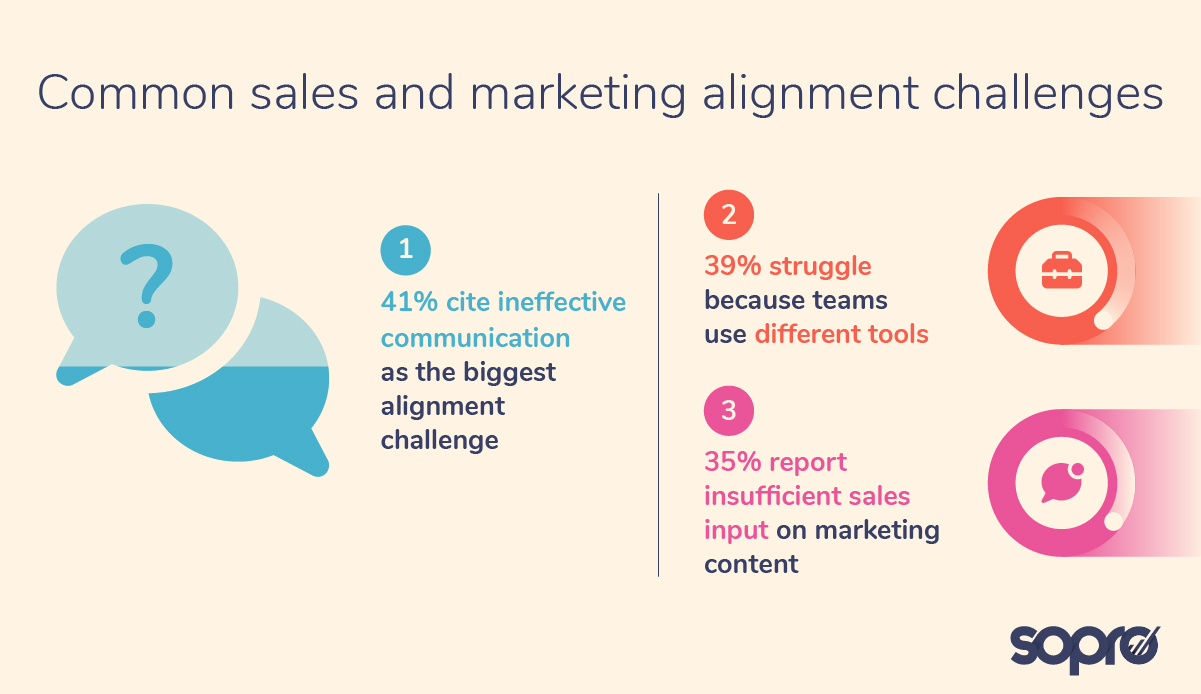
1. 41% cite ineffective communication as the biggest alignment challenge
Over two-fifths (41%) of organisations say ineffective communication between sales and marketing is their biggest obstacle to alignment. This is not simply about how often teams meet; it’s about what is shared and how clearly expectations are defined.
When sales does not communicate objections, buying triggers, and deal feedback, marketing continues producing messaging based on assumptions. When marketing does not communicate campaign intent, targeting logic, and engagement data, sales work in isolation.
Alignment begins with structured, consistent information exchange, not ad hoc conversations.
2. 39% struggle because teams use different tools
Technology fragmentation creates blind spots. Marketing tracks engagement in one system. Sales tracks conversations in another. Attribution becomes unclear, and hand-offs become inconsistent.
Without shared visibility across CRM, automation, and outreach platforms, alignment becomes theoretical rather than operational. Technology should enable alignment, not create silos.
3. 35% report insufficient sales input on marketing content
This is a common friction point. Marketing creates content designed to generate leads. Sales faces the objections that content fails to address.
When sales is not involved in shaping messaging, case studies, and positioning, content can feel disconnected from real buying conversations. The result is marketing activity that drives engagement but not conversion.
4. 34% struggle to share data effectively
Over a third (34%) report difficulty sharing data between teams. Data is the backbone of alignment. Without shared reporting on lead quality, conversion rates, pipeline progression, and revenue influence, teams rely on perception rather than evidence.
Alignment requires a single version of the truth. When reporting differs across departments, trust erodes and accountability weakens.
5. 30% lack visibility into marketing activity
A third (30%) of sales teams say they lack visibility into what marketing is doing. When sales don’t understand campaign strategy, targeting criteria or messaging themes, follow-up becomes generic.
Visibility matters. Sales professionals who understand campaign context can reference relevant content, recent activity, and buyer signals in their outreach, increasing credibility and response rates.
6. 70% fail to integrate structured sales plays into technology
More than 80% of organisations say they run structured, repeatable sales and marketing programmes. Yet 70% fail to embed those plays properly into their CRM and automation systems. As a result, only around 20% realise full commercial value.
This highlights a common execution gap. Strategy exists, but it is not operationalised inside systems, workflows, or reporting structures. Alignment fails when process and technology are disconnected.
7. 65% of practitioners report misalignment despite executive confidence
82% of C-level B2B executives say their sales and marketing functions are aligned. Yet around 65% of practitioners report a lack of alignment. This discrepancy is telling.
Alignment often appears stronger in board reporting than in daily execution. Strategic intent may exist, but operational consistency, shared definitions, and feedback loops frequently lag behind.
8. Only 30% say teams are strongly aligned
Fewer than a third (30%) of sales professionals say their sales and marketing teams are strongly aligned at their company.
Although over two-fifths (61%) say alignment has improved compared to last year, the data suggests progress remains gradual rather than complete.
This reinforces that alignment is not a one-off initiative. It is an ongoing process that requires shared targets, clear definitions, and constant refinement.
9. 43% demand higher quality leads from marketing
43% of sales professionals say they need higher-quality leads from marketing. Only 59% say the leads they currently receive are high quality. Lead quality remains one of the most persistent alignment tensions.
When marketing optimises for volume or engagement rather than commercial readiness, sales absorbs the inefficiency. Clear agreement on qualification criteria, buyer intent signals, and ICP definition is essential to reduce this friction.
10. 53% experience broken hand-offs
Over half (53%) of companies experience a broken hand-off, where sales follow-up with fewer than 35% of marketing-engaged prospects. This represents a significant wasted opportunity.
If marketing invests in generating engagement but sales don’t consistently follow up, the pipeline suffers. Conversely, if leads are passed too early, the sales effort is diluted. Effective hand-offs require timing clarity, accountability, and shared definitions of readiness.
11. 57% of sellers ignore marketing content
57% of sellers say they pay little attention to content produced by marketing because it feels generic or unresponsive. This is a serious misalignment signal.
When sales do not trust or use marketing assets, it indicates a disconnect between the messaging strategy and real-world objections. Collaborative content development, informed by sales feedback, increases relevance and adoption.
12. Buyer journeys have doubled to 10 touchpoints
Five years ago, B2B customers experienced around five distinct sales and marketing touchpoints. Today, that number can reach ten. This increase in complexity makes alignment more critical than ever.
As the buyer journey spans email, social, events, paid media, and direct outreach, maintaining consistency becomes harder. Without coordination, prospects receive fragmented messaging that slows decision-making.
13. 90% of decision makers want closer collaboration
Nine out of ten B2B decision makers say marketing and sales need to work more closely together to avoid overlapping work. Buyers notice duplication and inconsistency.
When different teams approach the same account with conflicting messages or repeated outreach, credibility weakens. Internal alignment directly affects external perception.
14. Only 37% of marketing leaders feel fully aligned
Three in four B2B marketing leaders say alignment significantly impacts revenue activation success, yet only 37% say they are fully aligned with their sales counterparts. This shows awareness is not the problem – execution is.
Most leaders recognise the importance of alignment. Fewer have implemented the processes, reporting structures, and shared KPIs required to achieve it consistently.
15. 20% experience inconsistent pipeline performance
A fifth (20%) of businesses report inconsistent pipelines, often a symptom of misalignment.
When targeting shifts, definitions differ, or follow-up is irregular, the pipeline becomes unpredictable. Alignment stabilises the pipeline by creating shared forecasting assumptions and coordinated campaign timing.
16. 59% face tighter buyer budgets
Almost three-fifths (59%) of senior B2B decision-makers say buyers now have tighter budgets. In more constrained economic environments, inefficiency becomes more expensive.
Poorly aligned outreach wastes both time and opportunity. When budgets shrink, precision and coordination matter more.
17. 58% cite increased competition
Under three-fifths (58%) of senior B2B decision-makers say increased competition is a major sales challenge.
In competitive markets, inconsistent messaging and disjointed engagement reduce differentiation. Alignment ensures value propositions remain coherent across every touchpoint.
18. 44% say buyers take longer to decide
Over two-fifths (44%) of decision-makers report that buyers are taking longer to make decisions.
Longer cycles amplify the importance of consistent nurturing. Marketing must reinforce value while sales maintains relationships. Without alignment, momentum stalls.
19. 43% report leads going silent
Over two-fifths (43%) of B2B leaders say leads go silent without explanation. Often, this reflects poor timing or unclear value communication.
When marketing insights about engagement behaviour are shared with sales in real time, follow-up can be more contextual and timely.
20. 47% struggle to generate enough leads
Just under half (47%) of senior leaders say generating enough leads is a key marketing challenge.
Volume concerns can pressure sales teams to lower qualification standards, which, in turn, frustrates sales. Alignment ensures that both teams prioritise commercially viable opportunities over raw volume.
21. 44% cite lead quality as a major challenge
Over two in five (44%) of decision-makers identify lead quality as a major issue.
This reinforces the earlier tension between quantity and qualification. Alignment works best when both teams share accountability for pipeline quality rather than attributing blame.
22. 37% struggle to prove marketing ROI
Almost two-fifths (37%) say proving ROI from marketing activity is difficult.
Without shared attribution models and closed-loop reporting, marketing impact remains ambiguous. Alignment improves ROI visibility by linking campaigns directly to pipeline progression and revenue outcomes.
23. 28% find integrating inbound and outbound difficult
28% say integrating inbound and outbound strategies into one cohesive approach is challenging.
This is increasingly important as businesses adopt multi-channel strategies. Without coordination between demand generation and outbound outreach, prospects may receive disconnected messaging or duplicated contacts.
Alignment ensures inbound engagement informs outbound prioritisation and vice versa.
Key characteristics of aligned sales and marketing teams
If misaligned teams struggle with communication, visibility, and accountability, what do aligned teams actually do differently?
The data shows that high-performing organisations share common structural behaviours – alignment is nearly never accidental.
These sales and marketing alignment stats show what high-performing revenue teams do differently.
1. 85% say shared goals and KPIs are essential for alignment
85% of businesses believe having the same goals and KPIs enables true sales and marketing alignment. This is the foundation.
When marketing is measured on lead volume and sales are measured on closed revenue, tension is inevitable. When both teams are measured against shared pipeline contribution, conversion rates, and revenue impact, incentives shift.
Aligned teams win together and lose together. Accountability becomes collective rather than departmental.
2. 88% prioritise lead quality as the primary success metric
88% of businesses say lead quality is extremely important. This reinforces one of the clearest themes across sales and marketing alignment research: quality drives performance.
When both teams define and agree on what a high-quality lead looks like, targeting sharpens. Marketing attracts the right accounts. Sales prioritises the right conversations.
Alignment improves quality by tightening ICP definitions, refining qualification criteria, and using intent signals more effectively.
3. 84% say lead volume still matters alongside quality
84% of businesses also say lead volume remains important. High-performing teams don’t choose between quality and quantity. They manage both deliberately.
Alignment ensures volume is generated within clearly defined audience parameters. Instead of maximising raw lead numbers, aligned organisations focus on sustainable and commercially viable pipeline flow.
4. 87% conversion boost comes from effective hand-offs and audience overlap
Where marketing and sales are aligned on audience targeting and execute effective hand-offs, organisations see an average 87% boost in conversions from target buying groups to the pipeline.
This is one of the strongest operational indicators of alignment.
High audience overlap ensures both teams pursue the same accounts. Structured hand-offs ensure timing is correct and context is preserved. When those two factors combine, pipeline conversion accelerates significantly.
5. 29% of the pipeline can be influenced by marketing in aligned organisations
In companies where marketing and sales align on audience and hand-offs, marketing influences up to 29% of the pipeline. In contrast, organisations with broken hand-offs generate only 10% of the pipeline. The gap is substantial.
Aligned teams recognise that marketing does not stop at lead generation. It supports mid-funnel nurturing, account engagement, and deal progression – sales benefits from continued reinforcement rather than operating in isolation.
6. 36% rely on customer testimonials to win deals
Over a third (36%) of sales professionals say customer testimonials are the most effective type of sales enablement content for winning deals. Aligned teams ensure marketing produces assets that sales actually use.
Testimonials and case studies address real objections. When sales shares frontline feedback, and marketing translates it into credible proof points, close rates improve.
7. 35% say market research content drives deal success
Research-based content positions organisations as informed and credible. It gives sales professionals authority in conversations and helps buyers justify decisions internally.
Aligned teams often collaborate to produce this kind of content, using sales insights to guide topics and marketing expertise to present it persuasively.
8. 30% rely on reviews to support conversions
Three in ten (30%) identify reviews as a key factor in winning deals. Buyers increasingly validate vendors independently. Marketing supports this process through reputation management and third-party credibility, while sales incorporates reviews into late-stage discussions.
Alignment ensures both teams understand where and how social proof influences the buyer journey.
9. 48% year-on-year increase in sales enablement tool adoption
Among US sales professionals, use of sales enablement tools increased by almost half (48%) year on year, rising from 40% to 59%. Technology adoption is a structural indicator of alignment maturity.
Sales enablement platforms centralise content, track engagement, and provide visibility into which assets influence deals. When implemented correctly, they reduce friction between departments and create shared insight.
10. The 5 most effective types of enablement content for winning deals
Research identifies the five most effective types of sales enablement content as:
- Social media content
- Market research
- Reviews
- Customer testimonials
- Product demonstrations
Aligned teams coordinate production and deployment of these assets. Marketing ensures consistency and quality. Sales ensures relevance and application.
The result is a cohesive buyer journey rather than fragmented touchpoints.
11. 78% use email as a primary alignment channel
78% of companies say email successfully drives leads. Email remains a core coordination channel between marketing and sales activity. When messaging themes, targeting, and follow-up are aligned, email supports both demand generation and outbound engagement.
This is particularly relevant for organisations working with a B2B email marketing agency or integrating structured outreach into a broader revenue strategy.
12. 56% to 38% use multi-channel strategies successfully
Five channels are used successfully by more than a third of firms:
- 56% use referrals
- 51% use paid social
- 38% use SEO
- 38% use LinkedIn messaging
- 36% use events
Aligned teams do not treat these channels as isolated tactics.
Instead, they coordinate messaging, targeting, and attribution across channels. A prospect who engages via paid social should not receive disconnected outreach from sales. Alignment ensures continuity.
13. 26% have fully unified sales and marketing teams
Over a quarter (26%) of businesses report fully unified sales and marketing teams that share strategy and measurement. While this represents a minority, it signals the direction of travel.
In unified structures, revenue responsibility is shared across functions. Reporting lines reinforce collaboration rather than separation. Alignment becomes embedded in organisational design rather than dependent on goodwill.
14. 43% use full-service sales outreach agencies to improve alignment
More than four in ten (43%) businesses use full-service sales outreach agencies, which often help improve coordination between sales and marketing.
External partners can introduce structured processes, shared reporting, and defined handoffs that internal teams struggle to implement on their own.
15. 30% year-on-year growth achieved through pod collaboration
One enterprise cybersecurity company implemented collaborative sales and marketing pods reporting to a combined business-unit leader, achieving 30% year-over-year growth.
Pod structures reduce silos by creating smaller cross-functional units accountable for shared outcomes. Marketing, sales, and other functions collaborate at a defined cadence with unified objectives.
This structure reinforces alignment through accountability and focus.
16. Structured win rooms improve deal focus and rigour
Top-performing sales functions use structured win rooms that bring together cross-functional teams, including sales, marketing, product, finance, and technology.
These teams operate at a defined cadence to focus specifically on closing deals.
Win rooms formalise collaboration at the most commercially critical moments. Rather than relying on informal support, they create disciplined coordination that improves deal conversion and forecasting accuracy.
Sopro’s tips for sales and marketing alignment
Alignment is not achieved by chance. High-performing organisations deliberately create structures, habits, and processes that keep sales and marketing working in concert. Based on Sopro’s experience, here are the most effective practical steps to achieve alignment in 2026.
1. Jump on calls together
Marketing teams should sit in on sales calls and even attend pitches. This allows marketers to hear first-hand the barriers and concerns of potential customers, and to test new messaging before it goes live.
The goal is to replace guesswork with real-world buyer insight, improving both content relevance and conversion rates.
2. Assign ambassadors from each team
Nominate one person from sales and one from marketing to serve as a bridge between the two departments.
Their role is to facilitate communication, chase up requests, initiate reviews, and coordinate collaboration. This creates accountability and prevents work from stalling between functions.
3. Get together regularly and make meetings meaningful
Monthly or weekly meetings are essential, but they must be more than reporting exercises. Teams should use sessions to:
- Share honest feedback on sales conversations, including competitor insights.
- Present live campaigns or those in the pipeline.
- Brainstorm using funnel metrics such as lead generation, MQLs, and conversion rates.
These meetings turn alignment from theory into operational practice.
4. Socialise and sit closer together
Stronger interpersonal relationships improve collaboration. Spending time together at events, conferences, or informal socials fosters trust and knowledge sharing.
Even small adjustments, such as repositioning office seating so sales and marketing sit nearby, can encourage day-to-day problem solving and informal alignment.
5. Create a shared communication channel
Set up a group chat on Teams, Slack, or a similar platform. This becomes a dedicated space to:
- Share important updates
- Discuss ideas
- Track project progress
The result is reduced friction and a single source of information for both teams.
6. Secure buy-in for content
Unused content is a common source of misalignment. Organisations should ensure that:
- Content is timely and relevant to prospects’ needs
- Sales is aware of what has been created
- There are clear mechanisms for requesting new assets
This can be achieved via:
- Dedicated agenda items in meetings
- Shared content calendars
- Slack channels
- Formal request processes
7. Develop joint personas and profiles
Creating shared buyer personas is crucial for aligning objectives and metrics. A unified view of buyers allows teams to:
- Understand pain points, needs, preferences, and behaviours
- Build collateral, outreach, and campaigns from the same foundation
- Shared personas ensure consistency across all customer touchpoints.
8. Create content for the entire funnel
Marketing activity must extend beyond lead generation. Most buyers are two-thirds of the way through the buying cycle before contacting sales, so content should exist:
- Before handover
- During sales engagement
- After closing
This ensures continued engagement and supports long-term customer success.
9. Formalise lead scoring and nurturing
Lead scoring acts as a joint qualification framework. It allows both teams to:
- Evaluate a lead’s likelihood of converting
- Disqualify low-fit leads in marketing
- Prioritise high-potential opportunities in sales
Lead nurturing should also remain collaborative, enabling sales to request content tailored to different personas, industries, or challenges.
10. Ensure seamless handoff
A smooth lead transition from marketing to sales is critical. This requires:
- Clear protocols
- Continuous communication
- Integrated processes
The objective is to maintain momentum and prevent prospects from disengaging at the point of transfer.
Expert Q&A: Sales and marketing alignment in practice

What does sales and marketing misalignment look like in practice?
Misalignment occurs when sales and marketing operate in silos, use different systems, report on separate metrics, and pursue disconnected objectives.
In practice, this often manifests as:
- Messaging that differs between marketing campaigns and sales conversations
- Leads falling through the cracks because handovers are unclear
- Marketing attracting traffic that never converts into a qualified pipeline
- Sales relying on outdated or unused collateral
- CRM systems filled with incomplete or inconsistent data
- Funnel leakage caused by MQLs being passed too early or deals stalling at the proposal stage
Confusion arises when sales representatives say one thing while marketing assets say another. That inconsistency disrupts buyer momentum and weakens credibility.
Over time, these gaps compound. Pipeline slows, attribution becomes unreliable, and revenue performance becomes harder to forecast.=
Who owns what when you align sales and marketing?
Alignment is a shared responsibility, not a handover point. Marketing typically owns strategy, content, campaigns, and inbound demand generation. Sales owns frontline conversations, buyer feedback, and deal execution.
However, true alignment requires joint ownership of:
- The ideal customer profile
- Buyer personas
- Core pain points
- Value propositions
- Messaging frameworks
- Named ABM accounts
- Pipeline impact
When teams co-own these elements, they function as a unified customer acquisition engine rather than two departments transferring work between stages.
Ownership becomes revenue-focused rather than task-focused.
What insights should sales and marketing teams be sharing to boost performance?
Sales should act as a source of live market intelligence, bringing back:
- Objections heard in conversations
- Competitive positioning insights
- Stakeholder dynamics
- Budget constraints
- Deal blockers and decision delays
Marketing, in turn, should share:
- Campaign performance data
- Keyword and SEO insights
- Content engagement metrics
- Attribution patterns
- Funnel conversion gaps
When these insights are combined, teams can identify content gaps, refine targeting, adjust messaging, and improve lead qualification criteria.
Win-and-loss analysis, alongside structured post-sale customer feedback, ensures both teams remain grounded in real buyer behaviour rather than internal assumptions.
How do you know when sales and marketing are genuinely aligned rather than simply meeting regularly?
Regular meetings alone do not indicate alignment. Alignment is visible in systems, behaviours, and measurable outcomes.
True alignment exists when:
- Both teams report against shared KPIs
- Dashboards track lead progression and sales engagement consistently
- CRM data is maintained accurately and in real time
- Messaging remains consistent across all buyer touchpoints
- Sales actively uses enablement content
- Funnel stages reflect how buyers actually purchase
- Lead handovers are documented, structured, and friction-free
When alignment is real, campaigns resonate more precisely, sales cycles shorten, and conversion rates strengthen across the funnel.
Which tools improve alignment between sales and marketing?
The foundation is a CRM that centralises activity, tracks pipeline progression, and surfaces performance trends.
On top of that, organisations typically benefit from:
- Sales enablement platforms that surface relevant content at the right moment
- Content management systems that ensure version control
- Conversation intelligence software to analyse call data
- Intent data platforms to prioritise high propensity accounts
- Email sequencing tools for coordinated outreach
- Lead scoring systems that formalise qualification
- Analytics dashboards for shared reporting
- AI-driven tools for research, prioritisation, and workflow automation
However, adoption matters as much as selection. Tools only improve alignment when they are consistently used, properly integrated, and supported with onboarding and training.
Technology does not create alignment by itself. It reinforces processes that already exist.
Methodology and sources
Sopro is an award-winning B2B prospecting agency with decades of expertise across a wide range of sectors. Proprietary research for this report has been compiled with data and insights from other sources to form a comprehensive collection of sales and marketing statistics.
Sources
- https://sopro.io/resources/reports/outbound-pulse-2025/
- https://sopro.io/resources/whitepapers/the-state-of-prospecting-26/
- https://53.fs1.hubspotusercontent-na1.net/hubfs/53/2025-State-of-Sales-HubSpot-V6.pdf
- https://align.me/wp-content/uploads/MathMarketing-alignment-report-2013.pdf
- https://cdn2.hubspot.net/hub/160303/file-773536484-pdf/docs/aberdeensalesmarketingalignmentreport.pdf
- https://evenbound.com/blog/hubspot-sales-and-marketing-alignment
- https://salesso.com/blog/sales-enablement-statistics/
- https://www.bain.com/about/media-center/press-releases/20252/70-of-companies-struggle-to-integrate-their-sales-plays-into-crm-and-revenue-technologies-finds-bain–company-survey/
- https://www.demandgenreport.com/resources/the-b2b-playbook-for-sales-marketing-alignment/
- https://www.forrester.com/blogs/the-truth-about-b2b-sales-and-marketing-alignment/
- https://www.gartner.com/en/newsroom/press-releases/2024-06-03-gartner-survey-reveals-marketing-and-sales-functions-collaborate-on-only-three-out-of-15-commercial-activities
- https://www.hubspot.com/hubfs/HubSpots%202024%20Sales%20Trends%20Report.pdf
- https://www.influ2.com/reports/sales-marketing-alignment-statistics
- https://www.marketingprofs.com/opinions/2016/29174/the-secret-to-account-based-marketing-success
- https://www.mckinsey.com/~/media/mckinsey/business%20functions/marketing%20and%20sales/our%20insights/future%20of%20b2b%20sales%20the%20big%20reframe/Future-of-B2B-sales-The-big-reframe.pdf
- https://www.predictivdata.com/blog/2025-b2b-revenue-activation-survey
- https://www.ruleranalytics.com/blog/sales/sales-marketing-alignment/




Share