53 must-read CRM statistics and trends for 2026

Summarise this article with:


In this blog
- Top 10 CRM statistics for 2026
- CRM market size and growth statistics
- CRM adoption statistics
- CRM statistics on sales performance
- CRM statistics on customer retention and experience
- CRM implementation challenges and barriers
- CRM data and data quality statistics
- Emerging AI trends in customer relationship management
- The impact of CRM on B2B growth
- Future CRM trends: Sopro’s predictions
- Sources

Customer relationship management (CRM) sits at the centre of almost every modern sales and marketing operation. It’s where pipelines are tracked, campaigns are measured, and customer relationships are managed at scale. But despite its importance, many businesses still struggle to get consistent value from it.
Part of the challenge is the pace of the space’s evolution. CRM is no longer just a system of record – it’s now expected to power automation, integrate with multiple tools, and deliver real-time insights driven by AI. At the same time, issues like poor data quality, fragmented systems, and low adoption continue to limit its impact.
As an award-winning B2B lead generation agency, Sopro works closely with revenue teams to turn prospecting into a predictable, scalable channel for growth. That means working with CRM systems every day. And from that experience, one thing is clear: the effectiveness of any CRM depends on how well it’s implemented, integrated, and maintained.
Here, we’ve pulled together the most important CRM statistics shaping the industry right now. From market growth and adoption to data quality challenges and emerging trends, these insights highlight where CRM is delivering value, and where there’s still work to do.
Top 10 CRM statistics for 2026
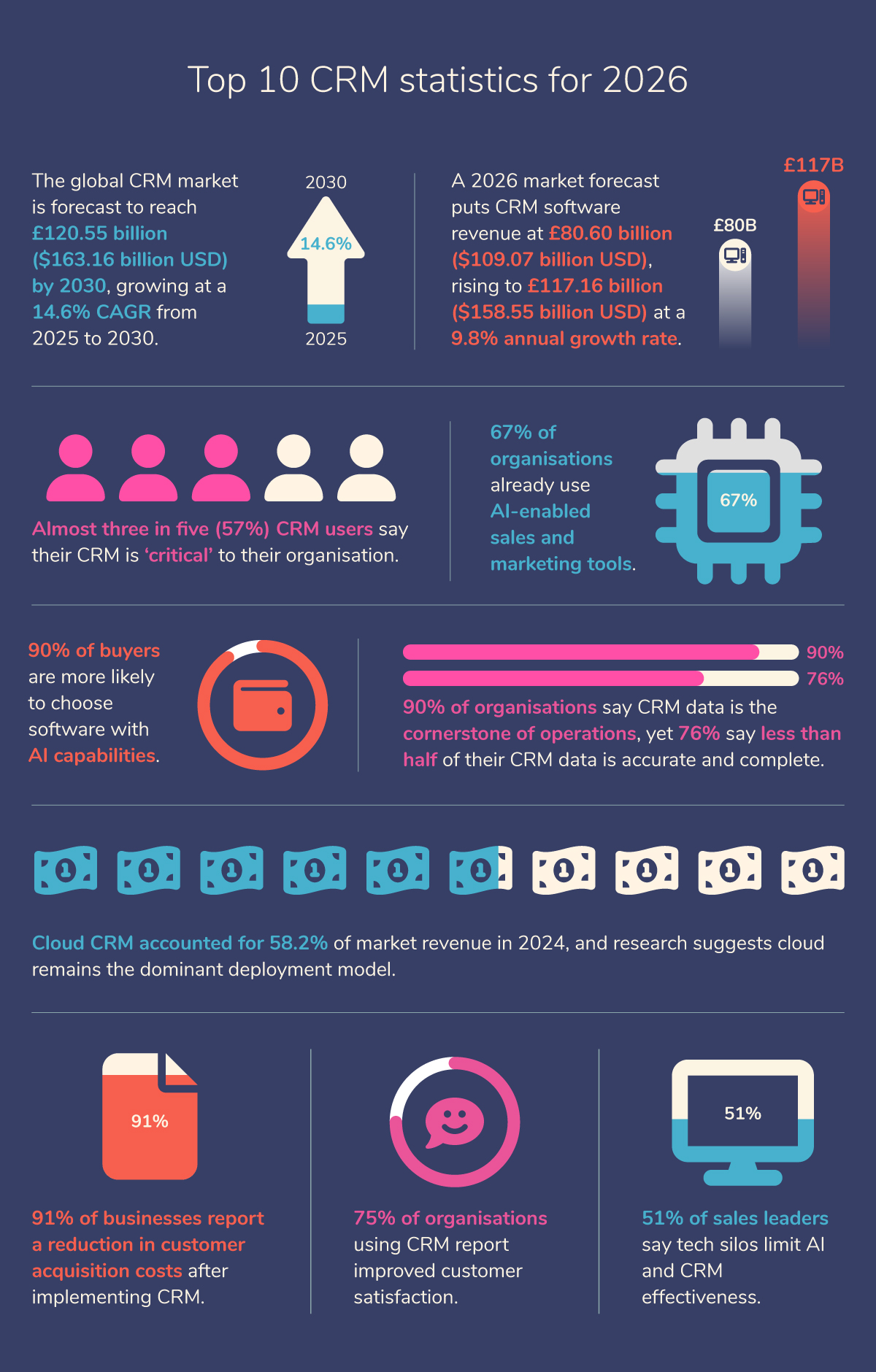
- The global CRM market is forecast to reach £120.55 billion ($163.16 billion USD) by 2030, growing at a 14.6% CAGR from 2025 to 2030. → Read more
- A 2026 market forecast puts CRM software revenue at £80.60 billion ($109.07 billion USD), rising to £117.16 billion ($158.55 billion USD) at a 9.8% annual growth rate. → Read more
- Almost three in five (57%) CRM users say their CRM is ‘critical’ to their organisation. → Read more
- 67% of organisations already use AI-enabled sales and marketing tools. → Read more
- 90% of buyers are more likely to choose software with AI capabilities. → Read more
- 90% of organisations say CRM data is the cornerstone of operations, yet 76% say less than half of their CRM data is accurate and complete. → Read more
- Cloud CRM accounted for 58.2% of market revenue in 2024, and research suggests cloud remains the dominant deployment model. → Read more
- 91% of businesses report a reduction in customer acquisition costs after implementing CRM. → Read more
- 75% of organisations using CRM report improved customer satisfaction. → Read more
- 51% of sales leaders say tech silos limit AI and CRM effectiveness. → Read more
CRM market size and growth statistics
1. CRM software revenue will reach £80.60 billion ($109.07bn) in 2026
The software segment alone represents a massive and growing share of the broader CRM ecosystem. This reflects increasing demand for platforms that can manage customer data, automate workflows, and support multi-channel engagement within a single environment.
2. The CRM software market will grow to £117.16 billion ($158.55bn) by 2030
This reflects continued demand for scalable, cloud-based, and AI-driven CRM tools. As businesses look to unify customer data and improve operational efficiency, investment in CRM software is expected to remain a key priority across both enterprise and mid-market organisations.
3. The CRM market is projected to reach £120.55 billion ($163.16 billion USD) by 2030
This increase of around £39.90 billion ($54 billion USD) underscores the growing importance of CRM systems to revenue growth and customer engagement strategies.
As businesses place greater emphasis on data-driven decision-making and personalised outreach, CRM platforms are increasingly central to commercial operations.
4. The average spend per employee in the CRM software market is projected to reach £21.45 ($29.03 USD) in 2026
Investment in CRM continues to rise as businesses prioritise customer data, automation, and revenue intelligence.
An average spend of £21.45 ($29.03 USD) per employee highlights how CRM is no longer limited to sales teams alone. Instead, it’s becoming embedded across entire organisations, supporting marketing, customer success, and operations.
This broader adoption reflects the growing expectation that CRM systems should act as a central hub for customer data and decision-making, rather than a standalone tool.
5. Cloud CRM accounts for 58.2% of deployments
Cloud-based CRM systems now dominate the market, reflecting a shift away from on-premise infrastructure.
This trend is driven by the need for flexibility, remote access, and seamless integration with other tools across the sales and marketing stack. As businesses adopt more digital workflows, cloud CRM provides the foundation for real-time collaboration and data sharing.
CRM adoption statistics
1. Around 80% of organisations use CRM for sales reporting and automation
CRM is now a standard tool for tracking pipeline performance and automating workflows. Its widespread use reflects how essential it has become for managing sales activity, improving visibility, and reducing manual tasks across revenue teams.
2. Almost three in five (57%) of CRM users say their system is ‘critical’ to operations
CRM is no longer optional – it’s central to revenue teams’ day-to-day work.
For many organisations, it acts as the primary system for managing customer relationships, coordinating outreach, and supporting core business processes.
3. 67% of organisations use AI-enabled sales and marketing tools
AI is rapidly becoming embedded within CRM systems, enhancing automation and insights.
This shift shows how CRM platforms are evolving beyond data storage into more intelligent systems that support decision-making and optimise workflows.
4. 90% of buyers prioritise software with AI capabilities
AI is now a key purchasing factor, influencing CRM selection decisions. As expectations around automation, personalisation, and data insights grow, businesses are increasingly choosing platforms that can deliver these capabilities natively.
5. 45% of teams purchase software specifically to improve integrations
This shows the growing need for CRM to connect seamlessly with wider tech stacks.
As organisations adopt more tools across sales and marketing, integration has become critical for maintaining data consistency and enabling a more unified approach to customer engagement.
6. The SME segment is forecast to grow at a 16.2% CAGR
While large enterprises dominate the market, smaller businesses are among the fastest-growing segments of the CRM market.
That suggests CRM adoption is continuing to spread beyond enterprise use cases, particularly as cloud-based systems lower the barrier to entry.
7. Asia Pacific is forecast to be the fastest-growing regional CRM market, at 16.3% CAGR
This points to strong momentum in emerging, rapidly digitising markets, where CRM is increasingly adopted to support customer experience, sales growth, and operational efficiency. It also suggests future CRM growth will not be concentrated in mature Western markets alone.
8. Social media monitoring is projected to grow at a 17.2% CAGR within CRM
This is one of the clearest signals that CRM is expanding beyond traditional pipeline and account management.
Businesses increasingly need CRM systems to capture customer signals across public and owned channels.
9. Almost one in five (19%) plan to buy CRM software within the next year
Alongside current adoption, this shows continued purchase intent in the category. It suggests that CRM remains a live investment priority for businesses upgrading legacy systems or formalising their existing processes.
10. 72% of marketers use AI features in their sales and marketing tools, compared with 65% of sales professionals
This is a useful adoption stat because it shows that AI-enabled CRM and adjacent tooling are not being adopted evenly across teams. Marketing appears further ahead, which may reflect differences in workflow complexity, experimentation, or training needs.
11. Email is the most important CRM engagement channel for 29% of respondents
This helps ground CRM adoption in how teams actually use these platforms day to day.
Rather than being abstract systems of record, CRM tools are still closely tied to practical engagement channels and campaign execution.
12. 91% of companies with 10 or more employees use CRM systems
CRM adoption is now near-universal across established businesses, including industries like staffing and recruiting, telecommunications, and professional training.
In these sectors, CRM systems are used to manage large volumes of contacts, track interactions, and coordinate communication across multiple stakeholders.
This level of adoption highlights how CRM has evolved from a sales tool into a core operational infrastructure across multiple industries.
13. Almost two thirds (60%) of decision-makers rate security as “critical” when evaluating new sales and marketing software
This is not a pure adoption stat, but it fits well if you want to show what now drives CRM selection and rollout.
Adoption is no longer just about features and usability – trust, governance, and data protection have become central to decision-making.
CRM statistics on sales performance
1. 73% of buyers avoid sellers who send irrelevant outreach
Relevance has become a defining factor in sales success. The majority of B2B buyers actively avoid sellers who fail to tailor their messaging to their needs.
This places increasing pressure on CRM systems to support accurate targeting and personalisation. Without high-quality data, delivering relevant outreach at scale becomes significantly harder.
2. CRM systems can increase conversion rates by up to 300%
When used effectively, CRM platforms can significantly improve conversion performance.
By improving lead tracking, enabling more consistent follow-up, and giving teams better visibility over the pipeline, CRM systems help ensure that opportunities are not missed or neglected.
This level of structure and insight allows sales teams to engage prospects at the right time, with the right context, ultimately increasing the likelihood of conversion.
3. Revenue can increase by up to 245% with CRM adoption
CRM systems don’t just improve internal processes; they can directly influence revenue growth.
By centralising customer data and enabling more targeted, personalised outreach, CRM platforms help teams identify higher-value opportunities and move them through the pipeline more effectively.
Over time, this leads to stronger conversion rates, improved retention, and a more predictable revenue engine.
4. 94% of businesses report improved sales productivity after implementing CRM
One of the most consistent benefits of CRM adoption is increased sales productivity. By automating repetitive tasks, streamlining workflows, and improving access to customer data, CRM systems reduce the amount of time sales teams spend on manual processes – when done right.
This allows reps to focus more on high-value activities such as prospecting, relationship building, and closing deals, ultimately improving overall performance.
CRM statistics on customer retention and experience
1. 47% of businesses report higher customer retention after adopting a CRM
Nearly half of businesses see measurable improvements in customer retention after implementing a CRM system.
This reflects CRM’s role in helping teams maintain consistent, informed communication with customers over time. By centralising interaction history, preferences, and engagement data, CRM platforms make it easier to deliver more relevant and timely follow-ups.
In practice, this reduces churn risk and strengthens long-term relationships, particularly in B2B environments where multiple touchpoints and stakeholders are involved.
2. 86% of SMEs using CRM rate their customer service as ‘exceptional’ or ‘very good’
Compared to just 73% of businesses without CRM, this highlights a clear link between CRM adoption and perceived service quality.
CRM systems give teams better visibility into past interactions, open issues, and customer needs, enabling faster, more personalised responses. This not only improves the immediate customer experience but also builds trust over time, which is a key driver of retention and repeat business.
3. 75% of organisations using CRM report improved customer satisfaction
Customer satisfaction is one of the most immediate benefits of CRM adoption.
With better access to customer data and interaction history, teams can deliver more personalised and responsive experiences, leading to higher satisfaction levels across the customer lifecycle.
4. 99% of B2B organisations use CRM for customer retention
In B2B-heavy industries such as management consulting, financial services, and professional services, CRM is almost universally used to support long-term client relationships.
This reflects the importance of structured, consistent engagement in sectors with longer deal cycles and relationships built over time. CRM systems play a central role in managing renewals, upselling, and account development.
5. 91% of businesses report a reduction in customer acquisition costs after implementing CRM
While not strictly a retention metric, this highlights the downstream impact of better customer experience and retention.
As CRM systems improve targeting, personalisation, and relationship management, businesses become less reliant on costly acquisition strategies and can generate more value from existing customers.
6. CRM systems can improve customer retention by up to 27%
Industries focused on long-term relationships – including consulting, training, and financial services – see measurable retention gains from CRM adoption.
By centralising customer data and enabling more consistent engagement, CRM systems help reduce churn and strengthen client relationships over time.
7. 47% of businesses report improved customer service efficiency after adopting CRM
Service-led industries such as telecommunications, financial services, and support-driven SaaS businesses benefit significantly from CRM implementation.
By streamlining workflows and centralising customer data, CRM systems allow teams to respond faster, resolve issues more effectively, and deliver a more consistent customer experience.
CRM implementation challenges and barriers
1. Fewer than 40% of sellers say AI agents have improved productivity
Despite the rapid adoption of AI in sales and CRM systems, fewer than 40% of sellers report that AI agents have actually improved their productivity.
This highlights a growing gap between investment in AI tools and the real-world value they deliver, particularly when data quality, processes, and integration are not fully optimised.
2. 51% of sales leaders say tech silos limit AI and CRM effectiveness
Disconnected systems remain a major barrier to realising value from CRM platforms. Over half of sales leaders report that technology silos delay or restrict the impact of AI and data-driven initiatives.
When tools don’t integrate properly, customer data becomes fragmented, workflows become inefficient, and CRM systems struggle to deliver a consistent view of the pipeline.
3. Sales reps spend 60% of their time on non-selling tasks
Despite widespread CRM adoption, sales teams still spend most of their time on administrative work rather than on revenue-generating activities.
Tasks such as updating records, managing internal processes, and handling data entry continue to take up significant time. This highlights a key gap between the intended efficiency of CRM systems and their actual use.
4. One in three CRM users doesn’t know how to assess data quality
A lack of measurement is one of the biggest barriers to effective CRM use. Around 33% of respondents said they are unsure how to assess the quality of their CRM data, making it difficult to identify issues or track improvements.
Without clear benchmarks or reporting standards, businesses struggle to understand whether their CRM is actually performing as intended. This limits the ability to optimise campaigns, improve targeting, or confidently act on insights.
5. Employees spend an average of 13 hours per week searching for data
CRM data may be centralised in theory, but in practice, it’s often difficult to access. The report found that employees spend around 13 hours per week just searching for the data they need.
This highlights a major reporting inefficiency. Instead of enabling faster decision-making, CRM systems can create friction when data is poorly structured, incomplete, or spread across multiple tools.
6. 68% of leaders believe teams have the data they need, but users disagree
There is a clear disconnect between leadership perception and frontline reality. While 68% of leaders believe revenue teams have sufficient data, actual CRM users report significant gaps in access and usability.
This mismatch makes it harder to improve reporting processes, as decision-makers may assume systems are working effectively when they are not.
7. 92% of businesses say valuable customer data sits outside their CRM
Despite being positioned as a ‘single source of truth,’ CRM often fails to capture the full picture. Research shows that 92% of organisations say their most valuable customer insights exist outside their CRM, typically spread across spreadsheets, email, and other tools.
This reinforces one of the biggest limitations of CRM systems: without proper integration, they risk becoming incomplete records rather than comprehensive data hubs.
8. Businesses use an average of 3-5 tools alongside their CRM
CRM rarely operates in isolation. Most organisations use 3-5 additional tools that integrate with their CRM, spanning marketing automation, analytics, outreach, and customer support.
This highlights a core reality: CRM is just one part of a wider revenue tech stack. Its effectiveness depends heavily on how well it connects with surrounding systems, rather than what it can do on its own.
CRM data and data quality statistics
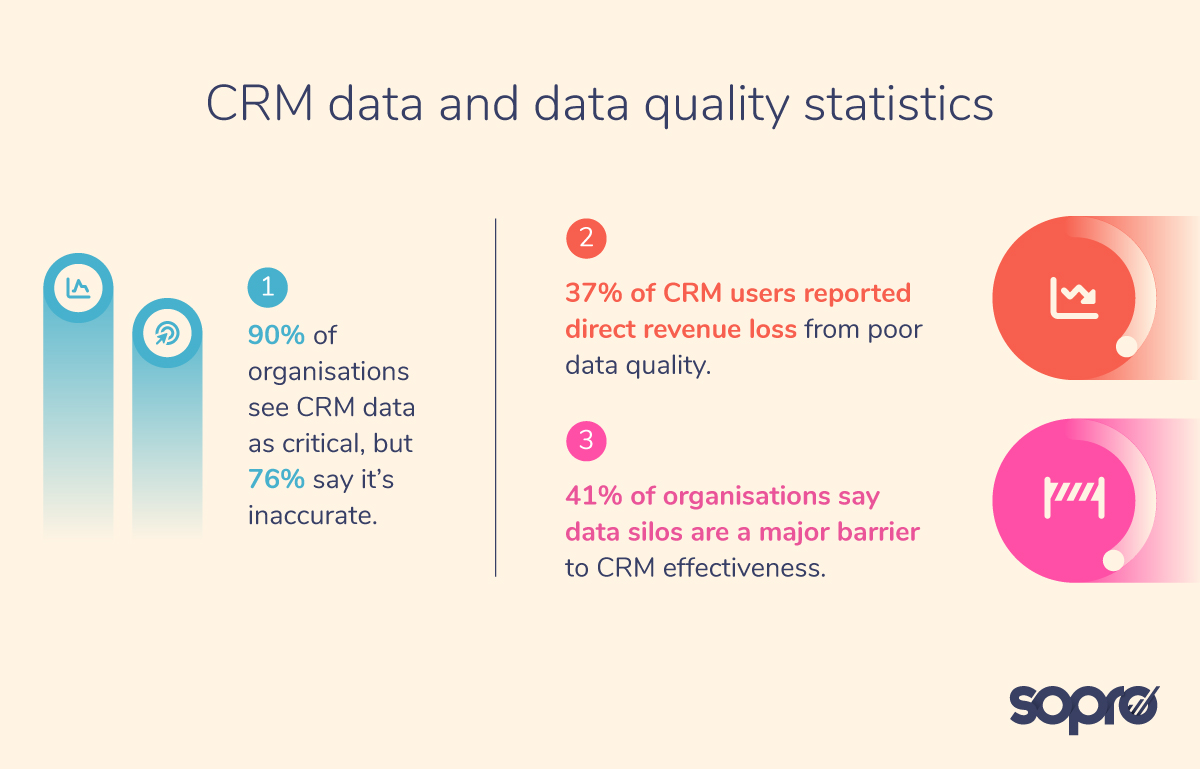
1. 90% of organisations see CRM data as critical, but 76% say it’s inaccurate
CRM data is widely recognised as foundational to business operations, with 90% of organisations describing it as the cornerstone of their customer, sales, and revenue processes. However, this reliance is undermined by a major quality gap: 76% of businesses say less than half of their CRM data is accurate and complete.
This disconnect highlights one of the biggest risks in modern CRM usage. While platforms are designed to centralise and streamline customer information, their effectiveness depends entirely on the quality of the data they contain. In practice, many teams are making decisions based on incomplete, outdated, or inconsistent data, limiting the value CRM systems are meant to deliver.
2. 37% of CRM users reported direct revenue loss from poor data quality
Poor data quality isn’t just an operational issue – it has direct commercial consequences.
This impact can take many forms, from missed sales opportunities and poor targeting to ineffective forecasting and wasted outreach. When CRM data cannot be trusted, it becomes harder for sales and marketing teams to prioritise the right accounts, personalise engagement, or measure performance accurately.
As a result, data quality is increasingly seen not just as a technical concern, but as a core driver of revenue performance.
3. 41% of organisations say data silos are a major barrier to CRM effectiveness
Data silos remain one of the biggest obstacles to getting value from CRM systems. When information is locked across different tools and departments, it becomes difficult to create a unified customer view or coordinate outreach effectively.
This lack of integration not only reduces efficiency but also impacts customer experience, as teams are forced to operate without full context.
4. 84% of leaders say AI is only as good as the data behind it
As CRM systems evolve to include AI-driven insights and automation, data quality is becoming even more critical. The vast majority of data and analytics leaders agree that AI outputs are only as reliable as the data feeding them.
This reinforces a growing reality: CRM platforms can only deliver value when the underlying data is accurate, complete, and well-structured. Without that foundation, even advanced tools risk producing misleading insights and poor decisions.
5. 87% of organisations say unified data is key to meeting customer expectations
Creating a single, unified view of the customer remains a top priority for most businesses. Nearly nine in ten organisations recognise that without connected data, it’s impossible to deliver the level of personalisation and responsiveness customers now expect.
However, achieving this unified view is often challenging in practice, particularly when data is spread across multiple systems, teams, and touchpoints.
This is where integration becomes critical. When prospecting data, engagement signals, and campaign activity feed directly into your CRM, it becomes far easier to build a complete, usable picture of your audience.
At Sopro, this is built into the model. Outreach data, intent signals, and engagement history sync directly into your CRM, so your team isn’t working across disconnected tools or relying on partial information.
If your CRM isn’t giving you a clear view of your pipeline, it’s likely missing the data that drives it. Explore how Sopro’s B2B lead generation service connects prospecting directly to your CRM, so every conversation, signal, and opportunity is tracked in one place.
6. 19% of company data is inaccessible to sales teams
A significant portion of valuable business data remains out of reach for the teams that need it most. On average, sales leaders estimate that nearly one-fifth of their organisation’s data is inaccessible.
This lack of visibility limits personalisation, slows decision-making, and reduces the effectiveness of CRM systems as a central source of truth.
7. Only 9% of organisations fully trust their data for reporting
Data fragmentation directly impacts confidence in CRM reporting. Just 9% of businesses say they trust their data enough for accurate reporting, largely due to inconsistencies across systems.
When CRM data is disconnected from other tools, reporting becomes unreliable, limiting its value for forecasting, decision-making, and performance tracking.
This reflects a broader shift in how CRM is used. Rather than acting as a standalone system of record, CRM is increasingly just one part of a wider revenue engine. Its effectiveness depends less on the platform itself and more on how well it connects to the tools and data that drive pipeline generation.
Emerging AI trends in customer relationship management
1. 94% of organisations say data readiness is critical for AI adoption
As AI becomes increasingly embedded in CRM systems, data quality is emerging as a defining factor. 94% of organisations agree that data readiness is essential for successful AI implementation.
This highlights a major shift in CRM strategy. It’s no longer enough to simply collect data – businesses now need structured, reliable data to power automation and insights.
2. 45% say their CRM data is not prepared for AI
Despite growing investment in AI, nearly half of organisations admit their CRM data is not ready to support it.
This gap suggests that many businesses are adopting AI tools faster than they are fixing underlying data issues, limiting the impact those tools can deliver.
3. 54% of organisations are already using generative AI tools at work
AI adoption is accelerating rapidly, with more than half of respondents already using generative AI in their workflows.
This reinforces the direction of travel for CRM platforms, which are increasingly expected to support AI-driven insights, automation, and personalisation.
4. 72% of teams report lacking the AI skills needed to use these tools effectively
While adoption is growing, capability is lagging behind. 72% of respondents say their teams lack the AI expertise required, creating a gap between technology investment and actual performance.
This suggests that CRM evolution is not just a technology challenge, but also a skills and enablement issue.
The impact of CRM on B2B growth
1. B2B teams use an average of 3.1 different outreach methods
Rather than operating from a single, unified CRM system, most B2B teams rely on multiple outreach methods across different tools and platforms.
According to Sopro’s State of Prospecting report, B2B teams now use an average of 3.1 different outreach methods, blending in-house activity, manual processes, and external support.
This fragmentation creates disconnects between channels, making it harder to maintain consistent messaging, track performance accurately, and scale prospecting effectively. Instead of accelerating growth, disconnected systems often introduce friction that slows pipeline generation and reduces overall efficiency.
2. Integrated CRM and lead generation drives 35% ARR growth
Companies that combine CRM systems with lead generation tools achieve significantly stronger revenue performance.
Research shows businesses using integrated systems see 35% annual recurring revenue (ARR) growth, compared to just 19% for those using CRM alone.
This highlights the commercial impact of connecting prospecting activity directly to CRM data, rather than managing it in isolation.
3. Conversion rates increase from 34% to 52% with integration
CRM systems on their own deliver solid results, with average conversion rates of around 34%.
However, when paired with lead generation tools, conversion rates rise to 52%, representing a significant uplift in turning prospects into customers.
This reinforces the value of combining data, targeting, and outreach within a single connected system.
4. Net revenue retention rises to 95% with connected systems
Retention is a key driver of long-term B2B growth.
Businesses using integrated CRM and lead generation tools achieve 95% net revenue retention (NRR), compared to 76% for CRM-only strategies.
This shows that connected systems don’t just improve acquisition – they strengthen long-term customer value.
Future CRM trends: Sopro’s predictions
Rob Harlow, CEO at Sopro, shares his perspective on where CRM is heading and how its role is changing in modern B2B sales:
“CRM hasn’t failed B2B sales teams, but it’s often misunderstood.
“At its core, a CRM is a record-keeping system. It tracks contacts, conversations, deal stages, and revenue once a prospect has already engaged. What it doesn’t do, and was never designed to do, is give visibility into the vast majority of the market that hasn’t yet entered the funnel.
“That gap is becoming one of the defining challenges in modern B2B sales.
“Research shows that buyers are already 70% through their journey before engaging a vendor, and 81% have a preferred supplier in mind by then. In practice, this means that traditional CRM systems capture only a fraction of the activity that influences whether a deal is won or lost.
“The next evolution of CRM won’t be about better record-keeping. It will be about expanding visibility beyond the pipeline.
“We’re already seeing this shift in how high-performing revenue teams operate. Instead of relying solely on CRM data, they are combining it with:
- Live engagement signals across their total addressable market
- Intent data at the company level, not just individual leads
- Continuous tracking of prospect behaviour before conversion
- Outbound activity that’s integrated directly into CRM workflows
“This creates a more complete commercial system, where CRM doesn’t just track outcomes but connects directly to the activities that drive them.
“At Sopro, this is exactly how CRM is positioned within the wider lead generation process.
“When a prospect engages with an outbound campaign, their data and interaction history are automatically imported into platforms such as HubSpot, Salesforce, Pipedrive, or Zoho CRM. Engagement signals, outreach history, and intent triggers are visible within the CRM itself, not in separate tools.
“The result is a single, connected view of pipeline performance, where:
- Outbound activity is fully attributable to revenue
- Sales teams can prioritise based on real engagement data
- Reporting is consistent across the entire funnel
- Prospecting becomes measurable, not a black box
“As B2B sales continue to evolve, the role of CRM will expand. But its value will increasingly depend on what it’s connected to, not just what it contains.
“The businesses that get this right won’t just manage pipelines more effectively. They’ll build a clearer, earlier understanding of their market, and turn that insight into sustained competitive advantage.”
Expert Q&A about CRM statistics

Why is CRM data quality so important?
CRM data quality underpins everything a revenue team does. If the data is inaccurate, incomplete, or outdated, it affects targeting, personalisation, forecasting, and ultimately revenue.
In B2B, especially, where deals are built over time and across multiple touchpoints, having reliable data is critical. It ensures sales teams are speaking to the right people, with the right context, at the right time.
At Sopro, we see this every day. Even the most advanced CRM platform will underperform if its data isn’t clean and well-maintained. Good data does more than support CRM performance – it determines it.
What are the biggest challenges with CRM systems?
The biggest challenges with CRM systems are rarely technical; they’re operational.
Many businesses struggle with data quality, inconsistent usage across teams, and fragmented tech stacks that don’t integrate properly. This leads to incomplete records, duplicated data, and limited visibility across the customer journey.
There’s also a gap between adoption and effective use. Having a CRM in place doesn’t guarantee it’s being used to drive value. Without clear processes, training, and ownership, CRM systems can quickly become underutilised or outdated.
Ultimately, the challenge isn’t implementing CRM. It’s making it work as a central, trusted source of truth.
How can businesses get more value from their CRM data?
Most businesses don’t have a CRM problem. They have a usage problem.
Too often, CRM is treated as a static contact database when it should be a working segmentation engine. If you can’t quickly break your audience down by industry, deal stage, or recent activity, your data isn’t doing its job.
Getting more value starts with structure and alignment. That means:
- Cleaning up lifecycle stages so marketing and sales are working from the same definitions
- Standardising how data is captured across teams
- Ensuring your CRM integrates properly with the rest of your tech stack
From there, it’s about activation. CRM data should inform who you target, how you segment, and what you say, not just sit in reports.
At Sopro, we see the biggest gains when CRM data feeds directly into outreach. When you’re using real engagement and conversion data to refine targeting and messaging, CRM stops being a record of what happened and becomes a driver of what happens next.
Is AI improving CRM performance or just adding complexity?
AI is starting to deliver real value, but only when the fundamentals are right.
For the first time, businesses can actually use the data they’ve been collecting for years. AI makes it accessible without a dedicated data team, enabling it to inform day-to-day decisions rather than just quarterly reporting.
That’s the upside.
The downside is complexity, and in most cases, that comes from layering AI onto broken processes. If your CRM data is incomplete or inconsistent, AI doesn’t fix that. It just gives you faster, more confident wrong answers.
Used properly, AI can enhance lead scoring, surface patterns, and support better decision-making. But it’s not a shortcut.
At Sopro, we treat AI as an amplifier. It strengthens good data, clear processes, and a strong strategy. Without those in place, it adds noise rather than clarity.
How should CRM data be used in B2B lead generation?
CRM data should be used to sharpen targeting, not just track outcomes.
In B2B lead generation, the real value comes from feeding performance data back into your prospecting strategy. Who converts, who responds, who disengages, and who never replies at all – that insight is what improves your next campaign.
At Sopro, our campaigns are built around generating sales-ready conversations from the outset. That means CRM data on outcomes becomes incredibly valuable for refining the ICP over time.
The key is to look beyond your wins.
Patterns in lost deals, stalled opportunities, and non-responsive contacts often tell you more about where to focus than closed-won data alone. CRM should help you identify:
- Which segments consistently engage
- Which ones drop off after initial contact
- Where handoff between marketing and sales breaks down
It’s also about connecting activity to pipeline. If a segment is opening emails but not booking meetings, that’s not a campaign success – it’s a signal that something in the messaging, targeting, or follow-up needs adjusting.
Used properly, CRM becomes a feedback loop. It doesn’t just show you what happened. It shows you where to improve, so your lead generation becomes more precise, efficient, and predictable over time.
Sources
- https://sopro.io/resources/whitepapers/the-state-of-prospecting-26/
- https://www.demandsage.com/crm-statistics/
- https://www.grandviewresearch.com/industry-analysis/customer-relationship-management-crm-market
- https://www.capterra.com/resources/sales-and-marketing-software-trends/
- https://www.bain.com/about/media-center/press-releases/20252/70-of-companies-struggle-to-integrate-their-sales-plays-into-crm-and-revenue-technologies-finds-bain–company-survey/
- https://www.statista.com/outlook/tmo/software/enterprise-software/customer-relationship-management-software/worldwide#revenue
- https://www.validity.com/resource-center/the-state-of-crm-data-management-in-2025/
- https://www.salesforce.com/uk/resources/research-reports/state-of-data-analytics/
- https://stonehousecomms.co.uk/blog/business-development-efficiency-and-growth-with-customer-relationship-management
- http://llcbuddy.com/
- https://www.salesmate.io/blog/crm-statistics
- https://www.sltcreative.com/crm-statistics
- https://www.sellerscommerce.com/blog/crm-statistics/
- https://www.breakcold.com/blog/crm-statistics
- https://jetpackcrm.com/how-crm-can-enhance-customer-retention-for-subscription-based-businesses/
- https://validity.turtl.co/story/the-state-of-crm-data-management-in-2025/page/1
- https://marketingltb.com/blog/statistics/crm-statistics/
- https://www.techradar.com/pro/fragmented-data-is-causing-businesses-huge-issues-especially-when-it-comes-to-ai
- https://ijrti.org/papers/IJRTI2512164.pdf
- https://6sense.com/science-of-b2b/buyer-experience-report-2025/




Share