59 cold outreach statistics and trends for 2026

Summarise this article with:


In this guide
- Our top 10 cold outreach statistics for 2026
- Cold outreach statistics
- Cold email response and conversion benchmarks
- Cold email subject line statistics
- Cold email personalisation statistics
- Cold email follow-up statistics
- Cold email deliverability and spam statistics
- Cold calling statistics
- Cold calling follow-up and timing benchmarks
- LinkedIn and social outreach statistics
- Cold outreach statistics by industry
- Cold outreach performance and buyer attitudes
- Cold outreach technology and tools statistics
- Methodology and sources

Cold outreach remains one of the most debated topics in B2B sales and marketing. For some, it’s an outdated tactic that belongs in the spam folder. For others, it’s still one of the most reliable ways to start high-value commercial conversations.
As an award-winning B2B lead generation agency, we hear both sides of the argument all too often.
And, let’s be honest, when outreach is lazy, untargeted, or non-compliant, buyers treat it like noise. When it’s relevant, well-timed, and genuinely useful, the same channels quietly drive a steady flow of meetings and revenue.
The truth, as the data shows, sits somewhere in the middle. Cold outreach hasn’t stopped working, but how it works has changed. Buyers are more selective, inboxes are more crowded, and relevance now matters more than volume.
At the same time, response rates, conversion benchmarks, and ROI figures show that cold outreach continues to generate results when it’s executed properly.
This page brings together the latest cold outreach statistics across email, calling, LinkedIn, and social selling. It covers buyer attitudes, performance benchmarks, industry trends, and the impact of personalisation, follow-ups, and technology, offering a clear, data-led view of what cold outreach looks like in 2026.
Take a definitive look at prospecting in 2026. Informed by 151 million outreach points, shaped by over 440 senior decision-makers, and including proven strategies and insight from experts.
Our top 10 cold outreach statistics for 2026
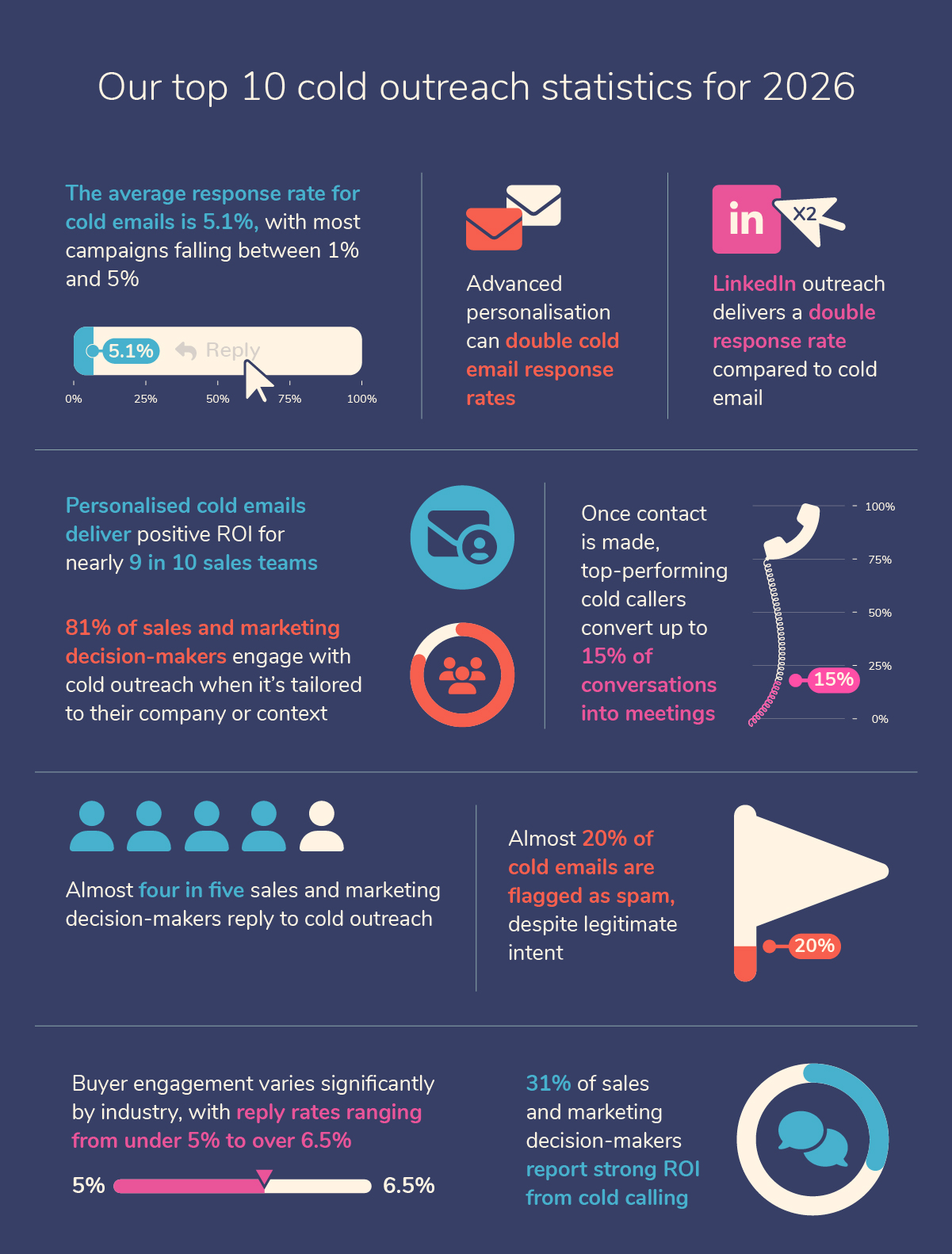
- The average response rate for cold emails is 5.1%, with most campaigns falling between 1% and 5%. → Read more
- Advanced personalisation can double cold email response rates. → Read more
- LinkedIn outreach delivers a double response rate compared to cold email. → Read more
- Personalised cold emails deliver positive ROI for nearly 9 in 10 sales teams. → Read more
- Once contact is made, top-performing cold callers convert up to 15% of conversations into meetings. → Read more
- 81% of sales and marketing decision-makers engage with cold outreach when it’s tailored to their company or context. → Read more
- Almost four in five sales and marketing decision-makers reply to cold outreach. → Read more
- Almost 20% of cold emails are flagged as spam, despite legitimate intent. → Read more
- Buyer engagement varies significantly by industry, with reply rates ranging from under 5% to over 6.5%. → Read more
- 31% of sales and marketing decision-makers report strong ROI from cold calling. → Read more
Cold outreach statistics
1. The average response rate for cold emails is 5.1%
For teams running cold outreach at scale, this figure sets a realistic baseline for performance – highlighting that cold email success is measured in incremental gains rather than dramatic spikes, especially in high-value B2B sales cycles. Outreach teams should view this as a starting point for optimisation, not a ceiling.
2. Typical cold email response rates range from 1-5%
Most cold email campaigns operate within this range, depending on list quality, relevance, and execution. For sales development representatives (SDRs) and marketers, this highlights how small improvements in targeting or messaging can impact results. Falling consistently below this range often signals poor data or misaligned messaging.
3. A conversion rate above 2% is considered solid, while anything over 5% is exceptional for most B2B industries
Conversion rates reflect meaningful engagement, not just replies, making them a more accurate measure of outreach effectiveness. For cold outreach teams, hitting 2% consistently suggests strong alignment between message and market. Rates above 5% are typically the result of highly focused campaigns rather than broad outbound activity.
4. 38% of consumers prefer marketing communications via email
Despite growing inbox fatigue, email remains the most widely accepted channel for initial business contact. This preference explains why cold email continues to dominate outbound strategies, even as other channels gain traction.
5. 81% of emails are now opened on mobile devices
Cold outreach emails are increasingly read in short, distracted moments rather than at desks. This has direct implications for formatting, copy length, and call-to-action placement. Outreach messages that aren’t mobile-friendly risk being ignored before they’re even processed.
6. Subject lines with 6-10 words achieve the highest open rates
This highlights the importance of clarity over creativity in cold outreach. Subject lines need to communicate relevance quickly – you can’t rely on vague hooks – and short or overly long subject lines are more likely to be skipped.
7. Monday has the highest open rate among weekdays
Inbox engagement tends to peak early in the week as decision-makers reset priorities. For cold outreach teams, this suggests that timing outreach to align with natural workflow rhythms can improve visibility. However, it also means Monday inboxes are more competitive, increasing the importance of relevance.
While this is an interesting stat, at Sopro, we don’t believe open rates are an effective metric. Open rates don’t reflect human engagement – they’re skewed by factors such as bot activity, privacy protections, and pre-loading messages.
Because of this, we avoid optimising outbound email campaigns for open rates. Instead, we focus on positive responses, meetings booked and the meaningful conversations our emails spark.
Cold email response and conversion benchmarks
1. Cold email conversion rates typically range from 1-5%
This range reflects completed actions such as bookings or qualified replies, rather than surface-level engagement. For cold outreach teams, it provides a realistic framework for forecasting pipeline impact. Performance outside this range usually indicates either exceptional targeting or significant execution issues.
2. Even small improvements in conversion rates can have a significant impact on revenue
In B2B sales, marginal gains compound quickly through repeated outreach. A fractional improvement in conversion can translate into substantial pipeline growth over time. Basically, it’s optimisation, fine-tuning campaigns, not volume, that’s the primary lever for sustainable cold outreach success.
3. 26% of sales and marketing decision-makers always click links in cold outreach messages. This rises to over 30% for B2B decision makers
This shows that links in cold emails aren’t inherently avoided; once trust is established, they’re actively used.
It shows outreach teams that credibility signals, clear value framing, and safe linking practices are of the utmost importance – poorly framed links reduce trust, well-framed ones accelerate engagement.
4. 12% never click links in cold outreach emails
A segment of buyers will always avoid links, regardless of message quality. This highlights why outreach emails should remain understandable and valuable even without clicks. For cold outreach professionals, relying solely on click-throughs to measure success risks underestimating engagement.
5. 83% of sales and marketing decision-makers will Google the company before clicking links in cold outreach messages
Cold outreach rarely stands alone; it triggers secondary research. This has major implications for brand presence, messaging consistency, and website clarity. Outreach teams are not just sending emails; they’re initiating a wider evaluation process.
Explore what works and what doesn’t in our guide to mastering B2B cold emails.
Cold email subject line statistics
1. Over two-thirds (69%) of sales and marketing decision-makers are more likely to open a cold business email if it includes a question
Questions signal relevance and invite dialogue rather than pitching. For outreach professionals, this highlights a shift in framing, from statements to conversation starters. Subject lines that imply value exchange outperform those that announce intent.
2. Shocking or alarmist subject lines are least likely to be read, with 32% saying they would ignore or delete these emails
Aggressive tactics actively reduce engagement. Just because something grabs attention, it doesn’t make it effective. If your outreach team’s relying on urgency or fear-based framing, you risk damaging trust before the message is even opened.
We analysed four million emails to find the best email subject lines for prospecting.
Cold email personalisation statistics
1. Over 57% of sales and marketing decision-makers believe most sales outreach feels impersonal and irrelevant
This stat explains much of the negative sentiment around cold outreach. It’s not the channel that fails, but the lack of relevance.
Basically, if you’re doing daily outreach, generic messaging doesn’t cut it. In fact, it could be harming performance, not just making internal goals less achievable.
2. Advanced personalisation increases response rates to 18%, compared to 9% for generic emails
This gap demonstrates how strongly buyers respond to outreach that reflects genuine research and relevance. For outreach professionals, it highlights the diminishing returns of surface-level personalisation alone. Investing time in contextual messaging can double engagement without increasing send volume.
Don’t have the time to write personalised emails? Don’t worry. Our generative AI messaging tool uses purpose-built systems designed for B2B sales outreach.
3. Personalised cold emails generate a 32% higher response rate than non-personalised messages
Buyers increasingly expect outreach to reflect their role, industry, or challenges. In crowded inboxes, generic messaging can’t compete. So, if you’re under pressure to improve results, personalisation is your friend – offering the highest-impact opportunities.
4. 36% of consumers prefer longer, personalised cold emails
Conciseness matters, but relevance matters more. This suggests that cold outreach emails should focus on clarity and value rather than extreme brevity. Well-structured, relevant messages are more likely to be read than short but generic ones.
Hone your strategy, enrich your emails with data, and write messages that resonate with tips in our guide – Email Personalisation: Strategies, Tactics, and Expert Advice.
5. Personalised subject lines can increase open rates by up to 50%
The subject line sets the tone for the entire outreach experience. So, if your cold outreach team isn’t personalising subject lines and aligning them with message content, you could be losing out on leads. Generic subject lines increasingly fail to earn attention.
6. 89% of sales teams see a positive ROI when using personalisation in cold email campaigns
Personalisation isn’t just a best practice, it’s commercially proven. This stat supports continued investment in research, segmentation, and tooling to support personalised outreach. Teams that deprioritise personalisation risk falling behind competitors.
7. 51% use segment-based personalisation, while only 5% personalise every email
Despite strong performance data, advanced personalisation remains underused. This gap highlights a significant opportunity for teams willing to go beyond minimal effort. For many organisations, execution, not awareness, is the limiting factor.
We’re an award-winning B2B Cold Email Agency. To take your business further in 2026 and get your work in front of decision makers, book a call with one of our team, and let’s get started.
Cold email follow-up statistics
1. Most prospects reply to the second or third cold email, not the first
Initial outreach often arrives at inconvenient moments or is deprioritised. Follow-ups provide additional opportunities for visibility without requiring new prospects. Persistence is key for outreach teams, and if following up isn’t a part of your cold email strategy, it should be.
2. Recommended follow-up sequences include 2-4 follow-ups
This range balances consistency with respect for recipient tolerance. It gives outreach teams a framework to remain visible without becoming intrusive. Stopping after one attempt leaves significant engagement potential untapped.
3. Follow-up emails can increase reply rates by nearly 50%
This highlights how much opportunity is lost when outreach stops too early. For sales teams, it emphasises the idea that success often results from structured sequences rather than single messages.
4. 44% of recipients unsubscribe due to high email frequency
Persistence must be paired with restraint. Excessive follow-ups quickly undermine trust and brand perception. Outreach teams need to balance consistency with relevance to avoid damaging long-term deliverability.
Cold email deliverability and spam statistics
1. Ideal cold email deliverability rates sit between 95% and 98%
Deliverability determines whether outreach is even seen. For cold outreach teams, poor deliverability renders messaging, targeting, and personalisation irrelevant. Maintaining high deliverability is foundational to outbound performance.
2. Nearly 1 in 5 emails is flagged as spam
Inbox filtering continues to tighten, increasing the risk of legitimate outreach being blocked. This raises the stakes for compliance, list hygiene, and sending practices. Outreach teams must treat deliverability as an ongoing operational concern.
3. Spam complaint rates should stay below 0.1%
Even small increases in complaints can trigger long-term deliverability issues. For teams that regularly send cold outreach, this highlights the importance of relevance and consent-friendly practices. Short-term gains from aggressive sending often lead to long-term losses.
4. Domain warming can improve email deliverability by up to 80%
Gradual ramp-up strategies protect sender reputation during new campaigns or domain launches. This is particularly important for teams scaling cold outreach activity. Skipping this step can severely limit inbox placement.
5. 49% of all emails sent each day are spam
Inbox saturation is structural, not temporary. For outreach professionals, this shows us why relevance and trust signals are essential for standing out. Competing on volume alone is increasingly ineffective.
Stay on the right side of the email filters with our guide to the difference between cold email and spam.
Cold calling statistics
1. Nearly a third (31%) of sales and marketing decision-makers report excellent or very good ROI from cold calling
Despite criticism, cold calling continues to deliver measurable returns for many organisations. This suggests that success depends heavily on execution rather than channel viability. For cold callers, it’s proof that preparation, targeting and follow-up can influence outcomes and add to pipelines.
2. Only about 2% of cold calls are successful across all attempts
Low contact rates significantly depress overall success figures. This reflects difficulty reaching decision-makers rather than outright rejection. For cold callers, it highlights the importance of data quality and timing.
3. A 4-5% conversation-to-meeting rate is considered solid, while top performers reach 15%
Once contact is made, outcomes improve substantially. This gap illustrates how preparation and messaging influence results. Skilled callers consistently outperform averages through research-led conversations.
4. Most regular cold callers see appointment conversion rates between 6% and 10%
Experience and repetition improve performance. This stat also suggests that cold calling is a skill, rather than a volume-driven activity. So, if your teams are cold calling, but you’re not investing in training, you could be losing out.
5. It takes an average of 18 calls to connect with a buyer
Contact attempts remain one of the biggest barriers to cold calling efficiency. This stat helps teams set realistic expectations and staffing models. Persistence is required simply to start a conversation.
6. Booking one qualified meeting often requires over 200 dials
This highlights the resource intensity of cold calling. For teams managing daily outreach targets, it highlights the need for prioritisation and accurate data. Poor list quality dramatically inflates effort, using up valuable resources.
7. 55% of high-growth companies find cold calling effective
Despite criticism, cold calling continues to play a role in successful sales strategies. This suggests effectiveness depends on execution rather than channel choice alone.
Explore the differences between cold calling and warm calling, and the pros and cons of each, in our guide.
Cold calling follow-up and timing benchmarks
1. 80% of sales require five or more follow-ups, yet most reps stop before reaching that point
The biggest performance gap in cold calling is persistence. Many opportunities are lost due to early abandonment rather than rejection. Outreach teams that maintain follow-up discipline consistently outperform peers.
2. Calls made between 4pm and 5pm are 71% more effective than midday calls
Buyer availability fluctuates throughout the day. Late afternoon calls often benefit from fewer meetings and greater focus. Timing optimisation can improve outcomes without increasing effort.
3. 96% of prospects research vendors before speaking to an SDR
Cold calls are rarely truly “cold”. Buyers expect informed conversations and quickly disengage from generic pitches. Preparation directly affects credibility and conversion.
LinkedIn and social outreach statistics
1. LinkedIn outreach delivers roughly double the response rate of cold email, around 10% vs 5%
Professional context reduces perceived risk and increases trust. For outreach teams, LinkedIn offers a complementary channel where relevance is visible before the first message is sent.
Want to maximise your use of LinkedIn? We’ve just the guide. Read How to Grow Your LinkedIn Network for Optimised B2B Outreach.
2. 42% say social media delivers the highest cold outreach response rates
Social platforms increasingly outperform traditional channels in engagement. This is proof that businesses need a multi-channel strategy. Your audience isn’t on one platform, so your team shouldn’t be either.
3. 35% report receiving their highest-quality leads from social platforms
Social outreach often delivers fewer but more engaged prospects. For teams focused on quality over volume, social channels are especially valuable.
4. Sales professionals using social selling are 51% more likely to hit quota
Relationship-led outreach translates directly into performance. This stat highlights how engagement-driven strategies outperform transactional approaches.
Find more insight in our guide – 62 LinkedIn Lead Generation Statistics.
Cold outreach statistics by industry
1. Reply rates vary significantly by industry, ranging from under 5% to over 6.5%
Industry saturation and buyer awareness heavily influence performance. Outreach teams should calibrate expectations and messaging accordingly rather than applying a one-size-fits-all approach.
2. The environmental sector records the highest open rates at nearly 48%
Lower outreach saturation creates greater visibility. Emerging or less-targeted industries often present stronger engagement opportunities.
3. Cybersecurity professionals show the lowest reply rates at 4.86%
High exposure to outreach and heightened risk awareness reduces responsiveness. Messaging in these sectors must be especially relevant to succeed.
4. Solar industry professionals combine high reply rates with low unsubscribe levels
This suggests relevance outweighs channel fatigue when outreach aligns with market demand. Targeting accuracy is critical.
Cold outreach performance and buyer attitudes
1. Buyer motivation, trust, and behaviour in cold outreach
19% of sales and marketing decision-makers in the UK and the US invest in sales outreach solutions due to legal and compliance challenges.
This highlights how regulatory complexity has become a real operational burden for outreach teams. For people running daily cold outreach, compliance is no longer a background concern; it directly influences tooling choices, processes, and risk tolerance. It also explains the growing demand for compliant, data-led outreach solutions rather than ad-hoc tactics.
2. 36% of sales and marketing decision-makers use cold outreach to discover new business solutions and service providers
Cold outreach is not purely an interruption; for many buyers, it’s an active discovery channel. This suggests that outreach messages are often evaluated through a research lens, not an immediate buying one. For outreach teams, it highlights the importance of positioning messages as informative rather than transactional.
3. 79% of sales and marketing decision-makers reply to cold outreach to ask questions or request more information
Responses are often exploratory rather than conversion-ready. For SDRs and sales teams, this means success should be measured by conversation quality rather than instant bookings. Outreach that invites dialogue performs better than outreach that pushes for immediate commitment.
4. 14% of sales and marketing decision-makers ignore cold outreach messages completely
Total rejection is far less common than often assumed. This suggests that most buyers are at least open to evaluating outreach when it’s relevant. For people doing daily cold outreach, the bigger risk is indifference, not hostility.
5. 57% believe most sales outreach feels impersonal and irrelevant
Buyer frustration is driven by poor execution, not outreach itself. Generic messaging undermines trust and damages brand perception – relevance is a primary contributor to success.
6. Over 80% engage with cold outreach when it’s tailored to their company or context
Personalisation directly influences willingness to engage. Outreach teams that invest in research are significantly more likely to earn responses.
Cold outreach technology and tools statistics
1. 73% of businesses use CRM software
CRM adoption underpins modern cold outreach operations. Visibility and structure are now expected rather than optional.
2. Companies using a CRM are 86% more likely to exceed sales targets
Process and data consistency affect outcomes. CRM usage correlates strongly with outreach effectiveness.
Make sure you’re using the right tools to boost efficiency and effectiveness with our guide to the 35 best B2B sales tools.
3. CRM systems save teams 5-10 hours per week
Automation reduces administrative overhead, freeing time for research and personalisation. Efficiency gains directly support better outreach quality.
4. 23% of daily cold callers use AI extensively, with another 49% using it occasionally
AI is increasingly used to support preparation and execution. It augments human effort rather than replacing it.
5. 83% of sales teams using AI report revenue growth
Technology now plays a measurable role in scaling effective cold outreach. Teams that ignore it risk falling behind operationally.
Explore 75 statistics about AI in sales and marketing to see how AI is transforming selling.
Expert Q&A on B2B cold outreach

What are the top cold outreach benchmarks for 2026?
Benchmarks always depend on your industry, market and list quality, but there are some reliable guardrails for 2026.
For cold email:
- Genuine click-through rates – Bot activity and privacy protections skew open rates. Instead, look at how many people are clicking your links and booking meetings.
- Reply rate – Sopro data shows an average response rate of around 5% for well-executed campaigns. Anything above that usually reflects strong relevance and clean data rather than luck.
Conversion to meeting/opportunity: 2%+ is solid, 5%+ is exceptional in most B2B settings.
For cold calling:
- Connect rate – It can take 15-20 dials to reach a decision-maker – that’s normal, not a failure.
- Conversation-to-meeting – Around 4-5% is healthy; top performers reach 10-15% according to research from Sopro.
- Overall “success” rate – Across all attempts, only about 2% of cold calls result in a positive outcome, which is why persistence and data quality matter so much.
For LinkedIn and social outreach:
- Reply rate – Sopro data shows LinkedIn DMs can achieve ~10% reply rates, roughly double a typical cold email campaign.
- Lead quality – A significant share of decision makers say social delivers some of their highest-quality leads, even if volume is lower.
If you’re comfortably within these ranges, you’re doing fine. The real gains come from moving a low-performing channel towards benchmark – and then using relevance and timing to push just above it.
How does buyer intent data improve cold outreach?
For people running outreach day in, day out, this matters in three ways:
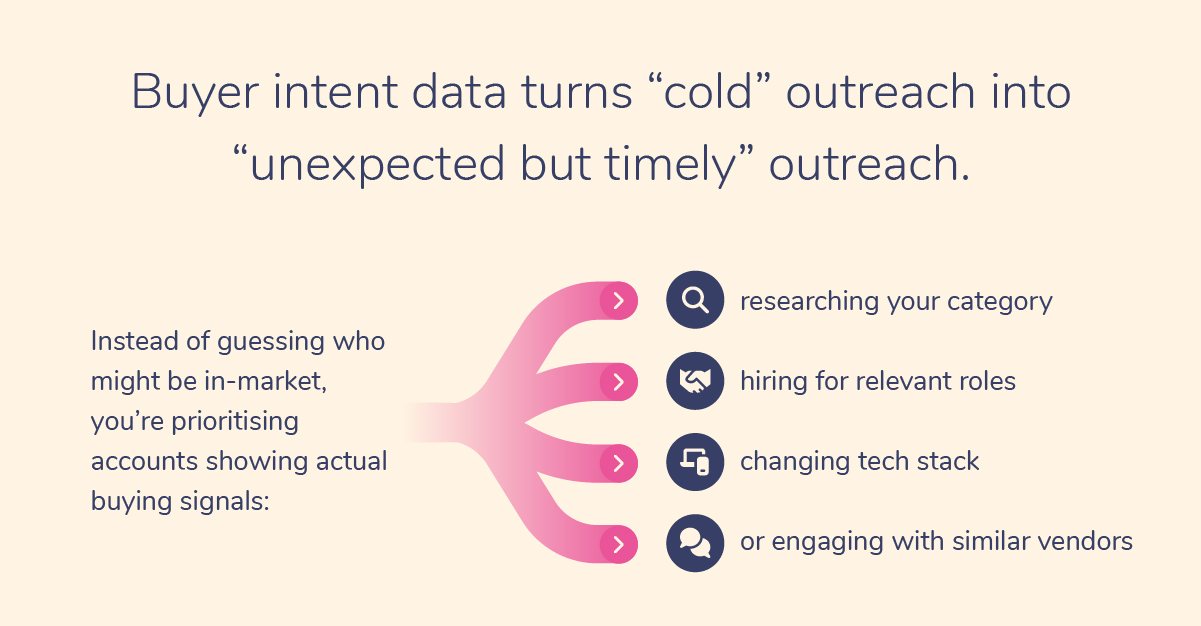
- Higher hit rate – You’re spending more time on prospects who are already leaning in your direction. That lifts reply and conversion rates without increasing send volume.
- Sharper messaging – If you know what content they’ve engaged with, or which pain points they’re exploring, your first touch can skip the generic value prop and jump straight to something specific. That kind of relevance is exactly what Sopro data shows buyers respond to.
- Less fatigue, fewer complaints – When outreach is aligned with real intent, it feels helpful rather than intrusive. That means fewer “please remove me” replies, fewer spam complaints, and better long-term deliverability.
In practical terms, intent data helps SDRs prioritise their day: who to call first, who to follow up, and who to park. It replaces “spray and pray” with “right person, right moment, right message”.
Which multi-channel strategies boost cold email replies?
The simplest answer: stop treating email as a solo act and start treating it as the centre of a small ensemble.
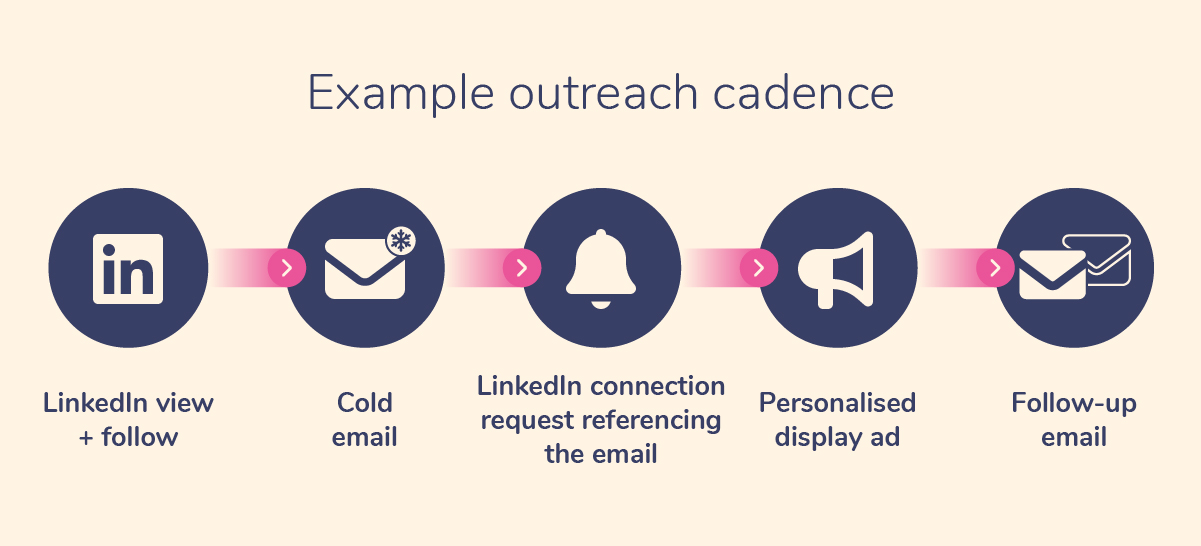
Each touchpoint builds familiarity, so buyers are more aware of your brand and more inclined to trust you when they do decide to engage. The goal isn’t to hammer every channel, but to create a sequence of natural-feeling touchpoints that increase the chances of the prospect seeing and responding to your message when the time’s right.
There’s no single multichannel template that works for everyone. The best sequences flex based on what the prospect does next. Clicks, connection requests, replies, and silence should all trigger different next steps, so your outreach feels more like a tailored journey than a rigid script.
Sopro data shows that most replies arrive after the second or third touch, not the first – multi-channel outreach just gives you better ways to stack those touchpoints.
A few principles that make a real difference for people doing outreach all day:
- Same narrative, different wording: Keep the core message consistent across channels, but don’t copy-paste. What works in a subject line won’t land the same way in a LinkedIn DM or voicemail.
- Reference previous touchpoints: “I dropped you a note yesterday” or “following up on my LinkedIn message” makes each interaction feel like part of a coherent conversation rather than random noise.
- Let prospects choose their channel: Some will reply via email, others via LinkedIn, others on the phone. Make it easy to respond wherever they’re most comfortable.
Done well, multi-channel doesn’t mean “more spam” – it means more context and more chances to be remembered when the timing is finally right.
Why has hyper-personalisation become essential?
Because the baseline has shifted. Generic outreach used to be annoying but tolerated. Now, with inboxes full of AI-written emails and cookie-cutter LinkedIn messages, generic outreach isn’t just ignored – it actively damages trust.
According to research from Sopro, over 57% of decision makers say most sales outreach feels impersonal and irrelevant, yet 81% will engage when it’s tailored to their company or context. That’s the entire argument for hyper-personalisation in two numbers. Buyers aren’t against being contacted – they’re against being treated like a line in a spreadsheet.
For people doing cold outreach for a living, hyper-personalisation changes the job:
- You spend more time on research and segmentation and less on sheer volume.
- Your first message shows you understand their world, not just your product.
- You’re competing on insight and relevance, rather than subject-line tricks or aggressive cadences.
Across email, phone, and social channels, the same patterns emerge. Generic, high-volume tactics underperform. Personalised, well-timed outreach supported by strong data and disciplined follow-up consistently delivers results.
For teams willing to adapt, cold outreach remains one of the most scalable ways to start meaningful B2B conversations, and the statistics make one thing clear: it’s not the channel that determines success, but how it’s used.
Methodology and sources
Sopro is an award-winning B2B lead generation agency with decades of expertise across a wide range of sectors. Proprietary research for the 2026 State of Prospecting report has been compiled with data and insights from other sources to form a comprehensive collection of cold outreach statistics.
Sources
https://www.emailtooltester.com/en/blog/cold-email-statistics/
https://www.emailtooltester.com/en/blog/spam-statistics/
https://woodpecker.co/blog/cold-email-statistics/
https://www.infraforge.ai/blog/cold-email-not-delivering-fix-these-6-issues
https://www.mailforge.ai/blog/average-cold-email-response-rates-2025
https://assets.mailshake.com/wp-content/uploads/2025/04/16091740/Cold-Email-Report-2025-Mailshake.pdf
https://profitoutreach.app/blog/sales-follow-up-statistics/
https://7292705.fs1.hubspotusercontent-na1.net/hubfs/7292705/Download%20Marketing%20Files/Cold%20outreach%20benchmarks%202025-%20The%20Belkins%20and%20friends%20report.pdf
https://expandi.io/blog/state-of-li-outreach-h1-2025/
https://jobera.com/cold-call-statistics/
https://instantly.ai/blog/the-truth-about-b2b-cold-calling-in-2025-statistics-and-success-rates/
https://blog.hubspot.com/sales/hubspot-sales-strategy-report
https://www.hubspot.com/hubfs/HubSpots%202024%20Sales%20Trends%20Report.pdf
https://blog.hubspot.com/sales/sales-statistics
https://www.salesforce.com/content/dam/web/en_gb/www/pdf/state-of-sales-sixth-edition.pdf
https://salesso.com/blog/sales-technology-statistics/
https://www.kixie.com/sales-blog/crm-statistics-and-market-insights-for-2025/
https://business.linkedin.com/sales-solutions/social-selling




Share