75 statistics about AI in B2B sales and marketing

Summarise this article with:


In this guide
- Top 10 statistics about AI in sales and marketing
- AI in business statistics
- AI in sales: Statistics and trends
- AI in marketing: Statistics and trends
- The benefits of AI in sales and marketing
- AI automation trends in business
- Barriers to AI adoption in sales and marketing
- Sentiment about AI in sales and marketing: What do consumers think?
- AI as the future of sales and marketing: Expert insights
- Sources
Love it or loathe it, one thing is for sure: AI is transforming the world of sales and marketing faster than any tech or tool before it. Once a shiny new toy for sales reps and marketing executives, it’s now a fundamental part of any high-performing team.
And believe us when we say this, because we’re speaking from experience. As an award-winning B2B lead generation agency, the Sopro team knows a thing or two about leveraging the latest AI technologies to improve operational efficiency and deliver ever-better results for our clients.
Here, we bring the need-to-know insights about AI in sales and marketing into the spotlight. We explore who’s investing in what, where the biggest adopters of AI tools are based, how customer perceptions of AI are shifting, and more…all to help your business make more informed decisions about how to adapt in Generation AI.
Top 10 statistics about AI in sales and marketing
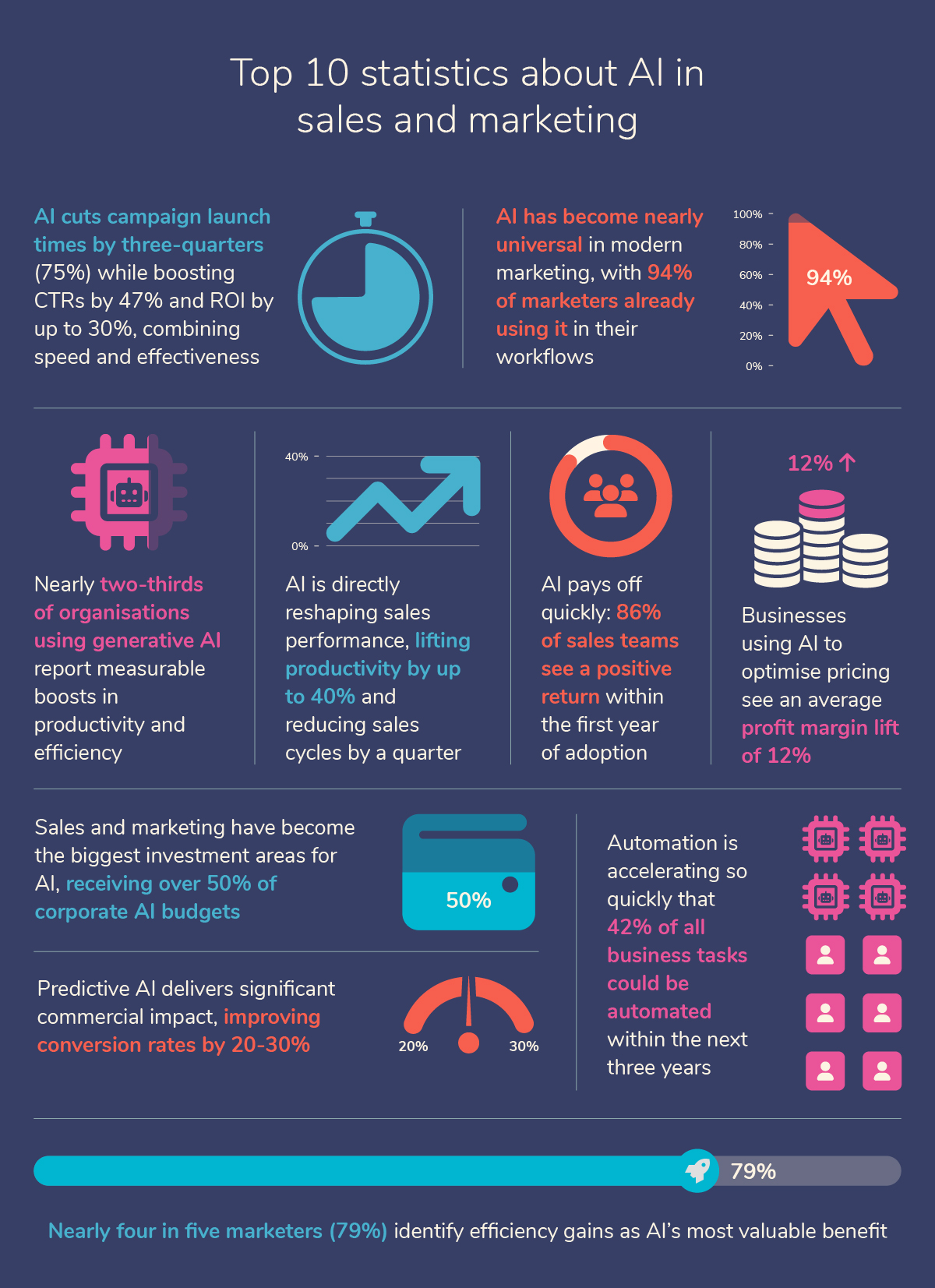
- AI cuts campaign launch times by three-quarters (75%) while boosting CTRs by 47% and ROI by up to 30%, combining speed and effectiveness → Read more
- AI has become nearly universal in modern marketing, with 94% of marketers already using it in their workflows → Read more
- Nearly two-thirds of organisations using generative AI report measurable boosts in productivity and efficiency → Read more
- AI is directly reshaping sales performance, lifting productivity by up to 40% and reducing sales cycles by a quarter → Read more
- AI pays off quickly: 86% of sales teams see a positive return within the first year of adoption → Read more
- Businesses using AI to optimise pricing see an average profit margin lift of 12% → Read more
- Sales and marketing have become the biggest investment areas for AI, receiving over 50% of corporate AI budgets → Read more
- Predictive AI delivers significant commercial impact, improving conversion rates by 20-30% → Read more
- Nearly four in five marketers (79%) identify efficiency gains as AI’s most valuable benefit → Read more
- Automation is accelerating so quickly that 42% of all business tasks could be automated within the next three years → Read more
AI in business statistics
Once the plaything of tech companies and Silicon Valley start-ups, artificial intelligence is now one of the most powerful forces shaping business operations globally.
Automation, analytics, forecasting, content creation, customer experience (CX), and more…across so many functions, AI has become an indispensable tool for businesses seeking to increase efficiency and scale smartly.
Here, we explore the stats that show just how widespread the uptake of AI is, and how usage trends are already evolving across sectors.
1. Out of 359 million companies worldwide, 280 million use AI in at least one business function
AI is now embedded across global business operations at an unprecedented scale. Of the 359 million companies operating worldwide, an estimated 280 million use AI in at least one function.
This adoption illustrates how deeply AI has evolved from an emerging technology to a business infrastructure. From automating repetitive tasks to supporting high-value decision-making, AI has become a foundational layer that bolsters modern operations.
For sales and marketing teams, this level of market penetration matters. When the majority of businesses are AI-enabled, traditional outreach risks falling behind. AI is raising the baseline for speed, efficiency, and customer experience, meaning the brands that don’t integrate it may struggle to compete.
2. 45% of organisations use AI in three or more business functions, while 63% use it in at least two
AI adoption spans multiple business functions. Nearly half of organisations (45%) now use AI across three or more core business areas, while almost two-thirds (63%) rely on it in at least two.
This depth of adoption demonstrates that AI isn’t a single-use tool. Businesses are leveraging AI capabilities across various departments, including marketing, sales, finance, operations, product development, customer service, and more. This often means improved speed, accuracy, and operational efficiency.
For commercial teams, this means buyer expectations are shifting fast. The companies you’re selling to are increasingly AI-enabled, operating with richer data, faster decision cycles, and more automated workflows. Sales and marketing strategies now need to meet those standards.
3. 88% report regular AI use in at least one business function, compared with 78% a year ago
AI usage is undeniably increasing. This year, 88% of businesses report using AI regularly in at least one function, up from 78% just 12 months earlier.
This jump in just one year reflects that the market is evolving at pace. Businesses are moving past AI testing and integrating it into daily workflows, processes, and decision-making.
For marketers and sales teams, this acceleration means:
- Your competitors are rapidly building AI-enhanced capabilities.
- Your buyers are increasingly comfortable interacting with AI-powered experiences.
In other words, AI maturity is no longer a way to stand out. The advantage now lies in how you use AI, not whether you use it at all.
4. Around 89% of small businesses use AI tools for everyday tasks like writing emails, creating marketing content, and analysing data
AI isn’t just a big-enterprise trend. Small businesses are now some of the fastest adopters, with 89% using AI for everyday workflows, leaning on it for tasks like drafting emails, creating content, and analysing data.
This is a major shift. While small businesses have traditionally lagged behind in adopting new technologies due to budget and resource constraints, AI flips that dynamic by offering instant productivity gains with minimal cost and setup.
For B2B marketers and sales professionals, this democratisation of AI is important. Small businesses now operate with efficiency levels that were previously only feasible for large teams. That means outreach needs to be smarter, more personalised, and more value-driven, since the bar for quality has risen everywhere.
5. In 2024, U.S. private AI investment grew to $109.1 billion, nearly 12× China’s $9.3 billion and 24× the U.K.’s $4.5 billion
The U.S. is leading global AI investment by an extraordinary margin. Private investment hit $109.1 billion in 2024, which is almost 12 times China’s $9.3 billion and 24 times the U.K.’s $4.5 billion.
This level of investment signals long-term commitment. It reflects a belief that AI will continue to reshape productivity, automation, and business performance for decades to come.
For sales and marketing leaders, this means that U.S.-driven advancements will increasingly shape the tools, platforms, and innovations you rely on. The pace of AI product development, particularly in IT, SaaS, CRM, data, and automation, is accelerating rapidly.
6. Generative AI attracted $33.9 billion in private investment globally in 2024, an 18.7% increase year-on-year
Generative AI continues to dominate AI funding, securing $33.9 billion in global private investment last year (an 18.7% year-on-year increase).
This persistent momentum shows that ops leaders now view generative models as essential infrastructure for future business success. And for B2B teams, it reinforces that generative AI isn’t a trend to dip into when convenient. It’s becoming a core driver of commercial performance, especially in marketing, outreach, and revenue operations.
7. Over the next three years, 92% of companies plan to increase AI investments
The next phase of AI adoption will be one defined by growth, not consolidation. A massive 92% of companies plan to increase their AI investments over the next three years.
This sustained commitment indicates that AI is being treated as a long-term strategic asset, not a temporary experiment. Businesses expect ongoing returns in efficiency, automation, and customer engagement.
For sales and marketing leaders, this signals a primary challenge will be staying ahead of the curve. As AI budgets increase, so will the sophistication of sales processes, creative output, and buyer experiences.
8. The 2030 projected AI market size is $82.23 billion (25% CAGR)
The AI market is scaling rapidly. Valued at $20.44 billion in 2024, it’s projected to reach $82.23 billion by 2030, representing a compound annual growth rate of 25%.
This trajectory reflects the expanding role of AI across industries and functions, particularly in revenue-generating areas such as sales, marketing, and customer experience.
For commercial teams, this growth means continuous innovation. New tools, models, and capabilities will reshape how teams build pipelines, personalise campaigns, and automate manual workload.
9. Asia-Pacific is the fastest-growing AI market
While North America leads in investment, the Asia-Pacific region is the fastest-growing for AI adoption, deployment, and innovation.
This rapid expansion reflects both economic growth and widespread digital transformation across APAC markets. Businesses in this region are adopting AI aggressively across finance, retail, logistics, and manufacturing, often leapfrogging legacy systems entirely.
APAC’s growing AI maturity will influence competitive dynamics, buyer expectations, and regional market opportunities.
10. Across all use cases, 57-68% of businesses increased AI investment last year
In the past year alone, between 57% and 68% of businesses increased their AI investment across key use cases, including automation and analytics, as well as customer engagement and content generation.
This signals both confidence and urgency. Organisations are not waiting when it comes to AI use. Instead, they are doubling down to extend efficiencies, scale operations, and gain a competitive advantage.
11. 64-68% of businesses expect further AI investment growth within 12 months
Looking ahead, 64-68% of organisations expect to increase their AI investment again within the next year.
AI spending is becoming an annual expectation, much like cloud or cybersecurity spending was a decade ago. The clear message is that AI will continue to absorb a larger share of operational and marketing budgets.
For revenue teams, this indicates that AI-powered capabilities, such as predictive lead scoring, automated outreach, and high-quality content generation, will continue to accelerate.
12. C-level and senior leaders show the strongest AI investment, at 73-82%
AI investment is being driven from the top. Between 73% and 82% of C-suite executives and senior leaders report that they are increasing their spending on AI.
This top-down support is crucial. It accelerates adoption, removes organisational barriers, and ensures AI becomes strategically aligned with commercial goals, not siloed within individual departments.
For sales and marketing leaders, leadership-level buy-in means AI transformation will continue to influence budgets, hiring, and performance expectations across revenue teams.
AI in sales: Statistics and trends
AI is being used as a practical tool in sales, transforming how teams prospect, engage, and close deals. By automating repetitive tasks and generating actionable insights, AI is helping sales professionals work smarter, focus on high-value activities, and deliver measurable results.
1. 57% of businesses increased AI investment in prospecting and personalisation in the past 12 months
Prospecting and personalisation are now two of the biggest beneficiaries of AI investment. Over half of businesses (57%) have increased spending on AI tools specifically for these activities in the past year.
This signals a major shift in where businesses believe AI delivers real value. AI-driven prospecting enhances targeting accuracy, data enrichment, and lead quality. At the same time, personalisation tools enable sales teams to tailor messaging at scale, a process that previously required significant time and manual effort.
For B2B organisations, this investment trend highlights a clear competitive pressure. Teams that don’t use AI in the earliest stages of the sales process risk slower pipeline growth and less relevant outreach.
2. Only 12% of companies don’t use AI for prospecting, signalling near-universal adoption
AI-powered prospecting has become almost universal in B2B sales. Just 12% of companies say they don’t use AI for prospecting.
This widespread usage indicates that AI has become a baseline expectation in lead sourcing. Organisations now rely on AI to identify intent signals, surface ideal accounts, enrich contact data, and prioritise the most sales-ready leads.
For teams still operating without AI support, the competitive disadvantage is severe. Your competitors are prospecting faster, smarter, and more efficiently.
3. Marketing (64%) and sales (61%) reported the sharpest increases in AI spending
No departments are adopting AI more aggressively than marketing and sales. Marketing teams saw the most significant increase in AI spending at almost two-thirds (64%), closely followed by sales at 61%.
This reflects the growing role of AI in generating demand, nurturing prospects, enriching data, and converting leads.
As customer journeys become longer and more complex, revenue teams are leveraging AI to enhance every stage.
4. 58% of sales teams use AI to write outreach messages | 57% for prospect research | 56% for data quality
AI is transforming the day-to-day work of sales representatives, and we have the data to prove it.
Sales teams now use AI for:
- Writing outreach messages: 58%
- Prospect research: 57%
- Improving data quality: 56%
These are among the most time-consuming sales tasks, and AI is now handling a significant portion of this workload. The ability to generate personalised messaging, extract insights on prospects, and clean CRM data means sales teams can spend more energy on actual selling rather than admin.
This shift shows AI’s role as a workflow engine rather than a one-off tool.
5. 73% of sales pros say AI helps uncover insights they couldn’t find manually
Nearly three-quarters of sales professionals (73%) say AI uncovers insights they simply wouldn’t have found on their own.
These insights range from buying intent signals to behaviour patterns, market trends, competitive shifts, and even deal-risk indicators. AI is broadening what sales teams can know, and therefore how effectively they can sell.
This capability is especially valuable in B2B environments where visibility is often limited and decision-making happens behind closed doors.
6. Sales professionals save 2h 15m per day using AI, and 78% say it helps them focus on higher-value tasks
Aside from just improving accuracy, AI is giving salespeople their time back. On average, sales professionals save two hours and 15 minutes per day using AI.
With 78% of respondents stating that AI enables them to focus on higher-value, revenue-generating work, the impact on productivity is dramatic. Instead of spending hours writing emails, preparing call notes, or updating CRM fields, representatives can spend more time building relationships and closing deals.
These savings are realised across entire teams, effectively increasing headcount capacity without increasing overhead. Share that with your CFO!
7. 74% of sales professionals believe AI makes it easier for buyers to research products
AI is empowering buyers just as much as sales teams. Almost three-quarters of sales professionals (74%) say AI makes it easier for buyers to research products and solutions.
This means customers are entering conversations more informed, more prepared, and often further along in their decision-making process. Sales teams must therefore provide deeper insights, clearer differentiation, and faster responses to stay competitive.
AI-enhanced buyer journeys require AI-enhanced seller responses to improve cohesiveness.
8. 54% of sales teams report increased efficiency thanks to AI tools
More than half of sales teams (54%) say AI tools have directly increased their efficiency.
This improvement comes from smarter lead scoring, automated tasks, faster content creation, and more reliable data. Sales cycles shorten when teams can act on up-to-date insights quickly and remove friction from their daily workflows.
For sales leaders, efficiency gains such as these are often the first major ROI signal when rolling out AI.
9. 65% of businesses see AI as a key driver of revenue growth in sales
AI’s role in revenue generation is becoming undeniable. Sixty-five per cent of businesses now view AI as a key driver of sales growth.
Rather than being seen as a cost centre or experimental tool, AI is increasingly treated as a core component of revenue strategy. It helps sales teams identify better opportunities, personalise outreach, prioritise leads, and maintain pipeline momentum.
The clear takeaway is that AI is not only supporting revenue growth but also accelerating it.
10. 70% of top-performing sales teams use AI in their workflows
High-performing sales teams are often AI-enabled. Seventy per cent of top-performing teams integrate AI across their daily workflows.
This correlation reflects the operational value AI brings, from forecasting accuracy to outreach optimisation and automated qualification. The best-performing teams utilise AI to augment human skills, not replace them entirely.
If the top of the industry is all-in on AI, the rest of the market will undoubtedly follow.
11. 86% of AI-using sales teams report positive ROI within the first year
There’s no point in shying away from it; AI adoption delivers fast returns. In fact, a remarkable 86% of sales teams using AI report positive ROI within their first year.
This includes cost savings, increased pipeline, reduced admin time, higher win rates, and improved productivity. AI is one of the rare technologies that offers both immediate and long-term value.
For organisations considering investment, this stat removes the biggest barrier, which is uncertainty over payoff.
AI in marketing: Statistics and trends
AI has become one of the most transformative forces in modern marketing. From content creation to campaign optimisation, marketers are embedding AI across their workflows to scale production, improve performance, and refine targeting. These statistics highlight how widely AI has been adopted and how profoundly it is reshaping the marketing landscape.
1. North America leads the AI marketing market with 32.4% revenue share
North America currently dominates the global AI marketing landscape, accounting for nearly a third of the total market revenue (32.4%).
This leadership reflects the region’s advanced digital infrastructure, concentration of AI vendors, and strong adoption among enterprise marketing teams. The U.S., in particular, continues to fuel innovation in content generation, predictive analytics, and ad optimisation technologies.
For global B2B brands, this means the majority of cutting-edge marketing AI solutions, from generative models to marketing automation tools, are being developed, tested, and deployed in this region first.
2. 94% of marketers have adopted AI, leaving only 6% not yet using it
AI has become nearly universal in marketing practice. An overwhelming 94% of marketers now utilise AI in some form, leaving only 6% who have yet to adopt it.
This figure captures a dramatic shift. AI is no longer an optional experiment or future investment, but a core marketing capability. Marketers rely on AI to automate content workflows, enhance targeting, personalise customer experiences, and generate insights.
Any team not using AI today sits well outside market norms, facing increasing efficiency and output gaps.
3. 73% of marketing teams use generative AI in some capacity
Generative AI has rapidly become a staple for marketing teams. Almost three-quarters of teams (73%) now utilise generative AI for tasks such as content creation, ideation, editing, and creative production.
This adoption reflects the technology’s ability to remove production bottlenecks, support creative ideation, and significantly accelerate campaign execution. For marketers operating under pressure to produce more with fewer resources, generative AI is now indispensable.
Its influence spans email marketing, social content, marketing and advertising copy, video scripts, and beyond.
→ If you’re in the marketing or advertising game and want to dial your lead gen efforts up to ten, speak to Sopro. We’re an award-winning lead generation agency for marketing and advertising businesses, and can provide tailored, hands-on support to get your pipeline moving.
4. 70% of marketers expect AI to play a larger role in 2025
Forward-looking confidence in AI remains extremely high. Seventy per cent of marketers believe AI will play an even greater role in their work next year.
This expectation highlights marketing’s continued shift toward automation, data-driven decision-making, and creativity at scale. As AI becomes more capable, especially in areas like personalisation and content deployment, marketers are preparing for deeper integration across the entire marketing ecosystem.
5. 51% of digital marketers use AI tools to optimise content and SEO
More than half of digital marketers (51%) now use AI tools to support content optimisation and SEO.
This includes keyword research, content scoring, topical clustering, SERP analysis, and on-page optimisation. AI’s ability to process large datasets and extract opportunities makes it especially powerful for SEO teams facing competitive search landscapes.
The adoption trend makes it clear that AI-enhanced SEO is quickly becoming standard practice.
6. 85% of marketing professionals use AI tools for content creation, and 45% use AI for brainstorming ideas
Content production remains one of the top use cases for AI. More than eight in ten (85%) of marketing professionals use AI for content creation, and nearly half (45%) use it for brainstorming and ideation.
These tools help teams generate first drafts, refine messaging, expand content variations, and accelerate creative workflows. AI reduces the time between concept and publish, and makes it easier to maintain consistent quality across formats.
7. Nearly half (47%) use AI for campaign analysis, and 44% automate follow-ups and sequences
AI is reshaping campaign execution and performance measurement.
- 47% of marketers use AI for campaign analysis, turning complex datasets into actionable insights.
- 44% automate campaign follow-ups and sequences using AI-driven workflows.
These capabilities enhance speed and accuracy, enabling teams to identify what’s working, where budgets should be allocated, and how audiences are responding in real-time. Automation also ensures consistent follow-up, vital for nurturing leads and maintaining engagement across long buying journeys.
8. 62% of firms increased AI spend last year, and 68% plan further increases
AI marketing budgets continue to expand. Sixty-two per cent of firms increased their AI spending in the past year. Over two-thirds (68%) plan to increase it again in the next 12 months.
This continued investment reflects strong confidence in AI’s ROI across marketing functions. From automation to analytics, businesses are increasing their AI budgets rather than just maintaining them at current levels.
For marketing leaders, this upward trend suggests that AI is becoming a long-term strategic investment, rather than a temporary test.
9. C-level leaders (87%) are driving AI investment for content creation
Despite reservations about the quality of AI-generated content, senior leadership teams are still willing to invest in tools that help streamline production processes. In fact, 87% of C-level executives say they plan to invest more in AI-driven content tools.
This top-down endorsement accelerates adoption and ensures marketing teams have the support and resources needed to explore, test, and scale AI capabilities. It also shows that AI is seen as a revenue enabler, not simply an efficiency tool.
11. Just 11% of Sopro survey respondents don’t use AI for content generation, down from 13% the previous year
The number of marketers who don’t use AI for content generation is shrinking rapidly.
Only 11% report not using it, which is down from 13% the previous year.
This year-on-year decline demonstrates steady movement toward universal adoption. As AI content tools become more capable, accessible, and integrated into marketing platforms, resistance and hesitation continue to diminish.
The benefits of AI in sales and marketing
AI adoption in the sales and marketing industries is delivering measurable, transformative impact. From accelerating campaign production to enhancing forecasting accuracy and increasing conversion rates, AI is enabling commercial teams to work faster, smarter, and more strategically. These statistics show how AI is reshaping sales and marketing performance.
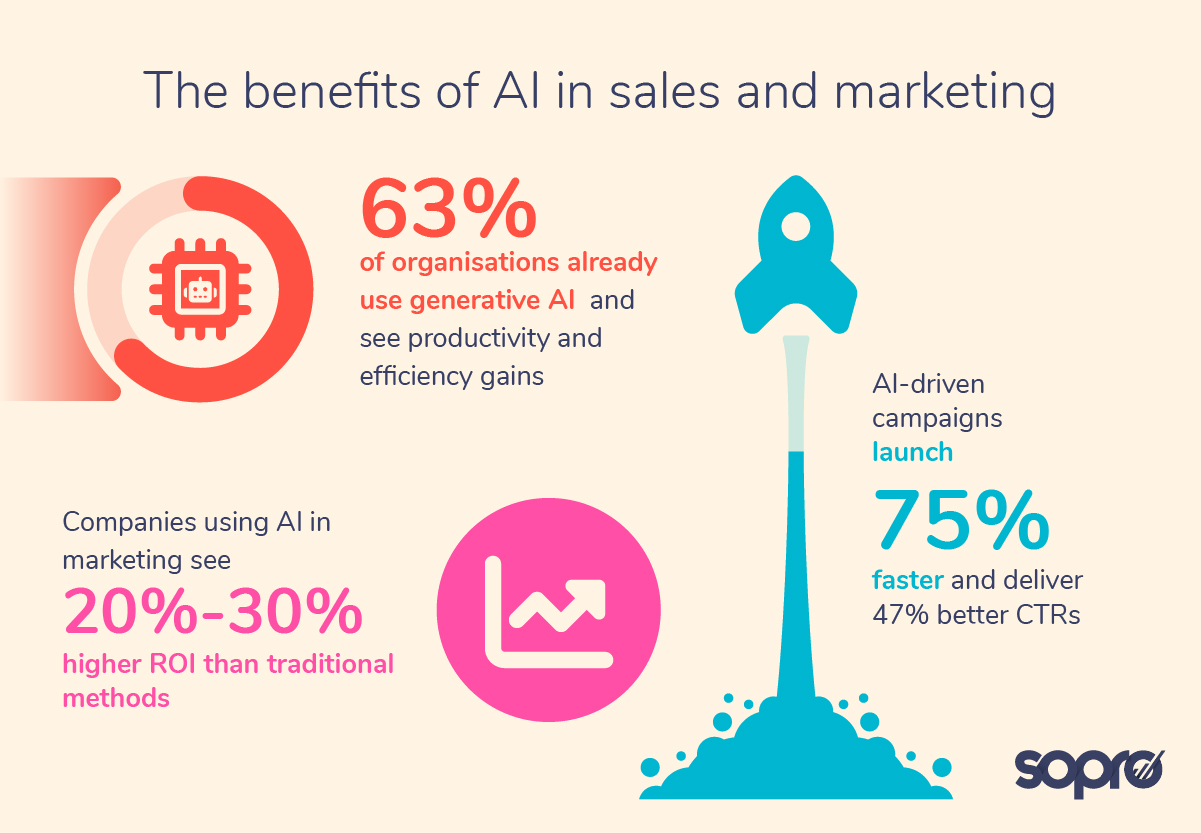
1. 63% of organisations already use generative AI and see productivity and efficiency gains
Generative AI is driving rapid improvements in output and operational efficiency.
Across all industries, 63% of organisations now use generative AI and report clear productivity gains as a direct result.
These tools streamline content creation, automate complex tasks, and accelerate workflows that once required significant time and expertise.
For sales and marketing teams, the benefits show up in faster campaign turnaround times, higher-quality messaging, and smoother cross-team collaboration.
GenAI is becoming one of the most immediate value drivers in commercial operations.
2. Companies using AI in marketing see 20-30% higher ROI than traditional methods
Marketing teams that adopt AI experience a significant performance uplift. Businesses that use AI-driven marketing report a 20-30% higher ROI compared to traditional approaches.
This improvement stems from better targeting, more relevant content, smarter budget allocation, and more consistent optimisation across campaigns. AI’s ability to analyse performance data in real time ensures teams can quickly target what’s working.
Higher ROI is becoming one of the strongest arguments for AI investment.
3. AI-driven campaigns launch 75% faster and deliver 47% better CTRs
AI dramatically accelerates campaign execution. Campaigns powered by AI launch 75% faster than those that do not use artificial intelligence and generate 47% better click-through rates.
This combination of speed and performance is reshaping expectations around campaign delivery. With AI assisting in content creation, audience targeting, A/B testing, and optimisation, marketers can scale campaigns without sacrificing quality.
It results in faster learning cycles and more effective outreach.
4. 82% of CMOs report increased confidence in forecasting due to AI
Forecasting is one of the most challenging aspects of marketing leadership, and AI is making it easier. Eighty-two per cent of CMOs say AI has increased their confidence in forecasting accuracy.
AI-enhanced forecasting models enable leaders to better anticipate demand, understand market trends, and allocate budgets more effectively. With more reliable predictions, CMOs can make faster, more strategic decisions.
This increased confidence is driving higher adoption among executives.
5. AI-driven pricing optimisation increases profit margins by 12%
Pricing optimisation is emerging as one of AI’s most commercially impactful uses.
Businesses that utilise AI for pricing see a 12% increase in profit margins.
By analysing customer behaviour, market conditions, and real-time demand, AI can recommend pricing strategies that maximise revenue without sacrificing competitiveness. For many B2B organisations, even minor pricing adjustments can mean significant profit gains.
6. 68% of sales reps say AI insights help them close deals faster
More than two-thirds (68%) of sales reps report that AI insights directly help them close deals faster, effectively enabling shorter sales cycles and increasing revenue per head.
These insights include buyer intent signals, recommended messaging, next-step suggestions, and risk indicators within open opportunities. By providing clarity at each stage of the sales cycle, AI reduces friction and supports smarter decision-making.
7. AI can increase sales productivity by up to 40% and reduce sales cycles by up to 25%
Sales teams that adopt AI report:
- Up to 40% increases in productivity
- Up to 25% reductions in sales cycle length
This efficiency comes from automated admin tasks, better lead prioritisation, improved forecasting, and smarter qualification. AI frees up representatives to focus on conversations that actually drive revenue, not the manual tasks that slow them down.
8. AI-enabled onboarding reduces sales training time by 50%
AI-enabled onboarding programmes reduce sales training time by 50%, demonstrating how improved performance isn’t the only benefit to AI in sales.
Using AI for personalised learning paths, simulated roleplays, content recommendations, and automated assessments helps new hires become productive far faster than traditional training models.
This is particularly valuable for fast-growing sales teams and industries with high churn rates.
9. Marketing teams deploying AI report 300% average ROI from revenue and cost savings
AI delivers strong returns in marketing, with teams that adopt AI reporting an average 300% ROI, accounting for both increased revenue and cost savings.
Automation, improved personalisation, better targeting, and faster production workflows help teams accomplish more with fewer resources. This performance uplift is driving rapid scaling of AI across digital marketing functions.
10. Conversion rates rise 20-30% when companies integrate predictive AI into marketing
Predictive AI is proving especially effective for improving conversions. Companies using predictive models, often for scoring, segmentation, or journey orchestration, report 20-30% higher conversion rates.
These gains come from better timing, more relevant messaging, and a deeper understanding of buyer behaviour. Predictive insights ensure campaigns reach the right people at the right time with the right offer.
11. 83% of marketers report higher productivity, and 84% say AI improves delivery speed
Marketers overwhelmingly feel the productivity impact of AI. 83% say AI has increased their productivity, while 84% say it has improved delivery speed.
Together, these benefits enable teams to move faster from idea to execution, which can be a critical advantage in competitive digital markets.
12. 69% of businesses agree that AI makes prospecting more effective for vendors
Prospecting is one of AI’s highest-impact use cases. Over two-thirds (69%) of businesses report that AI improves vendor prospecting, enabling suppliers to identify needs, tailor outreach, and engage buyers more effectively.
This matters especially in B2B sectors where buying cycles are long, and decision-makers are difficult to reach.
13. 63% agree AI improves relevance for buyers, rising to 84% among senior managers
AI isn’t just good for vendors; buyers feel the benefits too. Just under two-thirds (63%) believe AI-powered outreach is more relevant to their needs, and among senior managers, that figure rises to 84%.
This demonstrates that AI personalisation is resonating most with high-level decision-makers, which, for many, can be the hardest audience to engage.
14. AI-powered automation is narrowing the efficiency gap between SMEs and enterprises (66% vs 65%)
AI is levelling the playing field between small and larger businesses. Two-thirds of SMEs (66%) report efficiency improvements from AI, nearly identical to the 65% reported by enterprises.
This highlights one of AI’s most important impacts. It provides smaller teams with access to capabilities and efficiencies that were once exclusive to large organisations with substantial budgets.
For SMEs, AI is becoming a critical equaliser in the race for commercial growth.
AI automation trends in business
AI-driven automation is becoming increasingly crucial to modern business operations. From workflow management to personalisation engines and sales enablement, companies are increasingly using automation to reduce manual workload, streamline processes, and scale output. These statistics reveal the widespread deployment of automation and the measurable returns businesses are achieving as a result.
1. More than half of all corporate AI budgets go to sales and marketing automation
Sales and marketing functions receive the largest share of corporate AI investment. More than half of all AI budgets are now directed toward automation in these areas.
This reflects the strong ROI linked to automating outreach, personalisation, campaign workflows, and customer interactions. For commercial teams under pressure to deliver growth with fewer resources, AI automation has become one of the most valuable levers available.
The prioritisation of sales and marketing highlights automation’s role as a direct revenue enabler.
2. 61% of sales organisations use AI to automate repetitive tasks
A majority of sales teams (61%) now use AI to automate repetitive, admin-heavy tasks.
These tasks include CRM updates, data entry, meeting summarisation, qualification workflows, and follow-up reminders. By removing manual overhead, sales reps reclaim hours each week to focus on closing deals and nurturing relationships.
The result is leaner, more productive sales operations with fewer bottlenecks slowing pipeline momentum.
3. 71% of companies use or plan to adopt marketing automation | 49% specifically for personalisation
Marketing automation continues to scale rapidly. Nearly three-quarters (71%) of companies already use or plan to use marketing automation, and almost half (49%) deploy it specifically for personalisation.
Personalisation remains a top strategic priority, and AI-powered automation makes it possible at scale. Automated trigger journeys, dynamic content, and segmentation models ensure that customers receive relevant and timely engagement across all channels.
4. Marketing automation saves an average of 6 hours per week on routine tasks
Efficiency gains are one of the clearest benefits of automation. Marketing teams save an average of six hours per week thanks to automated workflows.
These time savings result from streamlining tasks such as email scheduling, content tagging, social publishing, campaign handovers, and reporting. For busy teams handling multiple campaigns simultaneously, this reduction in manual work directly boosts both productivity and creativity.
5. 79% of marketers say efficiency gains are the top AI benefit
Nearly four in five marketers (79%) identify efficiency gains as AI’s most valuable benefit.
This reflects a broader shift in how teams view AI automation, not just as a way to accelerate work, but as a way to operate with far fewer constraints. Faster workflows, automated decision-making, and reduced reliance on manual processes enable marketers to allocate more time to strategic and creative tasks.
6. Automated workflows reduce operational costs by 12.2% on average
AI automation is driving measurable financial efficiencies. On average, automated workflows reduce operational costs by 12.2%.
These savings come from reduced manual labour, decreased error rates, faster processing times, and streamlined cross-team operations. For larger organisations, even modest percentage reductions translate into significant budget impact.
7. Contact centre agents see 14% productivity increases from AI assistants
Customer service teams are also experiencing major gains from AI. Contact centre agents using AI assistants report a 14% increase in productivity.
AI-enabled tools handle tasks such as summarising calls, suggesting responses, automating ticket categorisation, and surfacing relevant knowledge. This enables agents to resolve issues more quickly and enhance customer satisfaction.
In high-volume support environments (call centres, customer service departments, etc.), small productivity increases like these scale rapidly across teams.
8. 42% of all business tasks are expected to be automated by 2027
Automation is poised to become even more pervasive in the years to come. Experts predict that 42% of all business tasks will be automated by 2027.
This includes everything from document processing and customer communication to analytics, forecasting, and operational workflows. As AI systems continue to improve, the scope of tasks suitable for automation expands dramatically.
Businesses that modernise early will gain a structural advantage in efficiency and scalability.
9. 60% of businesses automate lifecycle segmentation with AI models
Lifecycle segmentation is one of the fastest-growing uses of AI. Sixty per cent of companies now automate segmentation using AI-driven models.
These systems cluster customers based on behaviour, interests, and predictive indicators, enabling more targeted engagement across the buyer journey. Automated segmentation improves relevance, reduces wasted spend, and enhances campaign performance.
For marketing teams, it’s becoming a foundational capability for personalised, data-driven outreach.
Barriers to AI adoption in sales and marketing
Despite rapid adoption and clear commercial benefits, many organisations still struggle to implement AI effectively. Skills gaps, compliance challenges, unclear strategies, and hesitations around safety and data privacy all contribute to slower rollout. These statistics highlight the most common barriers preventing teams from realising AI’s full potential.
1. 39% of marketers aren’t sure how to safely use generative AI
Safety remains a major point of uncertainty. 39% of marketers say they don’t fully understand how to use generative AI safely.
Concerns span model reliability, data handling, copyright issues, and potential brand risk. Without clear guardrails and training, teams can feel hesitant to adopt tools that impact public-facing content and customer communication.
This uncertainty highlights the need for clarity, effective governance, and robust internal guidelines.
2. 43% of marketing professionals say they don’t know how to get the most value from AI
A lack of strategic understanding is also limiting adoption. 43% of marketers report they don’t know how to extract maximum value from AI tools.
This often stems from fragmented experimentation instead of coordinated, organisation-wide implementation. Without a clear plan, AI is underutilised or used inconsistently, leading to missed opportunities and weaker ROI.
3. 70% report their employer does not provide AI training
Training is one of the biggest gaps in AI adoption. A significant 70% of employees say their employer does not offer training related to AI.
Without structured onboarding, teams struggle to understand the capabilities of tools, interpret their outputs, and apply best practices. This results in slower adoption, inconsistent performance, and greater risk of misuse.
Training investment remains one of the most important, and also overlooked, enablers of successful AI deployment.
4. Data privacy is the top implementation concern (40%)
Data privacy is the leading barrier to AI implementation, with 40% of organisations identifying it as their top concern.
Marketers and sales teams handle sensitive customer data, making privacy risks especially prominent. Concerns about how AI systems store, process, and learn from this data often stall deployment or limit experimentation.
5. Lack of technical expertise affects 38% of organisations
Technical expertise gaps continue to be a significant challenge. 38% of organisations say they lack the skills needed to implement, scale, or maintain AI systems.
This shortage affects everything from data integration and model tuning to onboarding and ongoing optimisation. Without the right capabilities in-house, companies often rely on fragmented tools instead of fully integrated solutions.
6. Implementation cost is a barrier for 33%
Cost remains an obstacle, with a third of organisations (33%) citing implementation costs as a key barrier preventing wider AI adoption.
These costs include software licensing, data infrastructure, vendor support, and the internal time needed to deploy and manage new systems. While AI offers a strong ROI, upfront investment can still slow progress.
7. 62% say compliance slows AI deployment significantly
Regulatory and compliance requirements are affecting rollout speed. 62% of organisations say that compliance considerations significantly slow AI deployment.
This includes concerns regarding data protection laws, content regulations, industry-specific rules, and the increasing emphasis on responsible AI. Businesses want innovation, but not at the expense of compliance risk.
8. Only 27% of organisations review AI-generated content before use
Oversight processes are currently limited. Only 27% of organisations systematically review AI-generated content before publishing or using it.
This lack of quality control creates risks, including factual inaccuracies, brand inconsistencies, and compliance issues. It also highlights how quickly teams are adopting AI without first establishing governance practices. Human-involved AI processes are becoming increasingly critical.
9. Only 27% of employees have the right skills to support AI adoption
Skills shortages extend far beyond leadership teams. Only 27% of employees believe they possess the necessary capabilities to support AI adoption in their roles.
This includes skills in data literacy, prompt design, AI tool usage, model evaluation, and consideration of ethical implications. Without upskilling programmes, organisations struggle to scale AI usage.
10. Only 26% of office workers say AI is integrated into daily operations
AI is widely experimented with but rarely embedded. Only 26% of workers report that AI is fully integrated into their daily operations.
This gap indicates that many businesses remain stuck in a testing mode, with AI being used in isolated pockets rather than becoming an integral part of core workflows. Integration, not experimentation, is where the real operational value lies.
11. 43% of survey respondents cite a lack of clear AI strategy, and 42% cite shortage of skilled talent
Scalable AI adoption is held back, with 43% of survey respondents citing a lack of a clear AI strategy, and 42% admitting to shortages in skilled talent.
These challenges compound each other. Without a strategy, organisations adopt AI haphazardly. Without talent, they struggle to scale even promising early wins. Successful AI programmes require both vision and capability.
12. 79% say managing unstructured data remains a major obstacle
Unstructured data, including documents, messages, media, and transcripts, remains a significant issue. 79% of organisations say managing unstructured data is a major obstacle to AI adoption.
AI performance relies heavily on the quality and accessibility of data. When organisations lack the ability to clean, classify, and structure their data, AI models fail to deliver reliable insights. Managing unstructured data is becoming a critical priority for the next phase of AI maturity.
Sentiment about AI in sales and marketing: What do consumers think?
AI adoption is accelerating, but consumer sentiment is still complex. While many buyers appreciate the convenience and relevance that AI-powered experiences deliver, others express concern about trust, transparency, and the loss of human interaction. These statistics reveal how different demographics perceive AI and how marketers and sales teams are responding to it.
1. 41% of people under 34 have negative feelings about companies using AI in CX, compared to 72% of those over 65
Younger consumers tend to be more open to AI, but scepticism still exists. 41% of people under 34 have a negative view of businesses using AI in customer experience, a concern that rises sharply to 72% among people over 65.
This generational divide highlights the importance of tailoring AI deployment to audience expectations. Younger buyers are more accustomed to automation, while older consumers may view AI as impersonal or unreliable.
Businesses must strike a balance between efficiency and human authenticity to maintain trust across diverse demographics.
2. 69% of marketing professionals feel excited about AI’s impact on their jobs
Marketing professionals are largely optimistic. 69% say they feel excited about AI’s influence on their work, citing improved creativity, faster execution, and access to richer insights.
This enthusiasm reflects AI’s role as an enabler rather than a replacement, expanding what marketers can achieve rather than constraining them. However, excitement often coexists with long-term uncertainty.
3. 55% say AI improves customer experience and innovation
A majority of professionals believe AI is improving the quality of customer experiences.
55% say AI enhances both customer experience and overall innovation.
AI helps businesses deliver more relevant content, faster responses, and smoother interactions across channels. For consumers, this often translates into reduced friction and greater personalisation.
These benefits are driving increased experimentation across marketing and CX functions.
4. 90% prefer human customer service, but 80% who interact with AI chatbots report positive experiences
A striking gap exists between customer expectations and actual experiences. One in ten (90%) say they prefer human agents, yet 80% of those who use AI chatbots report positive experiences.
This suggests that resistance is often conceptual rather than experiential. Once customers interact with well-designed AI systems, especially those that handle simple tasks quickly, satisfaction levels rise significantly.
If you’re a marketer leading on AI chatbots, here’s our advice: ensure that any automated response technologies complement, not replace, human support.
5. 55% of marketers have high trust in AI-generated content
On the professional side, trust is growing. More than half (55%) of marketers report having high trust in content generated by AI tools.
Improvements in consistency, speed, and quality drive this trust. However, many teams still combine AI output with human editing to ensure accuracy and preserve brand voice. Hybrid workflows are still the dominant model when using AI.
6. 59.8% of marketers fear AI may jeopardise their jobs
Even with rising excitement, uncertainty persists. A staggering 59.8% of marketers fear that AI could pose a long-term threat to job security.
This fear reflects the rapid advances in automation and generative capabilities, particularly in content-intensive roles. For organisations, this highlights the need for clear communication, training, and responsible adoption strategies. AI anxiety is a real concern, and businesses must address it directly.
7. 70.6% believe AI can outperform humans in certain marketing tasks
A majority of marketers recognise AI’s strengths. 70.6% believe AI can outperform humans in specific marketing tasks, such as data analysis, A/B testing, segmentation, and personalisation.
Rather than viewing AI as a competitor, many see it as a specialised tool that excels in areas requiring speed, scale, or pattern recognition. Human creativity and strategic judgement remain essential, but AI extends what teams are capable of.
AI as the future of sales and marketing: Expert insights
Sopro’s team of sales and marketing experts share their on-the-ground insights on how artificial intelligence is rewriting the future of their trade, bringing improved access to automation, smoother workflows, and the great enabler of personalised outreach at scale.
1. AI is becoming the operating system for sales workflows
AI has become an integral part of the core engine behind modern sales activities. Instead of working across disconnected tools, sellers are increasingly operating inside conversational AI systems that handle research, admin, data enrichment, and first-draft writing.
AI-augmented sellers can now manage larger, cleaner books of business, maintain higher activity levels, and spend more time in live conversations. As buying groups grow and cycles lengthen, AI also supports multi-stakeholder mapping and coordinated, account-level touchpoints.
2. AI enables personalisation and human-led selling at scale
AI now enables personalisation at a large scale by generating tailored outreach, assessing sentiment signals, and analysing which message structures resonate. This allows teams to test, learn, and adapt rapidly across email, LinkedIn, and other channels.
However, performance still depends on human judgment.
Data shows that buyers react best to simple, low-effort, low-risk framing, rather than long explanations. AI provides scale, but humans provide nuance, interpretation, and meaningful conversation once a buyer engages.
3. Buyers are AI-literate and more self-directed
A large majority of B2B buyers now use generative AI during their purchasing process to compare vendors, test use cases, and build internal business cases.
Buying groups are larger, decisions are slower, and buyers often approach sales conversations with a preferred option already in mind. Sellers, therefore, must align outreach with a buyer who is informed, independent, and less reliant on early-stage education.
4. AI allows marketers to achieve better coverage and cleaner audiences
AI-driven systems now build and refresh Total Addressable Market (TAM) views, identify all relevant stakeholders inside target accounts, and score audiences to remove poor fits before outreach begins.
Teams that implement AI-driven targeting consistently see improved lead quality, stronger deliverability, and higher close-won rates because they target the right companies and the right people.
→ Fancy trying this for yourself. Explore your own TAM with Sopro’s AI-augmented Market Navigator tool. It’s free to use, and our experts will create a bespoke report tailored specifically to your business.
5. Producing AI-ready content is now more important for machine-mediated buyer journeys
As buyers now use AI tools to get answers, you must structure brand content for both human readers and machines. AI-powered search and assistants act as gatekeepers, surfacing the clearest and most authoritative content before users ever click through from results pages.
This favours brands that produce well-structured, evidence-backed writing with clear hierarchies and consistent messaging across channels. Performance data from outreach should also feed into content and campaign planning to ensure alignment.
6. We’ll see a shift from tool stacks to AI-driven revenue orchestration
The next stage of AI maturity is less about acquiring new tools and more about unifying channels, data, and teams. AI now integrates signals from multiple systems, recommends next-best actions, and paces outreach based on engagement and historical performance.
High-performing organisations create a single view of the audience across inbound and outbound channels, share data between sales and marketing, and utilise AI to coordinate timing and touchpoints.
7. Skills and confidence will continue to lag behind adoption rates
Despite high adoption, many commercial teams feel overwhelmed by the rapid evolution of AI tools. The majority of sellers want structured training and clear rules of engagement to integrate AI effectively into their workflows.
The most successful organisations adopt a hybrid model, where AI handles heavy lifting and operational consistency, while humans focus on judgement, trust-building, and closing complex deals.
Expert Q&A about AI in sales and marketing

How is AI impacting B2B sales and marketing?
AI is reshaping B2B sales and marketing from the ground up. It’s helping teams work smarter, not harder, by automating repetitive tasks, improving targeting accuracy, and supporting personalisation at a scale that was previously impossible.
Sales teams are using AI to prioritise the right leads, surface meaningful insights, and remove hours of manual admin from their day. Marketing teams are using it to create content faster, analyse campaigns more effectively, and deliver experiences that feel genuinely personalised.
At Sopro, we see AI as an accelerator. It amplifies the impact of strong strategy, data, and creativity, giving teams the tools to deliver more value, more consistently, without losing the human connections that drive B2B relationships.
Is AI good or bad for sales and marketing professionals?
rAI is good for salespeople and marketers…as long as it’s used responsibly.
AI is reducing production bottlenecks and freeing teams from repetitive tasks, allowing them to spend more time on strategy, creativity, and experimentation. It also helps marketers make better decisions with richer data, clearer insights, and faster feedback loops.
That said, it’s natural for people to feel cautious. Concerns around job impact, compliance, and content quality are real, and they need to be addressed with clear training and guardrails.
But AI isn’t here to take away what marketers do best. It’s here to streamline the work around the creativity, storytelling, and strategic thinking that only humans can deliver. When paired with human oversight, it can become a powerful extension of your marketing toolkit.
Where does AI best fit into a sales workflow?
oAI fits perfectly into the points of the sales workflow where time is wasted and insight matters.
For most teams, that includes:
- Prospecting: identifying the right accounts and enriching contact data
- Qualification: scoring leads based on intent, behaviour, and fit
- Outreach: drafting messages, summarising calls, and suggesting next steps
- Pipeline management: spotting deal risks and recommending actions
- Reporting: automating notes, CRM updates, and forecasting
None of these replaces the role of a salesperson. Instead, they enhance it. AI handles the manual work so reps can focus on relationships, including the conversations, the nuance, and the human trust-building that drives deals forward.
How is AI shaping personalisation in sales and marketing?
AI is redefining what personalisation means in B2B.
Instead of broad segments or generic messaging, AI can tailor content to individual prospects based on behaviour, industry, challenges, and intent signals. It helps brands speak directly to the needs of each buyer, without requiring teams to write every variation manually.
Ultimately, marketers can (and should) use AI to generate personalised content at scale. Sales teams, then, can use it to tailor outreach, identify the right follow-ups, and understand what each prospect cares about.
What are some of the biggest mistakes businesses make with AI?
The biggest mistakes often come from rushing ahead without a plan.
Some of the most common pitfalls include:
- Using AI without training teams properly
- Relying on AI to replace human judgement
- Skipping governance or quality checks
- Starting with complex use cases instead of simple wins
- Investing in too many tools with no clear strategy
AI succeeds when businesses treat it as a way to enable strategy. At Sopro, we encourage clients to start with focused use cases, build strong human processes, and scale responsibly. The companies that do this see the fastest ROI and the smoothest adoption.
Sources
- https://www.hostinger.com/tutorials/how-many-companies-use-ai
- https://www.mckinsey.com/capabilities/quantumblack/our-insights/the-state-of-ai
- https://hai.stanford.edu/ai-index/2025-ai-index-report
- https://www.mckinsey.com/capabilities/tech-and-ai/our-insights/superagency-in-the-workplace-empowering-people-to-unlock-ais-full-potential-at-work
- https://techkv.com/ai-in-marketing-statistics/
- https://www.grandviewresearch.com/industry-analysis/artificial-intelligence-marketing-market-report
- https://sopro.io/resources/whitepapers/the-state-of-prospecting-25/
- https://blog.hubspot.com/sales/hubspot-sales-strategy-report
- https://wifitalents.com/ai-in-the-sales-industry-statistics
- https://www.globenewswire.com/news-release/2025/05/07/3076257/28124/en/AI-for-Sales-and-Marketing-Market-Analysis-and-Global-Forecasts-Report-2025-2030-Convergence-of-AR-and-AI-Fuel-Opportunities-for-Immersive-Product-Demonstrations.html
- https://www.epsilon.com/us/insights/resources/the-state-of-ai-in-marketing
- https://www.demandgenreport.com/uncategorized/pulse-check-survey-how-are-b2b-marketing-teams-using-ai/48973
- https://www.surveymonkey.com/mp/ai-marketing-statistics
- https://www.primal.com.my/ai/marketing-statistics
- https://www.jasper.ai/blog/2025-ai-marketing-trends-insights-report
- https://salesso.com/blog/ai-marketing-statistics
- https://www.allaboutai.com/resources/ai-statistics/marketing
- https://sqmagazine.co.uk/ai-in-marketing-statistics
- https://coschedule.com/ai-marketing-statistics
- https://www.pwc.com/us/en/tech-effect/ai-analytics/responsible-ai-survey.html
- http://timesofindia.indiatimes.com/articleshow/123453071.cms
- https://www3.weforum.org/docs/WEF_Future_of_Jobs_2023.pdf
- https://www.salesforce.com/uk/news/stories/generative-ai-for-marketing-research
- https://www.mckinsey.com/featured-insights/artificial-intelligence/ai-adoption-advances-but-foundational-barriers-remain
- https://media-publications.bcg.com/The-Widening-AI-Value-Gap-October-2025.pdf
- https://www.surveymonkey.com/resources/premium/cx-and-ai-report
- https://influencermarketinghub.com/ai-marketing-benchmark-report




Share