65 B2B Marketing Trends & Statistics

Summarise this article with:



B2B marketing is in its complicated era. Budgets are under pressure, buying groups are larger, and buyers have more access to research than ever before.
The channels sellers rely on, like email, SEO, paid social and content, are being judged more closely on how well they influence the pipeline.
The result? B2B teams need to work harder to earn attention, build trust, and stay visible across longer buying journeys.
Sopro is a leading B2B demand generation agency, specialising in multi-channel outreach, including account-based engagement and email marketing services. To help you gain more of an understanding of what’s working (and what’s not), we compiled these B2B marketing trends and statistics, buyer behaviour insights and our experts’ predictions – helping you hone your strategy, guide your budget and sharpen your activity.
Our top 10 B2B marketing trends and statistics
- The average B2B buying decision now involves more than four people. → Read more
- More than 8 in 10 companies involve more than one person in purchase decisions. → Read more
- Nearly a third of B2B marketers say buyers are further along in their research before engaging with sales. → Read more
- More than 9 in 10 B2B buyers report using AI in their buying process. → Read more
- Over three-quarters of B2B marketers identify email as a top lead generation channel. → Read more
- 8 in 10 buyers are likely to engage with a brand that has relevant case studies or social proof. → Read more
- B2B customers are using twice as many interaction channels during the buying journey as they did 10 years ago. → Read more
- Less than a quarter of B2B teams coordinate across channels. → Read more
- AI-filtered audiences delivered 356% more closed deals. → Read more
- More than 8 in 10 B2B marketing decision-makers expect increased investment. → Read more
B2B buyer behaviour and journey trends
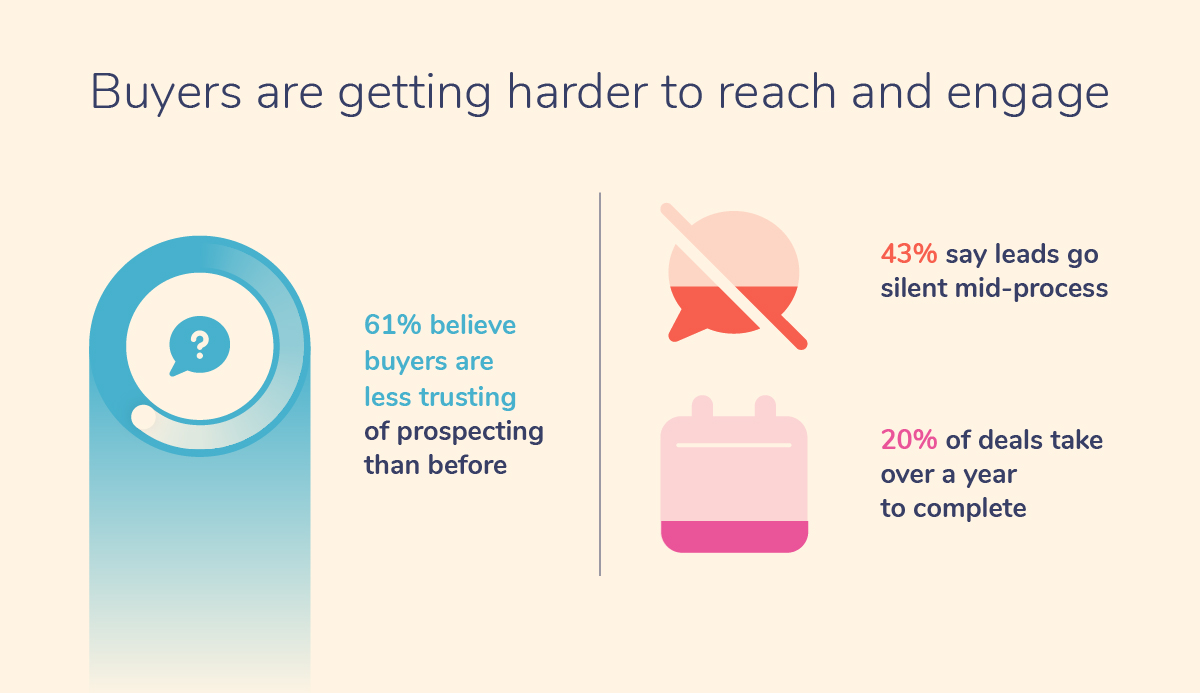
B2B buyers are taking their time – they’re doing more independent research, bringing more people into the decision, and asking for stronger proof before they commit.
This makes it harder for marketing teams, but it’s also a bigger opportunity to influence the journey before sales conversations begin.
1. The B2B buying decision now involves 4.05 people on average
Most B2B deals now need approval, input, or influence from several people. One person might care about commercial return, another about implementation, another about risk, and another about whether the solution will make their day-to-day work easier.
That means marketing needs to support more than one conversation. A strong campaign should help different stakeholders understand the value from their own point of view.
2. 84% of companies involve more than one person in purchase decisions
Only 16% say one person is responsible for deal decisions, while 18% report that six or more stakeholders are involved.
For marketers, this changes the way campaigns should be planned. A single persona may still matter, but it rarely tells the full story. The final decision may involve finance, operations, sales, marketing, procurement, leadership, and end users.
The brands that win are the ones that make it easy for internal champions to persuade everyone else.
3. 34% of sellers say deals involve more decision makers this year
This puts extra pressure on both sales and marketing. More decision-makers usually mean more objections, more internal discussion, and a greater chance the deal will stall.
Marketers can help by creating assets that answer common questions early, address different priorities, and provide sales teams with stronger materials to share throughout the process.
4. 31% say buyers are further through research before engaging with sales
Buyers are arriving later in the journey – by the time they speak to a sales rep, many have already searched, compared, read reviews, checked competitors, asked peers, and used AI tools to narrow their options.
That makes your website, content, search visibility, reviews, and brand reputation part of the sales process. Buyers are forming opinions long before they become visible in your CRM.
5. 61% believe buyers are less trusting of prospecting than before
Buyers are more aware of automation. They see more generic messages, and they’re quick to ignore outreach that feels irrelevant, lazy, or overfamiliar.
Prospecting still works, but weak prospecting has less room to hide. Relevance, timing, useful insight, and good data now matter far more than volume. Unlock the secrets to successfully targeting your prospects with our comprehensive guide to B2B sales outreach.
6. 59% say buyers have tighter budgets
Buyers may still have problems to solve, but they need a stronger case before spending money. That case often has to survive internal scrutiny, competing priorities, and finance approval.
Interestingly, this figure is down 6% from our 2025 State of Prospecting Report, but it’s still well over half of respondents who agree that buyers’ belts are tighter.
In light of this, marketers have to make value easier to understand. Stronger ROI messaging, clearer proof, and sharper commercial arguments are all part of that job.
7. 58% say there is more competition
For buyers, competition and lots of choice are healthy, but for sellers, more suppliers are competing for attention across search, email, social, paid media, review sites, and AI-led research journeys.
This statistic has increased by 13% compared to our previous State of Prospecting report, highlighting the shift in competition. As a result, marketers need to be more careful and considered, because a vague message won’t stand out for long (if at all). This is why positioning matters so much – buyers need to understand what you do, who you help, and why you’re different. And fast.
8. 44% say decision times are longer
Up 9% on our previous State of Prospecting report, these longer decision times change how marketing performance should be judged.
Some campaigns will create demand months before a buyer is ready to act. Some content will influence a deal without getting the final click. Some prospects will go quiet, then return later.
A short-term view can miss that influence. B2B marketing needs measurement that reflects the full buying journey.
9. 43% say leads go silent mid-process
Just because a lead’s gone quiet, it doesn’t mean you’ve lost them – they may be waiting for budget, speaking to other stakeholders, have hit an internal delay, or just not be ready at that moment.
This is where nurturing matters. Useful follow-up, retargeting, email sequences, thought leadership, and well-timed sales activity can pique interest and keep relationships alive without overwhelming the buyer.
10. 20% of deals take over a year to complete
One in five deals taking more than a year shows how patient B2B teams need to be.
This is especially relevant for high-value, complex, or multi-stakeholder purchases. The first touchpoint and the final decision may be separated by months of research, discussion, comparison, and delay.
Marketing still has work to do throughout that period. Staying useful over time can be the difference between staying in the conversation and being forgotten.
11. The average B2B buying cycle spans 3 to 11 months
A three-month journey needs strong conversion paths and fast access to proof. An 11-month journey needs a more patient mix of education, trust-building, and repeated engagement.
Purchases aren’t quick decisions, so it’s crucial that demand and lead generation work together. One creates and nurtures interest. The other helps capture it when the buyer is ready.
12. 94% of B2B buyers report using AI in their buying process
Buyers are using AI to summarise information, compare options, shape questions, and speed up research.
That means your content may directly influence buyers, but it may also influence the AI tools that help them make sense of the market. Clear, credible, well-structured content will play a bigger role in 2026.
B2B marketing trends by channel
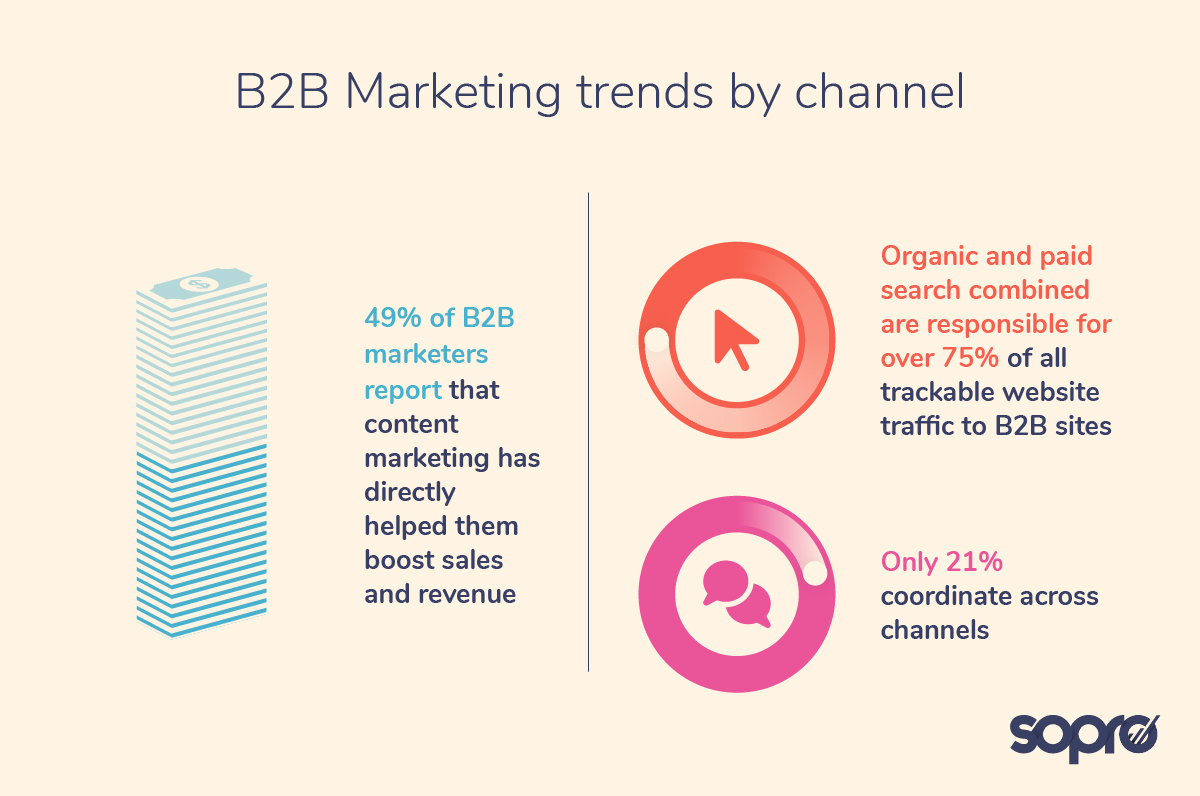
B2B digital marketing trends are moving in several directions at once – AI is changing SEO, email continues to lead the way, content is central to trust, and paid media is growing. And, as multi-channel marketing becomes the standard, personalisation and account-based engagement (ABE) services are evolving.
B2B email marketing trends and statistics
Email marketing gives teams a direct way to reach prospects, nurture leads, support sales, and create a pipeline. Buyers still respond to email, but only when the message earns its place in the inbox.
If this doesn’t scratch your email marketing-statistic itch, we’ve got plenty more where this came from. Check out these 43 email marketing statistics and trends for more.
1. 78% identify email as a top lead gen channel
Email continues to be one of the strongest B2B lead generation channels. Why? It’s direct – you don’t have to wait for a buyer to search, scroll, or click an ad. With the right data and targeting, you can reach the right people proactively.
The quality of the approach makes all the difference – in 2026, emails need to be relevant, researched and well-timed.
2. 67% agree that deliverability is a major barrier to success
Inbox placement has become a serious performance issue. A campaign can fail before the prospect sees it. Sender reputation, domain setup, data quality, message relevance, and sending behaviour all affect whether the email reaches the inbox.
Deliverability now needs to be treated as part of campaign strategy, not a technical afterthought.
Subject lines buyers are most likely to open
The subject line is the first part of an email prospects will see, so it needs to be impactful. Otherwise, your email will get lost in the pile with all the other ones people receive every day.
If you’re trying to improve your subject lines, check out our guide – we analysed over four million emails to find the subject lines for prospecting that really work.
3. 77% for an offer
In B2B, that offer might be a benchmark report, an audit, a consultation, an event, a template, an insight, or a practical resource. The strongest offers give the buyer a clear reason to care.
The subject line has one job: make the value obvious enough to open.
4. 71% for personalised name or company name
Basic personalisation still helps, but expectations have moved on. A name or company field can catch the eye. Real personalisation goes further. It shows the message is relevant to the buyer’s role, sector, challenge, or current business context.
5. 69% for a question
Questions create a small moment of reflection. A good question can prompt a buyer to reflect on a challenge they already recognise. That’s why question-led subject lines can work well in B2B email, especially when they are specific rather than vague.
“Struggling to convert more demo requests?” will usually beat “Quick question?”
6. 64% for intriguing or mystery
A little intrigue can make an email stand out, but the message still needs to deliver. If the subject line feels clever and the email feels empty, the buyer won’t thank you for the interruption. Remember: curiosity should lead to value, not disappointment.
7. 64% for topical, trend, or current affairs
Subject lines linked to market shifts, buyer behaviour, industry news, regulation, AI, budgets, or emerging trends can feel more relevant because they connect with what buyers are already thinking about.
8. 60% for time-sensitive or urgent
Urgency can drive action, but only when it is believable – buyers are used to false deadlines. In fact, 24% would ignore time-sensitive or urgent subject lines.
Use this tactic sparingly – if every message sounds urgent, the effect wears off quickly. Genuine time sensitivity, such as event deadlines, limited research windows, market changes, or budget planning periods, has more value.
9. 59% for humorous
A little humour can cut through a serious inbox, but it works best when it feels natural to the brand and audience. Forced jokes, gimmicks, or overfamiliar language can feel risky in B2B.
Humour doesn’t land with everyone, though – we also found that 16% would ignore humorous subject lines.
10. 47% for shocking or alarmist
Some buyers will open a message because it sounds dramatic. Others will see it as clickbait. For most B2B brands, credibility is more valuable than a short-lived open-rate spike, and a false alarm can damage trust.
Interestingly, our State of Prospecting 2026 also found that 32% would ignore shocking or alarmist subject lines.
B2B social media marketing trends and statistics
Social media has become a serious part of B2B marketing and for good reason – it supports brand awareness, thought leadership, demand generation, paid campaigns, employee advocacy, and buyer research. And for many prospects, a good social media presence can act as a key trust signal.
1. The top marketing channels driving ROI for B2B brands were their website, blog and SEO efforts
Paid social media content and social media shopping tools also rank among the top channels, but they don’t just work in isolation. In fact, these marketing channels work best when they’re connected:
- SEO helps buyers find you organically
- Your website explains your value
- Blog content answers questions and positions you as an expert
- Paid social creates reach and helps you target your ICP
- Social activity builds familiarity
The best multi-channel marketing strategies make sure these channels are pulling in the same direction.
2. Social media is among the most commonly cited content assets and interactions that business buyers find meaningful
Buyers are using social channels as a trust signal to judge credibility. Users can see what a brand talks about, how it communicates, who engages with it, and how active it is in the market. These things can shape perception before a buyer ever visits the website.
Social media may not always get the conversion, but it often helps create confidence.
B2B paid media marketing trends and statistics
Paid media can play a key role in your B2B marketing strategy – helping you reach specific audiences, promote content, retarget engaged buyers, support ABE, and generate demand. The risk is wasted spend, especially when targeting, creative, and follow-up are weak.
1. 51% identify paid social media as a top lead gen channel
The offer matters just as much as the targeting. A strong report, benchmark, event, or case study can perform well. A weak gated asset will struggle, even in front of the right audience.
One of paid social’s key strengths is targeting. Platforms such as LinkedIn allow marketers to reach people based on role, company, seniority, industry, and interests.
2. 23% of strategic B2B marketers allocate budget to paid media
Less than a quarter of teams are putting money into paid ads, highlighting an uncertainty around the channel’s rewards.
This spend needs clear objectives and defined outcomes – whether that’s creating awareness, capturing demand, targeting warm buyers, or promoting thought leadership – otherwise, it can become an expensive way to send traffic to pages that don’t convert.
B2B content marketing trends and statistics
With so many options available, buyers need information before they make a decision. They need to compare options, assess risk, and justify the decision internally – strong content helps them do that.
1. 80% are more likely to engage if there are relevant case studies or social proof
Case studies help buyers see what success looks like in a real business. They show the problem, the approach, and the result. They also give internal champions something useful to share with colleagues.
For high-consideration B2B purchases, accessible social proof can move a buyer from interest to confidence.
However, our State of Prospecting report also found that harnessing social proof in active marketing efforts can make outreach less effective.
The reason for this? Social proof works because it’s other people saying you can be trusted – trying to recreate this effect in your own voice, e.g. in an email, just doesn’t have the same effect.
2. Analyst reports are among the most commonly cited content assets and interactions that business buyers find meaningful
Analyst reports work because they feel informed, researched, and less biased than brand-owned sales material. They help buyers understand the market and validate their thinking.
B2B brands can learn from that format: original data, clear findings, expert interpretation, and useful benchmarks.
3. 97% of B2B marketers now report having a content strategy in place
Content strategy is now close to universal, which means the bar is high and having a strategy is no longer enough to stand out.
The difference comes from quality, originality, distribution, and how well the content supports commercial goals.
4. 79% of B2B marketers use a blog as a central part of their content and lead generation strategy
Blogs remain a core part of B2B content marketing strategies; they help brands rank in search, answer buyer questions, support nurture, create sales enablement assets, and build topical authority.
A strong blog is more than a content hub. It’s part of the way buyers learn to trust the brand.
5. 49% of B2B marketers report that content marketing has directly helped them boost sales and revenue
If you’re struggling to get buy-in from senior stakeholders who don’t think content drives revenue – show them this (and the stat below).
The right content helps buyers move through the journey with fewer unanswered questions. It can support sales conversations, handle objections, and keep prospects engaged between touchpoints.
This is why content should be planned around the buyer and their needs, not just keyword opportunities.
6. Content marketing campaigns cost 62% less compared to other types of marketing
Writing thought leadership pieces, long-form guides, reports, case studies, or statistics pages can take time, but they can also offer long-term success through links, leads, and the conversations they start.
So, if you’re looking to build influence over time, content can be especially valuable.
7. B2B clients who first engage with high-quality content require 20% fewer form interactions before signing a deal
When buyers have already consumed useful, relevant, high-quality content, they may need fewer interactions before they feel ready to speak to sales or commit.
In other words, content does not just generate leads, it can warm them up too – highlighting the power of writing effective, thorough content.
SEO marketing trends and statistics
Search behaviour now includes Google, AI tools, review platforms, social search, and industry-specific sources. Buyers still search, but the path from query to decision is less predictable.
The goal for B2B brands is broader than ranking. They need to be findable, credible, and easy to reference across the research journey.
1. 62% of B2B marketers say they understand the challenges in organic search and what to do about them
This is compared to 70% of B2C marketers, but it is still a large majority who realise that success now depends on authority, originality, technical strength, and a clear understanding of what buyers need at each stage.
2. 70% of B2B buyers return to Google at least three times during their research process to validate their findings
Search is a repeated behaviour, not a one-off action. Buyers might discover a supplier through one channel, then return to Google several times to check reviews, compare options, read content and validate claims.
This highlights the importance of organic visibility as a trust signal and a traffic source. If your business can’t be found, buyers can’t verify your legitimacy and expertise.
3. 90% of B2B buyers use search tools like Google and ChatGPT to research vendors
AI tools are a part of the research process – buyers use them to summarise, compare, and make sense of crowded markets. That has real implications for content quality and brand consistency.
If your messaging is unclear, thin, or inconsistent, AI-assisted research may not work in your favour.
4. 77.6% of content marketers cite “getting content to rank” as their top frustration
With more brands publishing content and competing for the same terms, ranking has become one of content marketing’s biggest pain points.
This doesn’t mean that the answer is more content, but that better research, stronger expertise and clearer search intent are more likely to take your content further.
5. 88% of marketers who invest in SEO intend to increase or maintain their investment through 2026
Despite changes in search behaviour, organic visibility remains a powerful way to capture existing demand and build brand authority over time.
Teams investing through 2026 are likely thinking beyond quick wins. They are building assets that support visibility, trust, and pipeline.
6. Organic and paid search combined are responsible for over 75% of all trackable website traffic to B2B sites
Paid search captures immediate intent, while organic search supports longer-term visibility. Together, they help buyers find and revisit suppliers during research. This makes search a central part of B2B demand generation processes.
Multi-channel marketing trends and statistics
Now, more than ever, B2B buyers are moving between channels. They might start with a LinkedIn post, researching the brand behind it, reading a report, signing up for a newsletter, visiting a landing page, comparing reviews and then speaking to sales weeks later.
Multi-channel marketing services join that journey, ensuring consistency in messaging.
1. 58% use multiple outreach channels
Most B2B teams already use multiple outreach channels. That might include email, LinkedIn, phone, paid media, retargeting, content, or events.
The mix will vary, but the direction is clear – if you’re relying on single-channel activity in 2026, you’re likely falling behind.
Discover more trends like these with these 59 cold outreach statistics.
2. Only 21% coordinate across channels
Despite nearly 60% of teams using multiple channels, less than a quarter are coordinating them, leaving a big gap in performance and consistency.
Poor coordination results in inconsistent messaging, duplicated effort, weak reporting, and a disjointed buyer experience.
3. B2B teams use an average of 3.1 different outreach methods
Having a presence on different platforms is one thing, but effectively layering outreach is where it’s at.
A prospect may receive an email, see a LinkedIn touchpoint, visit a landing page, and be retargeted with relevant content.
Each interaction should support the next, with messaging feeling helpful, not relentless.
4. B2B customers use an average of 10 interaction channels in their buying journey, up from 5 in 2016
The buyer journey now spans twice as many channels as it did a decade ago.
That growth changes how marketers need to plan campaigns. Buyers expect consistency across channels, even if different teams own each one internally. A fragmented internal setup can quickly fragment the buyer’s experience.
5. 42% of B2B respondents said they used more than 11 different touchpoints in the buying journey
With so many interactions required, the buying journey is tricky – businesses need to keep adding value, building trust and consistently explaining their product offering and services to keep prospects interested.
Over so many touchpoints, this can be challenging – emphasising the importance of a good strategy.
AI in B2B Marketing
AI is impacting almost every facet of our lives, and this is no more true than in B2B marketing. It’s changing content creation, targeting, personalisation, prospecting, reporting, and automation. More significantly, it is changing how buyers research and compare suppliers.
While AI certainly has its uses, it’s also creating a new challenge: how to use it to work faster and smarter without making the buyer experience feel less human.
1. 68% list AI content generation as a top area for investment next year
With over two-thirds of B2B marketers identifying content creation as a key investment area, this reflects the pressure on marketing teams to produce more content across more channels, formats, and audience segments.
The risk is that content can quickly become uniform – AI relies on what’s already out there to inform its output. Yes, it can be created more quickly, but expert insights, original data, and a different point of view are what people really want to read.
2. 67% list AI for prospecting or personalisation as a top area for investment next year
AI is becoming central to prospecting and personalisation because it can help identify relevant accounts, tailor messaging, prioritise outreach, and improve efficiency.
Used well, AI gives teams more time to focus on the highest-value opportunities. But used poorly, it simply produces more average outreach at a faster pace.
Prospecting isn’t easy, and it takes time to find a strategy that works for you – that’s why we wrote our guide to the 10 most common prospecting challenges and how to solve them.
3. 58% use AI for writing outreach messages
AI can help create first drafts, test variations, and adapt messages for different audiences – saving time, especially if your team’s running campaigns at scale.
It can be easy to fall into a trap, though. Sure, it looks fine, but copy still needs a human touch – buyers respond to relevance, not just fluency.
4. 57% use AI to improve data quality and targeting
If you’re just relying on AI to write and personalise your outreach, you’re missing out. AI can quickly review large amounts of data, cleaning, enriching, segmenting, and prioritising it to help you hone your targeting.
5. 70% think AI will make outreach more efficient, but not more human
This stat captures the balance between increasing efficiency and retaining a human touch in your outreach.
Sure, some stakeholders will see the efficiency gains, but 7 in 10 B2B marketers aren’t convinced it can make outreach feel personal.
The human elements: empathy, understanding, humour and a genuine understanding of the buyer’s world, can’t be replicated.
6. Only 11% are not using AI in prospecting at all
AI adoption is already common, with almost 9 in 10 using it for prospecting. With so many teams using it, the competitive edge doesn’t come from leveraging AI – it comes from having better data, prompts, strategies, and smarter editing.
7. AI-filtered audiences delivered 356% more closed deals while lead volume stayed the same
This is proof that it’s quality over quantity every time, and that one of AI’s biggest benefits is its ability to review data, helping teams find better opportunities, not more of them.
8. 30% of all buyers viewed genAI tools as a meaningful interaction type during the final commit stage of their purchase
Meanwhile, 17% who said the same about interacting with product experts, highlighting that third-party reviews and reactions are vital to selling your product or service.
This doesn’t make product experts irrelevant, but it does highlight a shift in buyer habits, and emphasise the importance of ensuring key trust signals, like reviews and testimonials, are up to date and available.
9. 50% of B2B marketing decision-makers report their organisation is experimenting with or currently using genAI
Generative AI is more than a curiosity for half of B2B marketers, indicating that AI is here to stay.
After trialling AI, the next phase will become more structured as businesses incorporate it into their processes. So, if your business is among the 50% that aren’t experimenting, you could be left behind.
10. 72% of buyers encountered Google’s AI Overviews during their latest research journey
AI search experiences are already affecting buyer research. Buyers may get answers, summaries, comparisons, and recommendations without clicking through to results in the same way, changing how marketers should think about SEO and content structure.
This means your content needs to be easy for people and machines to interpret; otherwise, you could be falling behind.
11. At least 20% of B2B sellers will be forced to engage in negotiations led by buyer-controlled AI agents
AI isn’t just changing the way we sell; it’s changing the process itself, with buyers using AI to negotiate, compare terms, or manage supplier evaluations.
This will force marketing and sales teams to adapt their materials for a more automated buying process.
In the future, the buyer may be a person assisted by a machine, with AI handling the majority of the filtering tasks.
12. 56% of B2B marketers say AI-powered automation is a high priority for their budget
As well as boosting efficiency, automation is becoming a budget priority, too,
That could include streamlining campaign workflows, lead scoring, data enrichment, reporting, personalisation, or content production.
13. 87% of buyers who used AI in their purchase process reported better business outcomes for their company
With nearly 9 in 10 reporting better outcomes, buyers will continue using AI – meaning research and filtering tasks are likely to become more AI-based.
To stay ahead, B2B brands need to make sure their content, testimonials, reviews, and positioning are strong enough to survive AI-assisted comparison.
14. Only 19% of B2B marketers have fully integrated AI into their daily workflows and processes
Despite an obvious interest in AI, fewer than one in five marketers have fully integrated it into their processes, indicating many teams are still in the early stages of adoption.
Most teams use tools for individual tasks, but full integration across campaigns, reporting, content, data, and sales enablement is less common.
This leaves room for competitive advantage, and the teams that operationalise AI well could move faster without sacrificing quality.
Budget and resourcing in B2B marketing
In this section, we explore the state of budgets and resourcing in B2B marketing, with insights into budget pressures, investment trends, and how these factors are shaping the challenges marketers face.
1. 83% of B2B marketing decision-makers expect increased investment
Despite financial uncertainty on a global scale, most B2B marketing decision-makers expect more investment.
This suggests confidence in marketing’s role as a driver of growth. However, it also means teams may face higher expectations from leadership – more budget rarely comes without more accountability.
2. In the US, 37% of marketing decision-makers are quite optimistic, expecting a budget increase of 5% or more
This is the same percentage as European marketers. However, US professionals are expecting just around half the spend of European marketers, who’re investing 9% of revenue in marketing activities. This discrepancy in budget increases could signal a lack of confidence among US marketers.
3. Just under half of respondents indicated they plan to invest 7.1% or more of revenue in marketing in Asia Pacific
Marketing spend in the Asia Pacific region falls between US expectations and EU realities, which suggests global brands are prioritising visibility, growth, and customer acquisition more than their US counterparts.
4. B2B marketing budget decision-makers allocate 42% of the overall marketing budget, on average, to programs, 35% for personnel, and 23% for technology
Programmes take the largest share of the average B2B marketing budget. This includes the campaigns, content, media, events, and demand-generation activities that reach the market.
Unsurprisingly, it’s the part of the budget most visible to buyers, and often the part most closely tied to pipeline expectations.
People also remain one of the largest investments, proving that while AI might be a current trend, strategy, creativity, messaging, analysis, campaign management, and sales alignment still need skilled marketers.
Technology also accounts for a fifth of average marketing spend, as companies look to get ahead by using the latest CRM systems, automation platforms, analytics tools, AI software, intent data, enrichment tools, and advertising platforms.
5. Average marketing budget by industry
Marketing spend as a percentage of revenue varies widely based on sectors, as the table below shows.
The ‘right’ budget depends on several factors, such as growth targets, sales cycle length, market maturity, competition, deal size, and channels.
For example, a fast-growing software company will need to be more aggressive with its marketing spend and strategy than an established manufacturing firm with long-established accounts.
| Industry | Percentage of revenue |
| Technology/Software | 11-15% |
| Consumer Packaged Goods (CPG) | 10-15% |
| Media and Entertainment | 8-12% |
| Healthcare/Pharmaceuticals | 6-12% |
| Financial Services | 7-10% |
| Agency/Consulting | 7-10% |
| E-commerce | 6-10% |
| Telecommunications | 6-9% |
| Food & Beverage | 6-9% |
| Professional Services | 5-8% |
| Automotive | 5-8% |
| Insurance | 5-8% |
| Manufacturing/Industrial | 5-7.5% |
| Retail | 4-7% |
| Energy & Utilities | 4-7% |
| Real Estate | 3-6% |
| Education | 3-5% |
| Nonprofit/charity | 1-2% |
1. 75% of enterprise B2B companies plan to increase their budgets for influencer and analyst relations
It’s not surprising, considering the importance of trust factors in modern B2B marketing, that so many enterprises are turning to trusted voices and sector influencers to consolidate their positions and grow their voice as industry leaders.
2. A median of 8% of recurring revenue for SaaS companies is spent on marketing
SaaS companies continue to invest a meaningful share of recurring revenue into marketing.
That reflects the pressure to grow the pipeline, increase market share, retain customers, and stand out in competitive categories.
Expert Q&A: B2B marketing trends in 2026

What are the big trends in B2B marketing in 2026?
The biggest trends shaping B2B marketing are longer buying journeys, larger decision-making groups, AI-assisted research, greater demand for personalisation, and rising pressure to prove ROI.
Buyers are doing more research before speaking with sales. They are using more channels, asking for stronger proof, and relying on AI tools to compare suppliers.
That means marketers need to show up earlier, stay useful for longer, and make it easier to build trust.
Which B2B marketing channels are most effective?
Email, SEO, content marketing, paid social and social media all play major roles in B2B marketing.
The strongest strategies rarely rely on one channel alone – emphasising the importance of a multi-channel approach, e.g. where search captures active demand, content builds trust, email creates direct engagement, paid social supports reach and retargeting, and sales outreach turns interest into conversations.
How is AI changing B2B marketing?
Marketing teams are using AI for content, targeting, personalisation, campaign automation, reporting, and data quality.
Meanwhile, buyers are using AI to research suppliers, summarise information, compare options, and prepare for conversations.
That means B2B brands need content and messaging that works for human readers and AI-assisted research.
Is email still effective for B2B marketing?
Email remains one of the strongest lead generation channels, but the standard has changed. Buyers are less tolerant of generic outreach, and deliverability is a growing challenge.
The best B2B email marketing is targeted, relevant, well-timed, and supported by accurate data.
Why is content marketing valuable in B2B?
Content helps buyers by explaining problems, comparing options, answering objections, building trust, and giving internal stakeholders evidence to share.
Strong content can also support SEO, email, paid media, social, account-based engagement, and sales enablement.
With buying journeys being longer, regularly updating your blog with optimised, relevant content keeps your brand in the conversation.
How should B2B marketers respond to longer buying cycles?
Longer buying cycles require stronger nurturing tactics, so marketers should plan for repeated engagement across search, content, email, retargeting, social, and sales follow-up.
A lead that’s not ready today can still convert later, so the aim is to stay visible and useful as the buyer navigates internal processes and discussions.
What role does demand generation play in modern B2B marketing?
Demand generation helps B2B brands build interest before buyers are ready to speak to sales. It connects brand, content, channels, data, and sales activity across the full journey.
That makes it especially valuable in markets with long sales cycles, multiple stakeholders, and high competition.
For tips on honing your strategies to reduce friction, check out our complete guide to sales cycles and how to shorten them.
How can B2B marketers build more trust with buyers?
Trust comes from relevance, proof, consistency, and expertise. Buyers want to see that you understand their world, have helped similar companies, and can support your claims.
This makes content like case studies, reviews, original research, useful content, transparent messaging, and credible thought leadership all the more helpful.
In 2026, trust will be one of the clearest differences between brands buyers consider and brands they ignore.
Methodology and sources
Sopro is an expert B2B lead generation agency, offering account-based engagement and email marketing services tailored to your business and its audience. We conducted proprietary research as part of The State of Prospecting 2026 report. Insights and findings related to B2B marketing have been compiled here, along with data from sources listed throughout this guide, forming a complete collection of trends and statistics.
- The State of Prospecting 2026 – Sopro
- B2B Buyers Make Zero-Click Number One – Forrester
- Marketing Statistics Every Team Needs to Grow in 2026 – HubSpot
- Predictions 2026: B2B Marketing, Sales, & Product – Forrester
- The B2B Marketing Organization of Tomorrow – LinkedIn
- 9 Takeaways and Insights From the 2026 B2B Content and Marketing Trends Report – CMI
- 57+ Content Marketing Statistics To Help You Succeed in 2025 – CMI
- Top Content Marketing Statistics – Forbes Advisor
- 79 B2B Buyer Behaviour Statistics for 2026 – SEO Works
- B2B Buying In The Age Of GenAI – Forrester
- Five fundamental truths: How B2B winners keep growing – McKinsey & Company
- Forrester’s 2026 B2B Marketing, Sales, And Product Predictions – Forrester
- The Future Of B2B Buying Will Come Slowly … And Then All At Once – Forrester
- B2B Content Marketing Benchmarks, Budgets, and Trends: Outlook for 2025 – CMI
- B2B Marketing Budgets 2026: Markets Are Volatile, But Planning Needn’t Be – Forrester
- 2026 CMO Budget Planning Guide + Workbook – Forrester
- Average Marketing Budget by Industry – Etropo
- Predictions 2026: The Race To Trust And Value – Forrester
- 2025 Spending Benchmarks for Private B2B SaaS Companies – Saas Capital




Share