Seasonal prospecting: why pausing outreach costs more than keeping it running year-round

Summarise this article with:


In this blog
- What the data told us about the cost of pausing outreach
- Is summer really a bad time for B2B prospecting?
- The hidden costs of stopping your outbound
- What does pausing actually cost your business?
- Today's outreach pause creates tomorrow's revenue gap
- Why December prospecting is essential to a strong January
- What happens when businesses pause outreach over Christmas?
- What to do when business slows down instead of pausing outreach
- How to measure the success of always-on outbound
- Keep your pipeline moving with Sopro, whatever the season

When the summer break arrives or Christmas approaches, putting your outbound channels on hold can feel like a sensible business decision.
We get it. Your prospects are taking holidays. Your sales team is stretched. And with fewer conversations turning into immediate opportunities, you might be questioning whether your investment would deliver better returns at another time of year.
We’re not saying that seasonal slowdowns aren’t real. But does stopping your outreach actually save you money?
Heads up – B2B prospecting isn’t something you should turn off and on like your central heating.
In this guide, we unpack years of proprietary data to reveal the what-ifs and what-not-to-dos of B2B outreach.
Why trust us?
Well, Sopro is a B2B lead generation agency with over a decade of hands-on outbound experience running successful outreach for businesses of all shapes and sizes – we know what works and what doesn’t, and we have the numbers to prove it.
What the data told us about the cost of pausing outreach
To find out, we analysed 132 million outreach emails across nearly 3,400 campaigns and over 3,000 clients. We wanted to understand what actually happens when businesses continue prospecting through quieter periods, compared with those that switch off and restart later.
And get this…our research shows the dip you’re trying to avoid by pausing is a fraction of the opportunity you lose.
Take a business contacting 2,000 new prospects every month. In a typical month, it could expect approximately 18.9 leads. In August, that falls to around 16.9.
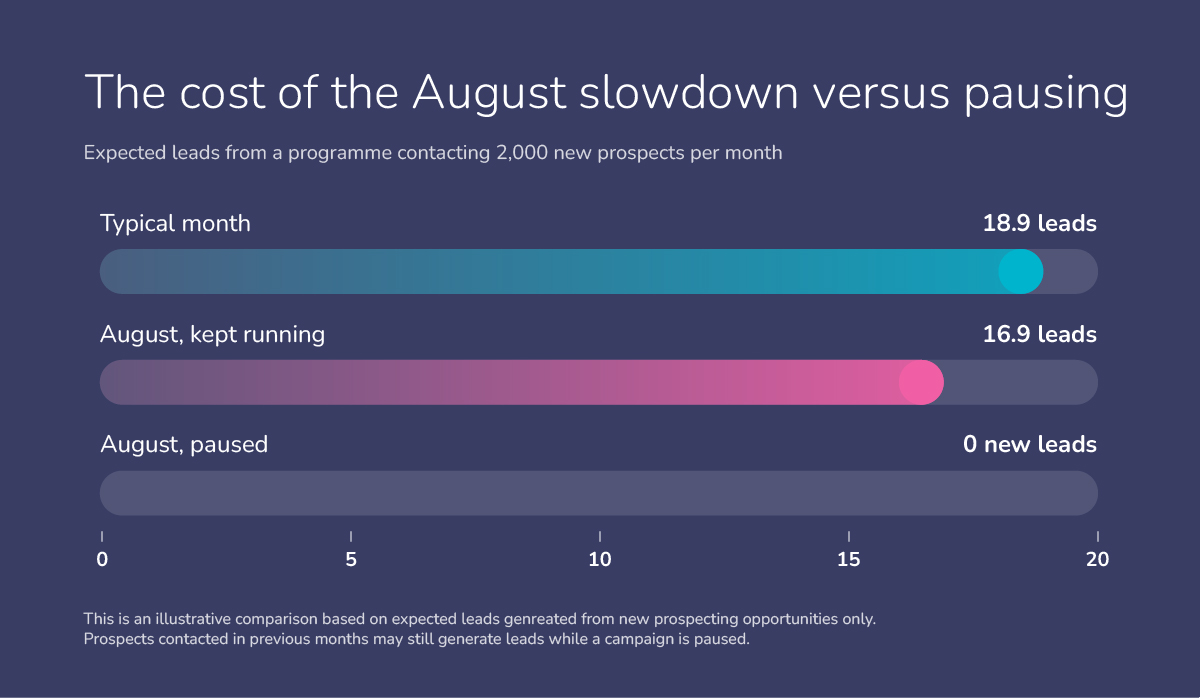
That’s a reduction of just over 10%. However, if you stop contacting new prospects altogether, you sacrifice the opportunity to generate those new leads at all.
And, twisting the knife that little bit further, the consequences don’t end when you switch your outreach back on.
Sopro’s data shows that pausing can create gaps in your future pipeline, delay revenue, and leave you rebuilding lead flow just as your market becomes more active again.
Is summer really a bad time for B2B prospecting?
The assumption behind most seasonal pauses is straightforward: fewer people at their desks means fewer opportunities to start sales conversations. It makes sense, right?
Well, our data suggests the difference between supposedly quiet months and more active periods is much smaller than you might expect.
August and December perform almost as well as October
We analysed four full years of Sopro client data, from 2022 to 2025, grouping prospects by the month they were first contacted and tracking the leads generated across their complete outreach sequences.
We then compared each month against October, a month businesses generally consider a strong period for prospecting.
Interestingly, August generated just 1% fewer leads than October. September was 2% higher, November 4%, and December 1%.
So, in other words, the months businesses frequently consider unsuitable for prospecting deliver results remarkably similar to those achieved when outreach is treated as business as usual.
Of course, individual industries and businesses experience seasonality differently. But these findings challenge the idea that summer and Christmas automatically represent poor opportunities for outbound.
An out-of-office reply doesn’t mean a lost opportunity
When we look more closely at the reasons businesses pause, the argument for switching B2B lead generation activities off becomes even less convincing.
One of the most common reasons for pausing summer outreach is the assumption that everyone is away.
Yet only 12% of the people Sopro contacts in August ever send an out-of-office reply.
What’s more, even when someone is away, that doesn’t necessarily make them a lost prospect…
- Chances are, if someone is out of the office, they’ll have someone on their team responsible for picking things up in their absence. Could you use the email address in their out-of-office auto-reply to get in touch with them as well?
- Even if someone’s on holiday and won’t see your email until they return to work, it doesn’t mean they aren’t interested in your offering. They’re going to have to play catch-up at some point. At Sopro, we actually use the ‘out of office reply’ to schedule another email for when the contact returns…after giving them a little time to settle back in, of course!
- Most leads don’t come from the first email. In fact, data shows that the majority of cold outreach is successful on the follow-ups, so even if you don’t get a response at first, you’ve got a whole sequence to win their attention.
Our analysis of approximately two million prospects contacted from 2023 onwards backs this. We found that people who sent an out-of-office reply in August were just as likely to become leads as those who didn’t.
And this raises a question: if your prospects are still receptive to outreach throughout summer, what are you actually gaining by stopping?
The hidden costs of stopping your outbound
The immediate consequence of switching off outreach seems obvious…you contact fewer people, and you’ll generate fewer leads. A + B = C.
But the true impact is harder to spot, particularly if you’re relying on monthly performance reports to decide whether pausing was worthwhile.
In fact, one of the most revealing findings from our research is that your reported lead rate can actually improve when you stop prospecting.
Wait, your lead rate can increase when you pause outreach?
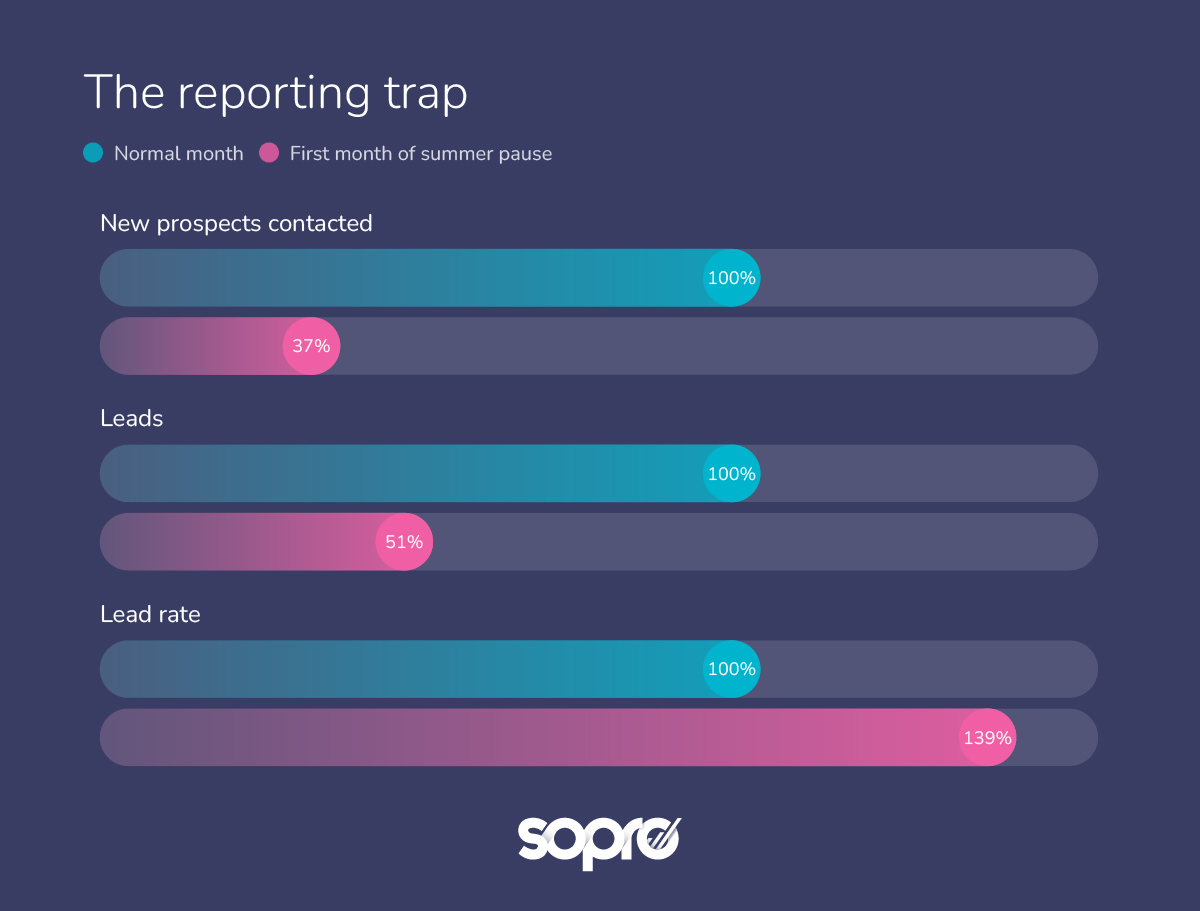
Yes, you read that right. We analysed more than 450 Sopro campaigns that genuinely paused outreach and subsequently restarted.
For campaigns that began their summer pause in July, new prospect volumes dropped to 37% of their normal monthly level. Yet they continued generating 51% of their usual leads.
As a result, their reported lead rate increased to 139% of normal.
We observed a similar pattern in December. New prospect volumes fell to 19% of normal, while leads remained at 28%. The reported lead rate rose to 148%.
So…what’s happening?
It comes down to how outbound sequences work in practice.
Sopro’s outreach plays out as a sequence of four messages to each prospect. How those messages are spaced depends on your market: in our classic sequence, they land over about four weeks, while programmes in smaller markets spread them further apart. Either way, the first message generates only around a quarter of the leads eventually produced by the complete sequence.
When a business pauses new prospecting, its existing sequences can continue running. Prospects already contacted still receive their follow-up emails, and those messages continue generating leads.
“Restarting outreach doesn’t mean immediately restoring results and seeing your regularly scheduled lead flow. Your programme needs time to rebuild momentum and generate impact.”
For a few weeks, the programme is effectively benefiting from outreach activity that happened before the pause. The result is a performance report that might make the decision to pause look entirely sensible.
But while existing prospects are progressing through their sequences, fewer new people are entering the pipeline. Eventually, those existing sequences finish. Without new prospects progressing through the same process, lead volumes fall.
The apparent improvement in performance was never evidence that pausing worked. It was the delayed return on previous prospecting activity.
But here’s the kicker… restarting outreach doesn’t mean immediately restoring results and seeing your regularly scheduled lead flow.
Your programme needs time to rebuild the sequence in which prospects receive the first, second, third and fourth messages.
In our classic four-message sequence, the second email arrives an average of 8.6 days after the first, the third after 15.1 days and the fourth after 21.7 days. Nine in ten prospects have received all four messages within a month.
That means a restarted programme initially has a disproportionate number of prospects receiving their first email, which is the least productive message in the sequence.
Our analysis found that campaigns that restarted after a summer pause operated at approximately 85% of their normal lead-rate efficiency in September. By October, that temporary reduction had disappeared. Where messages are spaced further apart, the rebuild takes correspondingly longer.
Now, with a classic sequence, the recovery period isn’t months, it’s approximately three weeks…but that doesn’t undo the cost of the pause itself. You still have to account for the prospects you didn’t contact, the opportunities you didn’t create, and the time spent rebuilding your lead flow.
A two-month pause, for example, can mean two months without new prospecting, followed by a period of reduced efficiency (around three weeks on a classic sequence) as your sequences refill.
That’s a substantial amount of pipeline to sacrifice to avoid a relatively modest seasonal slowdown.
“By pressing pause on outreach, you’re opting for a substantial pipeline sacrifice to avoid a relatively modest seasonal slowdown.”
What does pausing actually cost your business?
Lead rates and prospecting volumes matter, but ultimately, what matters to your business is the revenue those leads could generate.
The commercial impact of pausing depends on your sales conversion rate, average deal value, lifetime value, and the number of opportunities your outreach programme would otherwise create.
Let’s take the earlier example of a business contacting 2,000 prospects each month.
Even during August, our illustrative figures suggest that maintaining outreach could generate approximately 16.9 leads. Pausing means sacrificing the opportunity to create those leads through new prospecting.
How much could they be worth to your business?
Use the calculator below to estimate the potential revenue associated with the leads you could miss during a pause.
What could pausing outreach cost your business?
Estimate the potential value of the leads your business could miss by putting outbound prospecting on hold.
This is an illustrative calculation, not a revenue forecast. Default conversion and deal-value figures are hypothetical, not Sopro averages. Actual results will vary. This estimate excludes leads generated by previously active sequences, campaign fees and any changes in performance between months.
Now, something important: the calculation isn’t a prediction of lost revenue, as not every lead becomes a customer, and actual outcomes vary considerably between businesses.
But what it does do is highlight an important consideration when evaluating the apparent savings from a pause: the value of the opportunities you might be giving up.
Your immediate outbound costs are only one side of the equation – the potential contribution to your future sales pipeline matters just as much.
Today’s outreach pause creates tomorrow’s revenue gap
One reason businesses underestimate the impact of pausing is that the commercial consequences often materialise months after the original decision.
The prospects you contact today might not be ready to buy immediately. They may need to secure internal approval, compare suppliers or wait until their next budget cycle.
And during seasonal periods, those decisions can take longer.
Our own sales pipeline data from 2022 to 2025 demonstrates just how significant that delay can be.
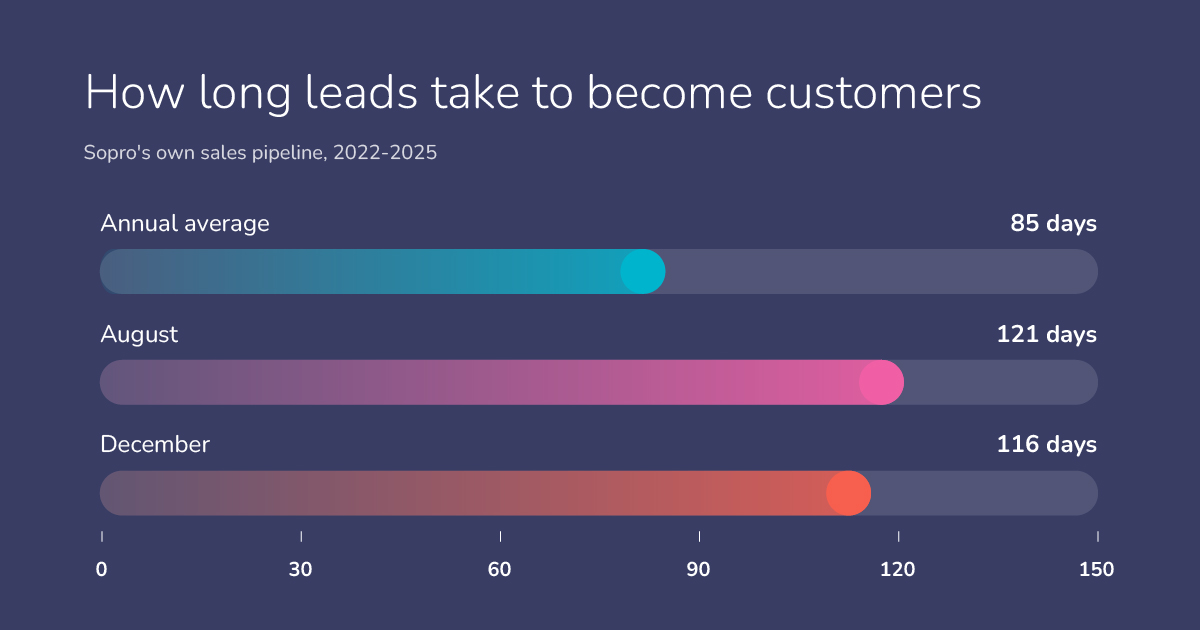
This difference in buying journey length – 85 days as the annual average versus 121 for August and 116 for December – helps explain why seasonal outreach can be commercially valuable even when it isn’t delivering immediate sales.
The leads you generate in August might become December’s revenue, and a conversation started just before Christmas could result in a deal the following spring.
So, if you’re measuring the success of August’s outreach solely by the sales it generates in August, you may be overlooking a substantial part of its value. And if you stop prospecting because immediate sales are slowing, you risk creating precisely the pipeline gap that will make future sales targets harder to achieve.
Why December prospecting is essential to a strong January
December is perhaps the clearest example of why judging outreach by immediate results can be misleading.
As businesses approach Christmas, it’s tempting to assume that decision-makers have switched off and that serious sales conversations can wait until January.
But January is consistently Sopro’s strongest month for replies and leads, and a significant proportion of those results can be traced directly back to outreach that began before Christmas.
In fact, our research found that 27% of January’s leads come from prospects first contacted in December – more than one in four January leads originate from outreach in the previous month.
This is based on well-planned timing.
With Sopro’s classic outreach sequence taking approximately four weeks, prospects first contacted in mid-to-late December received their second, third, and fourth messages during January.
It’s at this point that they’re returning to work after a Christmas break, reassessing their priorities for the new year, and deciding where to invest to reach their goals.
And because later messages in a sequence generate the majority of leads (check out our State of Prospecting research for evidence of this), December outreach helps establish a solid foundation for January’s performance.
Put another way, if you wait until January to start prospecting for the new year, you’re starting a leg behind. Your competitors are already midway through established outreach programmes and are beginning to reap the benefits of early action.

Keep growing with always-on outreach
Want to see how Sopro can keep your outreach working hard all year-round? Book a demo with our experts to learn more.
Book a demoWhat happens when businesses pause outreach over Christmas?
Our analysis of outreach that continued through December compared with campaigns that paused provides a particularly revealing result.
Campaigns that remained active through December generated 113% of their normal lead volume in January.
Those who paused achieved just 54%.
While individual circumstances will vary, the difference illustrates how strongly January’s results can depend on the prospecting activity that takes place before it.
The decision to pause in December isn’t simply a decision about December’s performance. It’s also a decision about the pipeline you’ll have available at the start of the new year.
If you want to start January with a healthy flow of sales opportunities, the groundwork needs to happen before January arrives.
What to do when business slows down instead of pausing outreach
A quieter period doesn’t mean you have to keep doing exactly the same thing. But it also doesn’t mean the best answer is to switch outbound off completely.
As the data shows, the stronger move (and one your competitors might not be making) is to tweak the programme while keeping your pipeline moving.
Adapt, don’t abandon.
1. Keep the channel live
Continuity is priority number one.
Even if seasonality does cause a dip in performance, resist the urge to treat that as a signal to hit pause altogether. As we’ve seen, Sopro’s data shows that August and December still generate leads when prospects are led through a complete outreach sequence.
Instead of getting cold feet when numbers don’t look quite as strong, keep outbound active and judge performance over a meaningful period, rather than making reactive decisions that could come back to bite you in future months.
2. Adjust activity to match your sales capacity
Sometimes the issue isn’t demand at all…it’s whether your internal team has the capacity to handle new opportunities.
Sure, response rates might be a little lower than their peak, but what are you going to do if half of your own team is out sunning themselves on the Costa del “Sorry, I’m not at my desk right now.”, and you don’t have the capacity to follow up with prospects who do enter your funnel?
That’s where a managed outbound programme gives you more flexibility.
Rather than switching the channel off, adjust activity around holidays, reduce sales coverage, or internal resource constraints. The objective is to maintain momentum without creating more immediate demand than your team can realistically handle.
3. Refine targeting rather than reducing visibility
If a particular segment is proving slower to respond, that doesn’t necessarily mean the whole programme needs to pause. Use quieter periods to sharpen who you’re targeting.
That could mean focusing more heavily on higher-priority accounts, adjusting sector or role targeting, or placing greater emphasis on audiences showing stronger signs of intent.
You stay present in the market, but with activity weighted towards the opportunities most likely to matter.
4. Adapt messages to fit the season
It’s natural that buyer priorities change throughout the year. Yours do, right?
Someone you contact in August might be planning for Q4, and someone you reach in December might be setting budgets or deciding what needs to change in January, so your outreach should reflect that.
When we plan outreach programmes, we adapt messaging to the context your prospects operate in, rather than assuming the same proposition will land equally well every month.
This helps us leverage seasonality to influence the message rather than seeing it as an end to the conversation.
5. Prioritise prospects showing the strongest intent
It doesn’t matter what time of year it is; some rules remain true regardless. Whether it’s April or August, it pays to remember that not every prospect needs the same level of attention at the same time.
If sales capacity is tight, the priority should be making sure the strongest opportunities are identified and acted on quickly.
A managed outbound programme can help surface those signals and keep the broader market engaged, so your team can focus its efforts where there’s a clearer reason to have a conversation now.
6. Let long-term signals mature
One of the easiest mistakes to make during quieter periods is assuming that a prospect who isn’t ready now has no value.
In reality, some of the most commercially important leads simply take longer.
Sopro’s own sales data shows that August and December leads take longer to close than the annual average. That doesn’t make them worse leads; it just means their buying journey is longer.
Keeping outreach running gives those opportunities time to develop rather than removing them from the pipeline before they ever get started.
7. Review performance properly before making a stop-start decision
Finally, if results are slowing, the next step is diagnosis, not an automatic pause.
Look at the full picture with your team: prospecting volume, lead rate across complete sequences, pipeline contribution, sales capacity, and the timing of eventual conversions. That gives you a much, much stronger basis for deciding what, if anything, to change.
Remember, when you’re running managed outreach with a team of experts at the helm (cough…Sopro…cough), you have the built-in flexibility to scale it up and dial it down, depending on demand. It never has to be a case of on or off and nothing in between.
How to measure the success of always-on outbound
Spoiler alert – you don’t measure the success of always-on outreach by looking at one month in isolation.
Generating B2B leads via outbound activity needs to be an always-on channel, so performance needs to be measured accordingly.
Month-to-month fluctuations will happen – there’s nothing you or anyone else can do about it. But rather than judging the value of your outreach by the busiest or quietest month, consider performance across a longer period by three complementary areas.
1. Prospecting activity and efficiency
Monitor the number of new prospects contacted, leads generated and lead rate across complete outreach sequences.
This gives you a clearer picture of your programme’s underlying performance and avoids drawing misleading conclusions from sequences that haven’t finished.
2. Pipeline development
Look beyond immediate lead volume to understand how outreach contributes to qualified opportunities and future sales conversations.
A lead generated in August might not become a customer until December, but that doesn’t make the original prospecting activity any less valuable.
3. Commercial outcomes
Ultimately, the bottom line is where outreach lives and dies, so measure how your activity contributes to deals won and revenue generated over time.
This provides a more meaningful basis for decisions about investment, outreach optimisation and long-term growth.
It’s also important to recognise that seasonality will affect individual businesses differently.
A business supplying schools, for example, may experience very different buying patterns from a company selling financial services or enterprise software.
Because of this, your own historical performance should inform how you adapt your outreach programme throughout the year.
Keep your pipeline moving with Sopro, whatever the season
There’s nothing wrong with questioning whether your outbound investment is delivering the returns you expect. In fact, we’d encourage you to do just that. You invest money, energy, and, at times, probably sanity, in your business, so taking a vested interest in its health is natural.
But before deciding to pause your outreach, it’s worth understanding what you’re actually saving and what you’re putting at risk.
Restarting a paused programme isn’t like flipping a switch and picking up exactly where you left off. Life ain’t a movie. Rebuilding momentum takes time, as programmes need to gain traction and run their course to be effective, meaning the consequences of stopping extend well beyond the first month.




Share