53 sales statistics and industry trends

Summarise this article with:


In this blog
- Our top 10 B2B sales statistics for 2026
- Sales statistics by channel
- Sales training statistics
- Sales funnel statistics
- Inbound sales statistics
- 1. Four in five businesses say prospecting works best alongside inbound marketing
- 2. Integrated brand and prospecting activity delivers better results
- 3. Buyers are 84% more likely to engage with brands they recognise
- 4. Website visitors contacted through outbound are almost three times more likely to become leads
- 5. More than 9 in 10 buying groups create a shortlist before speaking to suppliers
- 6. The buyer's preferred supplier wins more than three-quarters of deals
- 7. Most prospects already understand your product before the first sales call
- Outbound sales statistics
- Emerging sales trends from our experts
- 1. Brand-building will become a bigger driver of sales performance
- 2. Always-on prospecting will replace campaign-based outreach
- 3. Sales teams will need to influence buyers earlier than ever
- 4. Sales teams will simplify their tech stacks
- 5. AI will become an operating system – not just another sales tool
- Turn sales statistics into more selling opportunities
- Methodology & sources

Sales professionals, we hear you! Closing deals is the goal, but it’s only one part of a much bigger story.
Purchase cycles are never linear, with decision-makers taking longer to commit and buyers being more clued-up than ever.
The upshot? Relying on guesswork is no longer an option. We need a rock-solid understanding of the numbers behind every lead, conversation, pitch, follow-up email, win, and loss…along with an awareness of how industry shifts could impact us day-to-day.
Here, we share exclusive insights on the statistics and trends you can’t afford to ignore in 2026. We cover conversion benchmarks, channel performance, audience preferences, and more – giving you the data you need to turn your sales from so-so to Sopro.
On your marks, get set, sell.
Pssst…Sopro is an award-winning B2B prospecting agency, providing B2B lead generation services to businesses hungry for real pipeline growth. Want to see your sales soar in 2026? Book a demo to learn how Sopro can help you sell more.
Our top 10 B2B sales statistics for 2026
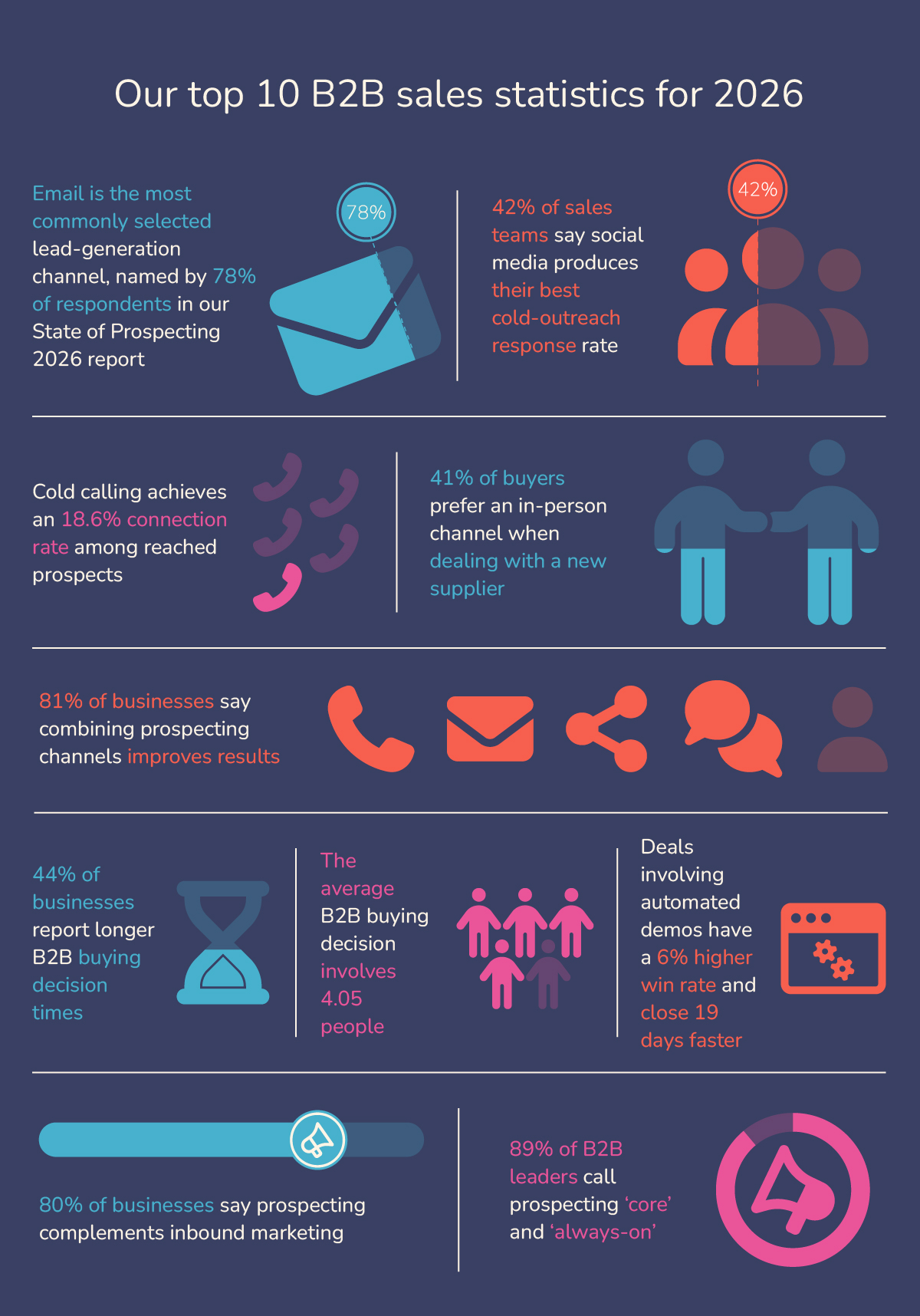
Want to get straight to it? Here are 10 standout sales stats from our team of experts:
- Email is the most commonly selected lead-generation channel, named by 78% of respondents in our State of Prospecting 2026 report → Read More
- 42% of sales teams say social media produces their best cold-outreach response rate → Read More
- Cold calling achieves an 18.6% connection rate among reached prospects → Read More
- 41% of buyers prefer an in-person channel when dealing with a new supplier → Read More
- 81% of businesses say combining prospecting channels improves results → Read More
- 44% of businesses report longer B2B buying decision times → Read More
- The average B2B buying decision involves 4.05 people → Read More
- Deals involving automated demos have a 6% higher win rate and close 19 days faster → Read More
- 80% of businesses say prospecting complements inbound marketing → Read More
- 89% of B2B leaders call prospecting ‘core’ and ‘always-on’ → Read More
Sales statistics by channel
Sales email statistics
1. Over three-quarters (78%) of B2B marketers say email is their most-used lead generation tool
Despite the rise of social selling and multi-channel outreach, email remains the backbone of B2B lead generation. Our latest State of Prospecting research found that 78% of businesses identify email as the lead generation channel they use most.
That shouldn’t come as much of a surprise. Email gives sales teams a direct line to decision-makers, scales easily, and makes personalisation possible without the cost of traditional outbound channels.
The takeaway? Email is still one of the most effective ways to generate new business – but it works best as part of a wider prospecting strategy rather than in isolation.
2. The average cold sales email reply rate is just 3.43%
Getting someone to reply to a cold email has never been easy, with the average reply rate at just 3.43%. The highest-performing campaigns regularly achieve 5.5% or more, and only the top 10% exceed 10.7%.
Rather than chasing volume, focus on improving quality. Better targeting, stronger personalisation, and more relevant messaging will have a far greater impact than simply sending more emails.
3. Follow-up emails generate more replies than first-touch emails
If you’re giving up after a single email, you’re leaving opportunities on the table. Emails two to six generate 58.6% of all replies, compared with 41.4% from the initial outreach email.
One email is rarely enough to start a conversation. Building a thoughtful follow-up sequence can significantly improve reply rates without dramatically increasing your workload.
4. 77% of buyers are more likely to open an email that includes an offer
The subject line is often the deciding factor in whether an email gets opened. More than three-quarters (77%) of buyers say they’re more likely to open an email if the subject line clearly communicates an offer. Giving prospects a compelling reason to click can make all the difference in a crowded inbox.
The key is to be clear rather than clever. Buyers are far more likely to engage with subject lines that immediately demonstrate value.
5. Personalised subject lines make buyers more likely to open emails
Personalisation starts before prospects even open your email.
More than seven in 10 buyers (71%) say they’re more likely to open an email with a personalised subject line, showing that even small details can make a big difference to engagement.
6. 69% of buyers are more likely to open an email if there is a question in the subject line
Sometimes, asking the right question is enough to spark curiosity.
Around 69% of buyers say they’re more likely to open an email if the subject line contains a question, making it another effective way to encourage them to take the desired action.
Just make sure the question feels genuine and relevant. A thoughtful prompt is far more likely to start a conversation than a vague or overly clickbait headline.
Social-selling statistics
1. Social media delivers the best cold outreach response rates for over two-fifths of sales teams (42%)
Social selling has firmly established itself as one of the most effective ways to engage prospects, with 42% of sales teams believing social media generates the strongest response rates from cold outreach.
That shouldn’t be too surprising. Platforms like LinkedIn allow sales teams to warm up prospects before making direct contact, creating familiarity that traditional cold outreach often lacks.
If social selling isn’t already part of your outreach strategy, you’re likely missing opportunities to start conversations before competitors do.
2. More than a third (35%) of sales professionals say social media generates their highest-quality leads
Generating leads is one thing. Generating the right leads is another.
One in three sales professionals (35%) identifies social media as their best source of high-quality prospects. Rather than simply increasing the volume of opportunities, social selling helps teams connect with buyers who are more likely to convert.
By researching prospects, engaging with their content, and building relationships before reaching out, sales teams can have far more relevant conversations from the very first interaction.
3. Almost half (45%) of sales professionals rate social media as “very effective” for driving sales
Social media is no longer just a brand awareness channel. For many businesses, it’s become a genuine revenue driver. Almost half of sales professionals (45%) describe social media as “very effective” for generating sales, highlighting just how valuable these platforms have become throughout the buying journey.
The businesses seeing the greatest success don’t simply publish content and hope for the best. They combine valuable insights, consistent engagement, and personalised outreach to turn conversations into opportunities.
4. LinkedIn follow-up messages achieve reply rates of more than 7%
Following up doesn’t have to mean sending another email. LinkedIn follow-up messages consistently achieve reply rates above 7%, demonstrating the value of including social media alongside traditional outreach channels.
This is another reminder that successful prospecting rarely relies on a single channel. Combining email, LinkedIn, and other touchpoints helps you stay visible, engage buyers where they’re most active, and maximise your chances of starting meaningful conversations.
Cold-calling sales statistics
1. Cold calls connect with almost one in five prospects
Cold calling is far from dead. In fact, almost one in five cold calls (18.6%) successfully connect with the intended prospect, proving there’s still plenty of value in picking up the phone.
Of course, getting through is only the first hurdle. The real challenge is making those conversations count. A strong opener, genuine curiosity, and a clear understanding of your prospect’s pain points will always outperform a generic sales script.
2. A third of all booked appointments come from cold calling
Over a third (33.6%) of all booked appointments came from cold calling in 2025, making it one of the most effective channels for generating sales conversations.
While digital channels continue to grow in popularity, speaking directly with prospects remains one of the fastest ways to qualify opportunities, handle objections, and move buyers further through the sales funnel.
3. Cold-calling success rates are improving
Industry benchmarks show cold-call success rates have increased from 2.3% to 2.7%. While that may seem like a modest improvement, it’s a significant uplift at scale and suggests businesses are becoming more strategic with their prospecting efforts.
Better targeting, stronger data, and more personalised outreach are helping sales teams to get in front of the right people.
In-person sales statistics
1. Buyers split their interactions almost equally between in-person, remote, and digital channels
There’s no longer a single “preferred” way for buyers to engage with suppliers. Instead, today’s B2B purchasing journey is spread almost evenly across in-person meetings, remote interactions, and digital self-service.
What’s particularly interesting is how consistent this behaviour is. Whether buyers are researching suppliers, evaluating options, placing orders, or making repeat purchases, they continue to divide their interactions across all three channels. Success isn’t about choosing between face-to-face and digital selling. It’s about delivering a seamless experience wherever buyers choose to engage.
2. More than two in five (41%) buyers prefer meeting new suppliers in person
Despite the growth of digital sales, many buyers still value face-to-face interactions when building new business relationships. In fact, 41% prefer an in-person meeting when speaking with a new supplier for the first time.
It makes sense. Purchasing decisions often involve significant investment, and meeting in person can help establish trust, answer questions more effectively, and strengthen relationships from the outset.
3. Four in 10 buyers prefer face-to-face contact for their first purchase
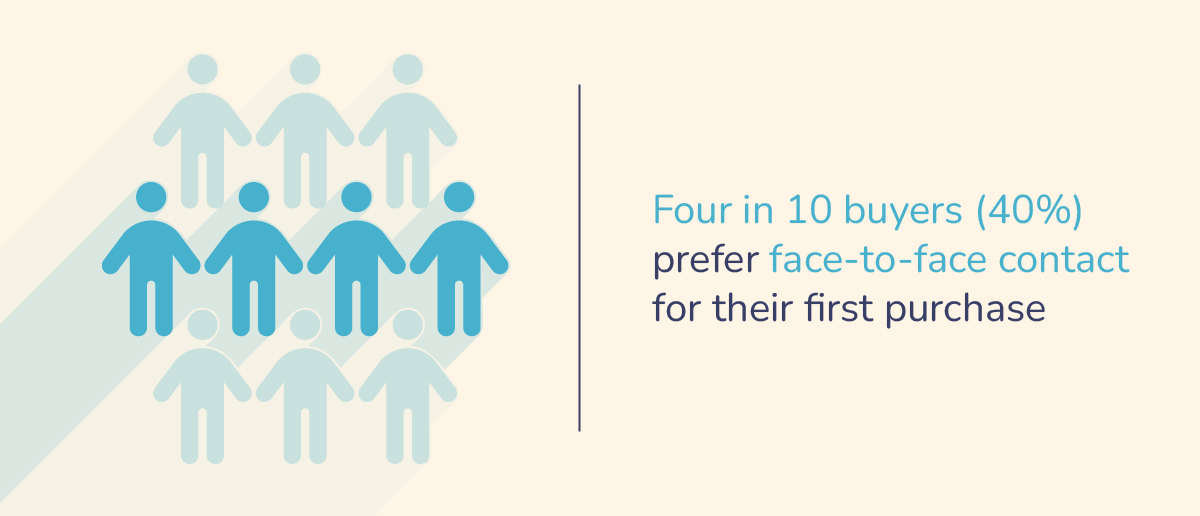
Similarly, winning a new customer often requires a more personal approach. Around 40% of buyers say they prefer in-person contact when purchasing from a supplier for the first time. Once trust has been established, digital channels often become more convenient.
Multi-channel sales statistics
1. More than half (58%) of businesses now use multiple outreach channels
Putting all your eggs in one basket has never been a winning sales strategy.
Over half (58%) of businesses now use multiple outreach channels to engage prospects, showing that businesses increasingly recognise the value of meeting buyers across multiple touchpoints.
2. Only one in five businesses has a fully coordinated multi-channel outreach
Despite the above, only 21% say their multi-channel outreach is fully coordinated. That means many organisations are still delivering disconnected buyer experiences across email, phone, social media, and other touchpoints.
Bringing every channel together creates a more cohesive customer journey, helping sales and marketing teams deliver the right message at the right time.
3. More than four in five (81%) businesses say combining channels improves results
If you’re wondering whether multi-channel prospecting is worth the effort, the evidence is pretty convincing.
More than four in five (81%) businesses say combining multiple prospecting channels delivers better results. At the same time, buyers prefer an average of 2.9 different contact channels, highlighting the importance of meeting prospects where they already are.
Rather than relying on email or phone calls alone, successful sales teams build familiarity across several touchpoints before asking for a conversation.
4. B2B buyers use an average of 10 interaction channels throughout the buying journey
Today’s buying journey is anything but linear. On average, B2B buyers interact across 10 different channels before making a purchasing decision, moving between websites, emails, phone calls, meetings, social media, and other digital touchpoints.
The more consistent your messaging is across those channels, the easier it becomes to build trust and keep prospects moving through the sales funnel.
5. More than half of buyers will switch suppliers after a poor multi-channel experience
Providing multiple ways to engage is important, but consistency matters just as much.
More than half of buyers say they would consider changing suppliers if their experience isn’t smooth across different channels. Disconnected messaging, inconsistent follow-ups, and fragmented customer journeys can all undermine trust before a deal is even signed.
The best multi-channel strategies don’t simply increase the number of touchpoints. They make every interaction feel connected, relevant, and effortless for the buyer.
Sales training statistics
1. More than half of salespeople receive coaching only once a quarter – or even less often
Regular coaching is one of the fastest ways to improve sales performance, yet it remains surprisingly uncommon. More than half (53%) of salespeople receive coaching quarterly or less often, limiting opportunities to develop new skills, refine techniques, and learn from recent deals.
The best sales teams don’t treat coaching as a sporadic exercise. They make it an ongoing process, using regular feedback to build confidence and improve performance over time.
2. More than a third of salespeople rarely receive personalised feedback
Generic feedback rarely changes behaviour. Yet 37% of sales professionals say they rarely or never receive personalised coaching, while only 21% believe the coaching they do receive is genuinely effective.
Tailored feedback helps salespeople understand what they’re doing well, where they need to improve, and how they can win more deals. Without it, even experienced reps can struggle to reach their full potential.
3. Four in 10 salespeople regularly deviate from their sales process
No two buyers are exactly alike, so it’s perhaps no surprise that around 40% of salespeople regularly move away from their organisation’s formal sales process.
While a clear framework is essential, the best salespeople also know when to adapt their approach. Balancing consistency with personalisation can help create more relevant conversations without losing sight of the overall sales strategy.
4. Adaptability is the most valued sales skill
Sales techniques, buyer expectations, and technology continue to evolve, making adaptability more valuable than ever.
In fact, 44% of sales managers identify adaptability as the most important soft skill for modern salespeople. The ability to adjust communication styles, respond to changing buyer needs, and embrace new ways of working is becoming just as important as product knowledge or negotiation skills.
Sales funnel statistics
Sales follow-up statistics
1. Longer buying decisions are becoming the norm
Following up has never been more important. According to our latest research, 44% of businesses say buying decisions are taking longer than before, while 43% report that prospects are more likely to go silent during the sales process. One in five also says deals now take more than a year to close.
In a market where buyers are taking longer to make decisions, consistent, well-timed follow-ups are often the difference between winning a deal and being forgotten.
2. The average enterprise buying cycle has fallen to 10.1 months
While B2B buying decisions are taking longer overall, enterprise sales appear to be bucking the trend. Research focused on organisations making purchases worth at least $25,000 found that the average buying cycle has fallen from 11.3 months to 10.1 months.
This doesn’t necessarily mean enterprise buying has become simpler. Larger organisations often have more dedicated procurement teams, clearer buying processes, and greater purchasing power, allowing them to move more efficiently once a project has been approved.
3. Buyers are speaking to suppliers later in the buying journey
The modern buyer spends more time researching before engaging with sales teams. In fact, the first contact now occurs around 61% of the way through the buying journey. By the time prospects engage with your sales team, they’ve often already narrowed down their shortlist and formed clear opinions about potential suppliers.
That means follow-up isn’t just about persistence. It’s about adding value, answering the right questions, and helping buyers make confident decisions once they’re ready to engage.
Sales conversion rate statistics
1. The average B2B buying decision involves more than four people
Sales is rarely about convincing just one decision-maker. On average, B2B buying decisions involve 4.05 people, while almost one in five (18%) involve six or more stakeholders.
With multiple people weighing in from different departments, successful sales teams need to build consensus rather than relying on a single contact to close the deal.
2. Winning deals involve more conversations with buyers
Sales professionals shouldn’t stop after speaking to one person or having just one conversation; successful opportunities include twice as many buyer interactions as deals that are ultimately lost.
Building relationships across the buying committee helps maintain momentum, uncover objections early, and reduce the risk of deals stalling if one stakeholder drops out of the process.
3. Enterprise deals require significantly more buyer engagement
Strategic enterprise opportunities average 17 buyer contacts before reaching a decision, reflecting the additional scrutiny, approvals, and collaboration that come with high-value purchases.
The bigger the opportunity, the more important it becomes to maintain regular communication with everyone involved in the buying process.
4. Multi-threading can increase win rates by up to 130%
For reasons mentioned above, putting all your trust in a single contact is one of the biggest risks in B2B sales. For deals worth more than £37,000 ($50,000), engaging multiple stakeholders throughout the sales process is associated with a 130% increase in win rates.
Sales demo statistics
1. Sales engineers spend almost four hours preparing and delivering every demo
A great sales demo doesn’t happen by accident. On average, a single product demonstration takes 3.6 hours to prepare and deliver, with sales engineers conducting around seven demos every week.
That represents a significant investment of time, making it more important than ever to ensure demos are relevant, tailored, and delivered to genuinely qualified prospects.
2. Most deals require multiple product demos before they close
On average, B2B deals require three product demos before a decision is reached. As buying groups become larger and more complex, multiple demonstrations often give different stakeholders the opportunity to ask questions and evaluate a solution from their own perspective.
Rather than aiming to close after a single meeting, sales teams should think of demos as an ongoing conversation that builds confidence over time.
3. Early product demos can dramatically improve win rates
Timing matters just as much as quality. Opportunities that receive a product demo within the first 14 days achieve a 72% win rate, compared with 59% for opportunities that don’t receive an automated demo during that period.
Introducing prospects to your product earlier in the sales process can help answer key questions sooner, build momentum, and reduce the likelihood of deals stalling.
4. Automated demos help close deals faster
Automation isn’t replacing the sales demo – it’s making it more effective. Deals involving automated product demos achieve a 6% higher win rate and close an average of 19 days faster than those without them.
By allowing prospects to explore products on their own terms while keeping sales teams focused on high-value conversations, automated demos can help accelerate the buying process without sacrificing engagement.
5. Bringing technical experts into demos can increase win rates by up to 30%
The right people can make all the difference during a sales demo.
When sales engineers are involved in demonstrations or technical discussions, win rates can increase by up to 30%. Their product expertise helps answer complex questions, overcome technical objections, and build trust with buyers, giving them greater confidence to proceed with a purchase.
6. Personalised product demos attract 48% more engagement
Personalised demos may take longer to put together, but they generate 48% higher view rates than generic demonstrations, showing that buyers are far more likely to connect when content is tailored to their specific needs, industry, or use case.
Inbound sales statistics
1. Four in five businesses say prospecting works best alongside inbound marketing
Inbound and outbound marketing are often treated as competing strategies, but the most successful businesses use both in order to create a more consistent buying experience.
In fact, 80% of businesses say prospecting complements inbound marketing. Despite this, only 26% have fully unified their inbound and outbound activities, suggesting that many businesses still operate the two approaches separately.
2. Integrated brand and prospecting activity delivers better results
Generating demand doesn’t stop once someone visits your website.
More than three-quarters (77%) of businesses say prospecting is more effective when it’s integrated with wider brand activity, reinforcing the importance of consistent messaging across every customer touchpoint.
The stronger your brand presence, the easier it becomes for outbound activity to start conversations with prospects who already recognise your business.
3. Buyers are 84% more likely to engage with brands they recognise
Brand familiarity plays a huge role in sales success. Eight in 10 buyers (84%) are more likely to engage with outreach when they recognise the sender. Whether they’ve seen your content, visited your website, or encountered your brand elsewhere, familiarity helps build trust before the first conversation even begins.
That’s why the best-performing sales teams don’t rely on cold outreach alone. They combine prospecting with brand-building activity that keeps their business front of mind.
4. Website visitors contacted through outbound are almost three times more likely to become leads
Not every website visitor is ready to enquire on their own. Businesses that proactively reach out to people who have already visited their website find that those prospects are nearly three times more likely to become leads than visitors who aren’t contacted.
Using buyer intent signals to prioritise outreach helps sales teams focus their efforts where they’re most likely to generate results.
5. More than 9 in 10 buying groups create a shortlist before speaking to suppliers
Today’s buyers complete far more research before engaging with sales teams. In fact, 94% of buying groups rank potential suppliers before making first contact, meaning many purchasing decisions are already well underway before a conversation even begins.
For businesses, this reinforces the importance of being visible throughout the research phase rather than waiting until prospects raise their hand.
6. The buyer’s preferred supplier wins more than three-quarters of deals
Making the shortlist is one thing. Becoming the favourite is another.
Research shows that the supplier buyers favour before making contact goes on to win the deal 77% of the time, highlighting just how influential early brand awareness and thought leadership have become.
7. Most prospects already understand your product before the first sales call
The days of salespeople introducing buyers to a product for the first time are largely over. Nine in 10 (91%) of sales professionals say prospects already have a good understanding of their product before the first conversation takes place.
That means the role of the salesperson has shifted. Rather than simply sharing information, the focus is now on answering questions, solving problems, and helping buyers make confident purchasing decisions.
Outbound sales statistics
1. Almost nine in 10 businesses consider prospecting a core sales activity
Despite the growth of inbound marketing, outbound prospecting remains a fundamental part of B2B sales.
In fact, 89% of B2B leaders describe prospecting as a core, always-on activity rather than something that’s switched on and off depending on pipeline.
Consistent prospecting helps businesses build a healthier pipeline, reduce reliance on inbound enquiries, and create more predictable revenue over time.
2. Outbound marketing is one of the biggest areas for investment
Businesses aren’t just maintaining their outbound efforts – they’re actively investing in them.
More than two-thirds (68%) of B2B organisations identify outbound marketing as a leading investment priority, reflecting the growing importance of proactive lead generation in an increasingly competitive market.
As buying journeys become longer and more complex, businesses are recognising the value of reaching potential customers before they actively start looking for a solution.
3. Nearly eight in 10 businesses say prospecting reaches decision-makers that inbound can’t
Inbound marketing is highly effective at capturing existing demand, but it doesn’t always reach every buyer.
Around 79% of businesses say outbound prospecting helps them engage decision-makers that inbound methods struggle to reach, making it an important way to generate new opportunities rather than simply waiting for prospects to come to you.
The strongest sales strategies don’t choose between inbound and outbound. They combine both, using inbound to capture demand while outbound creates it.
Emerging sales trends from our experts
Existing data tells us what’s happening now…but predictions can help us stay ahead of the game by looking at what’s set to happen in the future. Here, our sales experts share their hard-earned insights into the trends set to shape sales strategies throughout the rest of this year.
1. Brand-building will become a bigger driver of sales performance
Brand recognition won’t just improve awareness – it will improve results. Our research shows buyers are 84% more likely to engage if they recognise the sender, while prospects who visit your website before outreach are around three times more likely to become leads.
At the same time, 58% of buyers say sales outreach feels impersonal and irrelevant, creating an opportunity for businesses that are consistently present across their TAM – not just blasting campaigns when pipeline is thin. The businesses that stand out won’t necessarily be the ones sending more outreach, but the ones buyers already recognise by the time that outreach lands.
2. Always-on prospecting will replace campaign-based outreach
Only 3-5% of any market is actively in a buying cycle at a given moment, and we expect that reality to push more businesses towards always-on prospecting rather than short-term campaign bursts. Instead of waiting for buyers to enter the market, successful sales teams will focus on building familiarity, nurturing relationships, and staying visible long before purchase intent emerges.
3. Sales teams will need to influence buyers earlier than ever
Buyers are already entering sales conversations with clear preferences, and we expect that trend to accelerate as AI, peer recommendations, and self-directed research continue to reshape the buying journey. Today, 81% of B2B buyers already have a preferred vendor by the time they engage with sales, while 70% are well into their buying journey before speaking to anyone. As a result, sales strategies will need to focus less on persuading buyers during the sales process and more on building trust, visibility, and credibility long before prospects are ready to buy.
4. Sales teams will simplify their tech stacks
We’re watching an entire generation of B2B sales teams get sold on the idea that the answer to their prospecting problems is more tools. Individual platforms for enrichment, contact data, email automation, LinkedIn outreach, AI orchestration, and workflow management all promise to solve a specific challenge. The result is often a fragile, expensive tech stack that still requires significant headcount to operate.
Our State of Prospecting research found that 41% of teams say their outreach data and tools aren’t fully integrated across sales and marketing. That’s not a tool problem – it’s an orchestration problem. As sales technology continues to evolve, we expect the businesses seeing the greatest success to simplify their tech stacks, prioritising integrated workflows over adding more point solutions. The companies winning tomorrow won’t necessarily have more tools – they’ll have fewer moving parts that work together more effectively.
5. AI will become an operating system – not just another sales tool
Simply adding AI to an existing sales process won’t automatically improve results. Gartner found that sales organisations providing AI-powered next-best actions are 2.6 times more likely to achieve commercial growth, while those that invest in upskilling sellers on AI are 2.4 times more likely to achieve strong revenue growth.
As AI becomes a standard part of the sales toolkit, we expect the biggest gains to come from businesses that rethink how work gets done, rather than simply automating existing processes. The organisations that pull ahead won’t be those using the most AI tools – they’ll be the ones using AI to create smarter workflows, better decision-making and more time for high-value customer conversations.
Learn more by reading our roundup of the latest statistics and trends about AI in sales and marketing.
Expert Q&A: Your sales questions

How is AI changing sales?
AI is making sales faster, more efficient, and more scalable – but it’s not a replacement for human strategy or relationship building. Our data shows that 58% of sales teams are now using AI to write outreach messages, while 57% of buyers say most outreach feels impersonal and irrelevant. Those two numbers highlight an important point: AI is a powerful tool, but only when it’s used to support a thoughtful sales strategy rather than replace it.
Used well, AI can help sales teams improve targeting, personalise outreach at scale, and spend more time building relationships. Used poorly, it simply enables more low-quality outreach, making it easier for buyers to ignore cold emails.
Why do sales professionals miss their quotas?
The conventional answer to why sales reps miss quota is a list of individual failures: poor prospecting habits, weak objection handling, and bad time management. It’s a comfortable answer because it points at the person, not the system. But the data tells a different story.
According to our State of Prospecting research, only 40% of B2B companies are currently exceeding new business targets – and that’s not because half the sales profession suddenly forgot how to sell. It’s because the market got structurally harder: 58% of buyers say there’s more competition, 44% say decision cycles are longer, and 43% say they get ghosted mid-process.
Which sales KPIs should small businesses track?
In my opinion, most small businesses are tracking the wrong sales KPIs. They obsess over activity metrics – calls made, emails sent, LinkedIn connections accepted – and mistake motion for momentum.
The KPIs a small business should actually track come down to three things:
- Are you reaching the right people (TAM coverage and audience quality)?
- Are those people responding? For this, consider lead response rate – the industry average is 3.1%, so use that as your benchmark.
- Is the cost sustainable (cost per lead against average deal value)? If you know those three numbers, you can make real decisions.
If you’re staring at open rates and call volume, you’re managing activity, not growth.
Is remote selling effective?
Yes, remote selling can be highly effective when it’s done well and can reduce sales cycle times.
Buyers now split their interactions almost equally between in-person, remote, and digital channels, with remote selling often the most practical option. This is especially true given that 84% of B2B purchase decisions involve more than one stakeholder, who may be spread across different offices, time zones, and hybrid work schedules.
Is inbound or outbound better for lead generation?
Neither is inherently better – the strongest lead generation strategies combine both inbound and outbound marketing. Inbound marketing helps you capture existing demand from buyers who are already looking for a solution, while outbound prospecting creates new opportunities by reaching decision-makers before they’re actively searching.
The evidence supports a blended approach. Our latest State of Prospecting research found that 80% of businesses believe prospecting complements inbound marketing, while 81% say combining multiple channels delivers better results. Rather than choosing between inbound and outbound, focus on creating a joined-up strategy that generates demand, captures it and nurtures prospects throughout the buying journey.
Does sales team turnover matter?
Sales team turnover matters because relationships matter. Every time a salesperson leaves, they take product knowledge, prospect relationships, and valuable sales experience with them. Replacing that expertise takes time.
That doesn’t mean turnover is always a bad thing. Fresh perspectives can strengthen a sales team, and some level of movement is inevitable. The businesses that perform best don’t just focus on retaining great people – they build repeatable sales processes, share knowledge effectively, and maintain accurate records, so success isn’t dependent on any one individual.
Turn sales statistics into more selling opportunities
Knowing the numbers is one thing. Putting them into practice is another.
At Sopro, we help B2B businesses generate more qualified conversations through data-led prospecting that combines email, LinkedIn and multi-channel outreach. Whether you’re looking to improve reply rates, build a healthier pipeline or reach more decision-makers, we’re here to help. Book a demo here.
Methodology & sources
Sopro conducted proprietary research as part of The State of Prospecting 2026 report. Insights and findings related to B2B sales from that research have been compiled here, along with data from other sources, to form a complete collection of sales statistics.
https://instantly.ai/cold-email-benchmark-report-2026
https://belkins.io/blog/sales-follow-up-statistics
https://blog.hubspot.com/sales/state-of-sales
https://www.cognism.com/reports/cold-calling-report-2026
https://www.salesloft.com/resources/guides/skill-gaps-in-2025
https://www.gong.io/blog/the-best-sales-insights-of-2025
https://www.navattic.com/report/state-of-demo-automation-2026




Share